New barbarians 1986 by k.., p.1
New Barbarians (1986) by Kirk Mitchell, page 1


HAIL, PROCURATOR!
“Intriguingly thought out... This subgenre is one of the most difficult in the field—the author must have extrapolative talent and know his history—and an addition to it based on this much knowledge is good to find.”
—Isaac Asimov's Science Fiction Magazine
“The best the year has produced so far ... the action scenes are terrific! For those looking for a good read, there is not much better around.”
— Whispers
Kirk Mitchell's
saga of alternate worlds continues . . .
The Procurator is now Caesar—
and the NEW BARBARIANS must be destroyed.
PROCURATOR NEW BARBARIANS
ACE SCIENCE FICTION BOOKS
NEW YORK
This book is an Ace Science Fiction original edition,
and has never been previously published.
NEW BARBARIANS
An Ace Science Fiction Book/published by arrangement with the author
PRINTING HISTORY
Ace Science Fiction edition/December 1986
All rights reserved.
Copyright © 1986 by Kirk Mitchell.
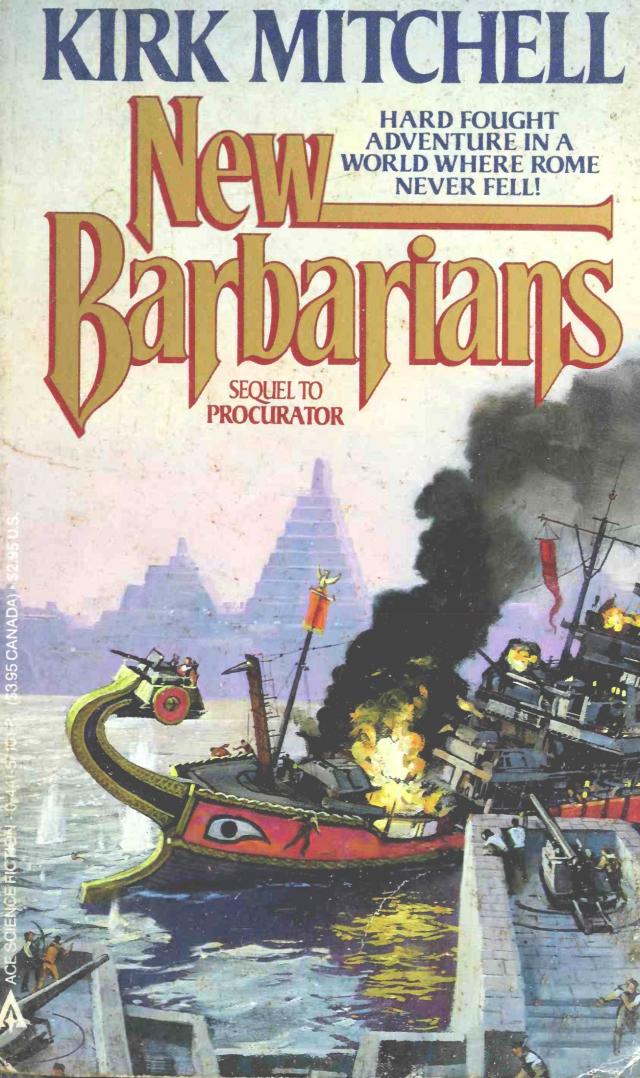
Cover art by James Gurney.
This book may not be reproduced in whole or in part, by mimeograph or any other means, without permission. For information address:
The Berkley Publishing Group,
200 Madison Avenue, New York, N.Y. 10016.
ISBN: 0-441-57101-8
Ace Science Fiction Books are published by The Berkley Publishing Group,
200 Madison Avenue, New York, New York 10016.
PRINTED IN THE UNITED STATES OF AMERICA
And this is how it was before the Compassionate, the Merciful, arose out of the east, having taken flight there long ago on a raft of serpents;
There was a vast chamber bright and sweet for its myriad blooms; a lake shimmered through the windows on all sides, a placidity of golden waters wherever one gazed; yet, herein an old king dwelt in darkness, prayed to darkness, and spoke from the soul of darkness. To his lord general, a nephew whom he loved as his own son, he said, “The fateful hour should come without warning.”
This troubled Lord Tizoc. “Reverend one, is it not honorable to declare the Flowery Way to our brothers whose blood the Fifth Sun will taste as nectar?”
“No,” the old man said, “we must never share the truth of why we make this war. Let them believe it is for flesh, fuel, or even the ground on which we stand. We alone must know: We have chosen to fight because they are vigorous and new to this country—as we were once vigorous and new to this valley that now bears our ancient name, the Mexicae. We make war because we recognize ourselves in their bold manner and are thus assured they will satisfy the thirst of Lord Tonatiuh ...”
1
The Roman Envoy to the court of Maxtla III closeted himself in his apartments whenever the Aztecan priests were butchering human flesh to their gods. And Britannicus Musa was careful not to linger at the upper-story window that afforded a view across the shallow waters of Lake Texcoco at the Great Temple that dominated the island capital.
Shortly after his arrival in Tenochtitlan two months before, he had not been so wary. What he had witnessed made him anxious to bolt from this dusky mountain valley, and his grasp on reality—previously so concrete, so Roman—was more tenuous than he cared to admit. Britannicus saw no healing possible as long as he remained among a race that reveled in both flowers and gore. Prior to that day, he had never imagined that blood could gush down a flight of stone stairs like a Caledonian freshet, its progress slowed only by congealment at the lowermost steps.
But a strong sense of duty—and the comfort he took from wine—induced him to remain.
His orders had originated from the Emperor Germanicus in Rome: The colonel was to open negotiations with Maxtla in the hope of easing friction between Aztecan and Roman forces glaring at each other across the muddy flow of the River Terminus. The two hundred and forty-third heir to Caesar Augustus desired peace in the Novo Provinces with a desperation that confused the younger officers of his legions. But, so far, little of substance had been resolved, and although the octogenarian reverend speaker had absented himself from the talks, Maxtla’s nobles had been exquisitely polite, almost brotherly in their attempts to please the Roman ambassador—in all matters of no consequence.
In his bare feet, Britannicus padded across the airy chamber to the window that faced northeast—away from the Great Temple and its crimson fountainhead of a sacrificial stone. He stared through the haze at the Tepeyaca Fortress. This lofty, cylindrical redoubt straddled one of three causeways that joined the capital to the mainland; its twin sister, the Acachinanco, stood guard south of Tenochtitlan. They easily could be counted among the largest structures in the world, and the causeway tunnels passing through them were large enough to admit a sand-galley.
He could espy a barracks atop the Tepeyaca that, with its upturned eaves, might have been modeled on Serican architecture. This and things his most trusted agent had whispered to him were convincing Britannicus that the Aztecae enjoyed ties with that great silk-dispensing realm Rome knew only through the accounts of Baluchi traders—the Sericans allowed no one else to penetrate their western hinterlands. To Romans, this empire seemed as legendary as Troy—and there existed no Virgil capable of translating its mysteries for patrician dinner parties.
The fortress bleared out of focus, and Britannicus’s mind drifted back to a day one week ago when Lord Tizoc, Maxtla’s ablest general and most likely successor, had conducted him on a tour of the Tepeyaca. There were no embrasures in the structure, but this was explained when two enormous bronze doors were pulled open against a strong suction: The Tepeyaca was largely a granary—an admirably airtight one, too, and only its expansive roof was dedicated to military purposes.
Traipsing up the ramp that wound around the outer wall to the battlements on the dome, smirking at the haughtiness of his Aztecan host, Britannicus tried to estimate the volume of this store of grain. As usual, he found Roman numerals too cumbersome for quick computation. Tizoc must have been reading his thoughts, for once they had reached the summit of the fortress, the general pointed at a serpent-shaped chimney rearing up from Tenochtitlan’s skyline, its fanged mouth vomiting white smoke into the already foul air: “We would starve but for the godly gift of spirulina—it is processed there, Lord Musa.”
This was the second time Britannicus had been informed that this algae, harvested from the lagoons of Texcoco, was the chief source of protein for the Aztecae. In the interests of diplomacy, he had swallowed his skepticism. There was no way a body of brackish water, slightly larger than the new harbor at Ostia, could substantially help feed the ten million people crammed into this volcano-ringed bowl. But Britannicus had politely nodded at the immobile barbarian face: “I see.”
Sandals now scraped the stone floor behind him.
Britannicus started, then recovered himself before meeting the smile of one of the slave girls Tizoc had provided the Roman emissaries for their comfort—and pleasure. She was the prettiest of the dozen, with full breasts and a waspish waist. Britannicus suspected that his adjutant, Lucius Balbus —who at this moment was downstairs having his body oiled— had already bedded her. His agent believed this girl to be one of the reverend speaker’s most trusted spies. So, when Britannicus looked upon her, he imagined that Maxtla’s ears were sewn to her head. In this way, he felt free to address the god-ruler he was never permitted to see.
“To whose glory do your priests murder captives this afternoon?” he asked in his rough Nahuatl.
She avoided his eyes as she laid out his clean tunic and cloak on a couch. “To the goddess Chalchiuhtlicue, lord.”
“What place does she hold among your other gods?”
“She is mistress to Tlaloc.”
“You mean the fellow to whom you sacrifice children?”
“Yes, lord,” she said matter-of-factly.
“Worshipers of Ba’al-Hammon,” Britannicus said in Latin, naming the fiery Punic diety to whom the Carthaginians had fed their children. He had already learned from a less circumspect slave that Chalchiuhtlicue was patroness of ventures by water. Something was coming—by water. It had not taken the Roman long to realize that Maxtla’s next move could sometimes be predicted by taking note of the god his grubby priests had chosen to honor with human sacrifice.
Britannicus’s expression became wistful: Her thin smock was penetrated by the sunlight slanting in through the window. The silhouette of her naked body was defined inside the glowing cloth. Absently, he ran his mind through his thinning red hair, then gave her his back and gazed off at the Tepeyaca Fortress again, blaming his errant thoughts on a weariness that had infiltrated all of his moods in the past few months. He was far too tired for a man of thirty.
Before this posting in Tenochtitlan, Balbus and he had endured five years of Hibernia with the most wretched of legions—the Third. In the last month of their tour, they had been captured by rebels and herded blindfolded from fen to virulent bog, never knowing when the knives would skid across their throats. Rescued at last, they transferred to the Tenth Legion in the Novo Provinces (as far as one could get from Hibernia in the Roman world)—and nearly lost their lives in the wholesale insanity of the Pamphilean Plot. A praetorian colonel fancied that the newly arrived officers might have had something to do with the Emperor Fabius’s murder. Only the general amnesty d
“Lord Musa.” A child's voice intruded on his thoughts from the corridor.
“Come.” The Roman found himself smiling at the small boy whose chore it was to guard the portal to the dwelling. “What is it?”
“A pochtecatl from Chalcatzingo begs to lay his wares at your feet.” The boy was holding something behind him.
“Show me what you have there.”
Grinning, the child offered Britannicus a small stone jaguar. “A god—he has many more.”
“Tell this merchant I have no need of gods,” Britannicus said gently. “Return this to him.”
“But he promises a fair price, lord.”
Britannicus touched the boy’s soft brown hair. “There is no fairness where gods are concerned, my young friend.” He could feel the slave girl’s eyes scrutinizing him. Britannicus feigned a yawn, then indicated with a wave for her to dress him. The hand he held behind him was trembling.
The stone causeway that linked the foreign quarter in Tlacopan to Tenochtitlan was the shortest but the most heavily used. A glimpse of the crush of foot traffic on the narrow lane convinced Britannicus to march off in a different direction—toward the quay where he could catch a barge to the island.
He hoped that his face had remained expressionless upon hearing from the boy that a merchant from Chalcatzingo wished an audience. The slave girl, who had not missed a word—who never missed a word—was certainly canny enough to sniff out a coded message. Previously, Britannicus had arranged for his agent to contact him in this way if some sudden peril arose. Then he would proceed without delay to the Great Temple, the most public place in the valley and therefore the least conspicuous for an outlander. The delivery of the message without the jaguar would have meant that his agent had been unmasked and was probably already dead. Britannicus had been enormously relieved to see the figurine in the child’s hands; he was in love with his agent, something he admitted only to himself.
Britannicus thought that all the benches on the barge had been taken until the steersman good-naturedly gestured for the Roman to come aft and sit beside him. As he worked his way toward the stern, he realized that one of the muscular polers had furtively touched the pale skin of his forearm. Britannicus glowered at him.
“Forgive me, lord,” the bargeman said, “but I have been curious too long now.”
“About what?”
“Whether or not you have blood. You are warm, so you must have blood.”
Trying not to smile, Britannicus continued to sidestep his way down a gauntlet of bare knees. Every barbarian tribe under the sway of the Aztecae was represented among the passengers. A macaw pecked at his silvered cuirass from the shoulder of a Chiapan merchant, who sought the Roman’s pardon with a giggle, revealing the shyness of a people who lived in a dense privacy of tropical forest. A pair of stoical Tarascans, soldiers on leave perhaps, met Britannicus’s eyes briefly, then glared off with disdain. He had heard that these northerners were as pitiless as their desert homeland.
One man, whose eyes were more almond-shaped than those of the others, appeared to belong to none of the peoples Britannicus had mentally catalogued during his stay. All at once, this barbarian drew a hood over his top-knotted hair as if the breeze were pestering him and shuffled toward the bow before Britannicus could engage him in conversation.
The steersman patted his worn plank for the Roman to sit. “Here, please—we must be off. You are quite a curiosity.” Like many Aztecae, the man had a hooked nose and mahogany-colored hair. “I have seen you before. But you always took one of the other barges. You are a Person of the Sun, yes?”
“I’m a citizen of Rome.”
“You are free to call yourself as you like, lord. But to us you are a Person of the Sun. You rise up out of the east, as does our god Tonatiuh. Please tell me, have you made the acquaintance of Quetzalcoatl in your land?”
"I don’t think so,” Britannicus said with measured civility. He had been hounded by this question again and again. Apparently, one of the local gods could not be accounted for and each responsible Azteca was taking it upon himself to discover the whereabouts of this missing deity. “Our realm covers half the world and 1 have not seen it all.”
“What of your reverend speaker—is he a god?”
“So far, the Emperor Germanicus has declined that honor.”
“How can a god choose not to be one?”
Britannicus smiled. “In our world, we hold everything to be possible.”
The steersman fell silent, looking somewhat dissatisfied by the answers he had received.
The Roman was glad to have been invited to sit so near the stern post. It gave him the opportunity to corroborate something his agent had told him: “What you see is all a dream made up for Roman eyes—the barges have run on smokes for over a year now.” The inference was that Maxtla, like a cunning bride on her wedding night, was pretending to be less experienced than he actually was.
Britannicus began rubbing his eyes as if the chronically smoky air of the capital had finally gotten to them. Crouching in this feint, he peered backwards at the stern post. Like all exposed portions of Lake Texcoco barges, it was brightly painted. But a square section of it was even more vivid, as if—until quite recently—a plate of some sort had protected this area from the elements. He coughed wetly into his hand, then dangled his fingers into the waters as if to wash them, but when he brought them in he swiped the outer hull. Several minutes later, he glanced at his fingertips. They were smudged with residue. It was petroleum, and he had not encountered even the most primitive engine anywhere in the Aztecan Empire.
The reverend speaker was no virgin—but why such an elaborate deception for a Roman suitor?
“Tell me,” Britannicus asked the steersman, pointing at the hooded man, who was now facing forward, “what tribe is that one?”
“Xing. That is what they call themselves.”
“Where does his land lie from here?”
“Far across the Sea of the West.”
From this, Britannicus understood that the man was a Serican! “Why has he come to Tenochtitlan?” He was waiting for a reply when he saw that the steersman’s attention had been seized by an eagle knight, who was glaring at him from the yawning beaks of his headdress. Britannicus had learned that these elite warriors were the praetorian guards of the Aztecan Empire. The humble steersman would say no more.
Britannicus ran his elbow across the hilt of his ceremonial short sword to assure himself that the weapon was still strapped to his side. His heart was hammering, although he told himself that he had been in worse spots before. This was really nothing—an uncomfortable moment, but he was longing for a draught of wine or even pulque, the barbarian fare fermented from cactus juice. Just the mention of pulque was enough to make Balbus gag.
The barge glided under a bridge built across a gap in the causeway. This wooden span, Britannicus surmised with the practiced eye of a military engineer, could be destroyed in the event the capital was invested by an invading army.
Once the barge had cleared the cool shadow of the bridge, Britannicus could see what he had only half-jokingly named “The Forum Aztecum”—for the shrines and monuments had been laid out across the glistening marble square with a symmetry and grace that made Rome’s heart seem cluttered by comparison. Everything about the place appealed to his love of order—except the blood drying on one of the twin staircases of the Great Temple.
He purchased a spray of amaranth in the bazaar at the base of the massive pyramid, then relinquished his sandals before bounding up the flight of steps the priests had not used that afternoon to dispose of the bodies of their victims. Foreigners were allowed on the sacred structure as long as certain amenities, such as making offerings of grain, were observed. The higher the Roman climbed, the stiffer the breeze became. The noise of the bazaar below faded to a soft murmuring. For the first time in weeks, Britannicus could make out the white cones of the great volcanoes on the southeastern rim of the valley.