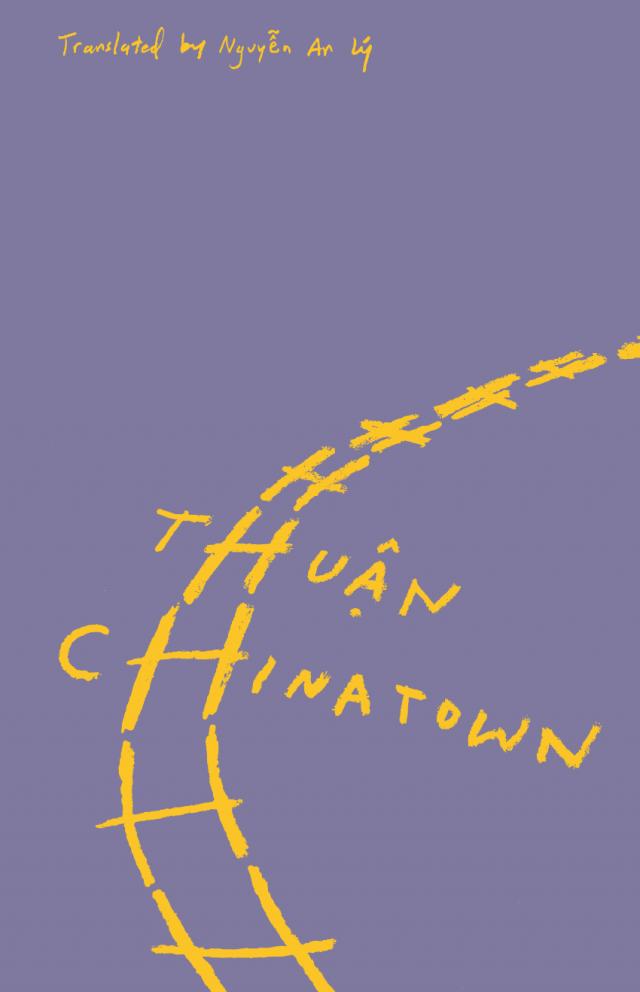
Chinatown
Copyright © 2005 by Thuận
Translation copyright © 2022 by Nguyễn An Lý
All rights reserved.
Except for brief passages quoted in a newspaper, magazine, radio, television, or website review, no part of this book may be reproduced in any form or by any means, electronic or mechanical, including photocopying and recording, or by any information storage and retrieval system, without permission in writing from the Publisher.
Chinatown was first published in Vietnam in 2005 by NXB Đà Nẵng.
This edition is published by arrangement with Tilted Axis.
Manufactured in the United States of America
First published as a New Directions Paperbook Original (NDP1535) in 2022
Design by Erik Rieselbach
Library of Congress Cataloging-in-Publication Data
Names: Thuận, 1967– author. | Nguyễn An Lý, translator.
Title: Chinatown / by Thuận ; translated by Nguyễn An Lý.
Other titles: Chinatown. English
Description: New York : New Directions Publishing Corporation, [2022] | “A New Directions paperbook original”
Identifiers: LCCN 2021061994 | ISBN 9780811231886 (paperback) | ISBN 9780811231893 (ebook)
Subjects: LCGFT: Novels.
Classification: LCC PL4378.9.T57493 C4813 2022 | DDC 895.9/2234—dc23/eng/20220107
LC record available at https://lccn.loc.gov/2021061994
New Directions Books are published for James Laughlin
by New Directions Publishing Corporation
80 Eighth Avenue, New York 10011
Chinatown
My watch reads ten o’clock. Vĩnh stretches and moans that he’s sore. He’s been sleeping on the Métro. His head on my shoulder. The train has stopped at some minor station. Fifteen minutes and still no sign of it moving. They have stumbled upon an abandoned duffel bag. They suspect a bomb in such a forlorn place is a ploy to mask a far more sinister scheme. I wonder if I should stay put and see just how sinister. Or leave and catch a bus. Vĩnh puts his head back on my shoulder and falls back asleep. At twelve the boy is as tall as Thụy was at sixteen. He eats lunch in the school cafeteria. One plate of mashed potato. One piece of fried steak. Two slices of jambon. Two slices of cheese. Yogurt. Ice cream. Cake. Thụy ate lunch at home. Home from school he would go straight to the kitchen to prepare lunch. Two cups of rice, half a bunch of morning glory, six brown shrimps for the three of them. Vĩnh is as tall as Thụy at sixteen. His hair is cropped like Thụy’s hair. His eyes are slanted like Thụy’s eyes. In class his friends call him that Chinese. In the streets people call him that Chinese. In the 13th arrondissement they address him in Cantonese. In school everybody called Thụy that Chink. Spawn of Deng Xiao Ping. Goon boy of Beijing. In the neighborhood everybody would see him and ask, hey when are you going back to your country. Have you sold all your furniture yet. The headmaster was summoned by the local police. Student u Phương Thụy should be watched closely. Student u Phương Thụy’s family have expressed their wish to stay in Vietnam. The higher-ups are still deliberating. The higher-ups have not yet made up their mind. But it’s our duty to ensure that he is watched closely. The party congress has decreed that Beijing is enemy number one of the Vietnamese people. Student u Phương Thụy should be watched closely. The family might not have shown any signs yet. But it’s our duty to ensure that he is watched closely. After meeting with the police, the headmaster summoned a staff meeting. After meeting with the staff, the homeroom teacher summoned a student council meeting. The next day a murmur went through the whole class, that boy Thụy is a problem. The next day again a rumor went through the whole school, that boy Thụy’s family is on the counterespionage police’s watch list. That boy Thụy’s family receives secret documents from Beijing all the time. In class no one talked to him. No teacher called him to the blackboard. The other students looked away when he walked by. He was left out of military classes. He was exempted from writing letters of solidarity to servicemen in the Spratly Islands. In the final year of high school even the worst-behaved students were admitted to the Communist Youth Union. Not Thụy. They didn’t even mention him. They acted like they’d never heard of any Thụy. They acted like there was no Thụy in the class. At sixteen he was as tall as Vĩnh is now. His hair was cropped. His eyes were slanted. On the bus, he fell asleep with his head on my shoulder. He told me he was born in Yên Khê. We were born in the same year. Thụy three months and two days before me. The next day a murmur went through the whole class that I had fallen for Thụy. The next day again a rumor went through the whole school that I was bewitched by that Beijing goon. The headmaster summoned my parents. The homeroom teacher wanted a private word with me. The math teacher wanted a private word with me. The literature teacher wanted a private word with me. The English teacher wanted a private word with me. The secretary of the school youth union wanted a private word with me. You should focus on topping your class in the final exams. You should focus on getting the highest scores in the exit exams. You should focus on bringing honor to our school in the university exams. Some evoked responsibility to try and convince me. Some brought up exams to try and threaten me. No one even mentioned Thụy. No one seemed to have heard of him. My parents also acted as if they’d never heard of him. Not once in my three years at high school did my parents mention him. And not once in my five years at university in Russia. My father said, you should focus on getting your red diploma. My mother said, just get the red diploma and then you can do as you please. My parents both hoped I would forget Thụy. My parents have been hoping for the last twenty-three years that I will forget Thụy. Vĩnh stretches again. The sinister scheme is still waiting for the special forces to come and investigate it. I’m still wondering if we should stay or try to catch a bus instead. The other three passengers in the Métro car growl, will the train start again or not, at least let us know that much. Three hours a day on public transportation is no way to live. I turn and say I also spend three hours a day on public transportation. No one reacts. I add so does the guy, he also spends three hours a day on public transportation. Still they don’t react. I say his name is too long for anyone to remember, even if one spells it out. There’s no point anyway. Better to call him the guy. He often calls me from his office desk. He often calls me on my fifteen-minute lunch break. While I’m chewing my sandwich in the staff room. My doctor says it’s stress. Public-transportation-induced stress. Three hours a day. Stress doesn’t exist in the third world. Third-world people suffer from many life-threatening diseases but never from stress. Vietnam is a third-world country but Vietnam enjoys delicious fruit all year round. Vietnam is richly endowed with natural resources. Vietnam boasts of Hạ Long Bay, the wonder of the world, of Sài Gòn, the pearl of the Far Orient, of Marguerite Duras, the Goncourt laureate. Stress doesn’t exist in the third world. Stress can only be cured by Vietnam. The guy has visited Vietnam twelve times. Eleven times traveling from north to south by Soviet motorbike. A true tây ba lô, a “backpack westerner.” He lives like a tramp, until he is back in Charles de Gaulle in his shorts and undershirt only, his hair to his shoulders and covered in mosquito bites. In the Métro people look at him sideways. In Vietnamese hotels receptionists cast one look at him and sigh. Why do you torture yourself so, I ask him. You think you’re better than me, he asks me. He asks me a lot of things. Do you miss your mom’s lemonade after all this time. Can your dad still carry a bicycle upstairs. So is Vĩnh still having that sore throat. Paul here gave it to Arthur just yesterday. Do your colleagues have any good ideas for the end of the year. Mine suggest eating out. The Cyclo Restaurant. Now it’s my turn to pick the place. I’ll have Vĩnh’s favorite, roast pigeon. Yamina is repeating a year so is she going to be in the same class with her brother Yasin. How is Mlle. Feng Xiao these days. Is she going back home to have Deng Xiao Ping reinterred soon. He asks me a lot of things. Not once does he mention Thụy. Not once. He acts like he’s never heard of any Thụy. Going to Vietnam, he avoids booking the same flight as Vĩnh’s. Coming back to France, he does the same. He’s afraid of running into Thụy at the airport. I ask him a lot of things. Not once do I ask about his wife. Not once do I mention his private life. Neither of now nor of the past. I don’t need to know. I tell myself I don’t need to know. I tell myself I don’t have the time to poke around in his private life. How many times a month Paul and Arthur see their mother, where and for how long, is not something I concern myself with. I don’t know his office number. Every time I call his home I have to check my notebook. He hasn’t moved in the last ten years. But still I have to check my notebook. Hey is everything alright. Are things well with your job. Anyone having a sore throat over there. Vĩnh wants to talk to Paul and Arthur. Now there are two possibilities. Either Vĩnh will talk to one of the boys, for thirty minutes. I’m paying for unlimited minutes between the banlieue and Paris proper. Or else: so both boys are out. That’s alright. No big deal. No need to call back. Children’s talk, you know. The guy can recite my home number, my school staff room number, my cell number, my neighbor’s number, Mlle. Feng Xiao’s number with his eyes closed. I changed my email address three times in the last three years. But he never makes a mistake and he doesn’t need a notebook. Wanadoo, Club-internet, Liberty.surf. My first and Thụy’s middle name. Thụy’s first and my middle name. My last name and Thụy’s. Thụy’s last name and mine. I myself can’t remember. I have to check my notebook. To him it’s no sweat. He
doesn’t need a notebook and he never makes a mistake. Going away, or back to his old home in Rennes, he always writes to me. Hi there. It’s Sunday, are you going to worship at Mlle. Feng Xiao’s soon. Remember to drop by Tang Frères and pick up some pigeon for Vĩnh. That movie The Quiet American is out soon. Wait for me and we’ll go see it together. You should just send Vĩnh to my place. My aunt will roast some birds for the boys. But he says he prefers to call me. You have such a sullen face but your voice is not so bad. Easy on the ears, even. Your French is a jumble of accents. There’s Vietnamese. And then Soviet. And Hà Nội. And Leningrad. Five years studying English in Russia didn’t score you a lectureship in Thanh Xuân University, but a post in a secondary school in a Parisian banlieue is good enough. Being a secondary school teacher trumps being a member of the five-million-strong club of the French unemployed. Your voice isn’t so bad. Talking to you on the phone is less tiring than looking at your sullen face. Now that’s very stressful. So do your forty-nine colleagues at school say the same thing. He says his only strength is a stubborn memory. He can rattle off my work history like it’s nothing. Vĩnh and I can both forget our own birthdays. The guy, he remembers everything. Remembers everything even without a notebook. Without a glance at the birth certificates, he knows that I was born in the national ob-gyn hospital, that Vĩnh was born in the Vietnam-Sweden children’s hospital, 2.9 kilograms in weight, sixty centimeters from head to toes. Twelve years later, Vĩnh is a meter taller, weighs ten times more, shoe size 39. Twelve years later, at one p.m. on a Sunday, Vĩnh pestered me for some roast pigeon. He says roast pigeon is the height of Vietnamese cuisine, as plentiful in calories as his school cafeteria lunch. Going back to Vietnam for the summer or New Year, he mostly eats lunch in Tạ Hiện street. At the sight of him the server will produce three portions of roast pigeon and one portion of fried rice. The waiter knows that he won’t eat pickled glittering chive, that he likes Coke but not Tsingtao beer. Coke by Hà Nội brewery company in partnership with Tai Feng limited joint stock, for whom Vĩnh’s grandmother is a branch representative. His grandmother who at the time he was born was counting the days until the end of the month to receive her early pension, along with his grandfather and their friends from Lương Ngọc Quyến street, nine men and nine women, twenty government workers all told who at the age of forty-five had been advised by the staff offices to submit their retirement letters. Twelve years later, one p.m. on a Sunday, I told Vĩnh, mom’s so tired, your three roast pigeons marinated in húng lìu must wait until next week. He wailed, mom is always tired. If you’re out of money, I’ll lend you some. The money given to him by Thụy. I don’t ever touch that money. Vĩnh says, I want to be independent. The moment I turn eighteen I’ll get a job. The moment I turn eighteen I’ll have a passport. A Vietnamese passport. A French passport. A Chinese passport. I will speak three languages. By then Chinese will be more powerful than English. Un milliard de chinois. Et moi. Et moi. Et moi, I tease him. I know he loves to be teased so. I knew he would soon fall asleep. He is still tired from going parachuting with Paul and Arthur yesterday. Those two proposed a tour of duty in Iraq six years from now. Vĩnh waved a dismissive hand. Six years from now, regardless of whether the war in Iraq is still going on, he will parachute into Baghdad armed with his Chinese passport. Six years is enough for Chinese businesses to overtake American and British competitors, for his grandmother’s Tai Feng joint stock to have opened dozens more branches in the Gulf states. Six years from now I will be forty-five. Thụy will be forty-five. There’s another twenty years of teaching in store for me, so as to qualify for a Ministry of Education pension when I come to the end of my days. Who knows what’s in store for Thụy, whether Hong Kong or Iraq, US or Rwanda. Six years from now Thụy’s Chinese tongue will have grown sixfold in value. Six years from now Thụy’s u clan will have grown sixfold in population. Vĩnh is asleep. I’m fast asleep beside him. I’m considering having a dream about Thụy and me, hand in hand going to receive our pension, when the guy calls. His call wakes us both up. I don’t need to answer to know that it’s him. Four p.m. on a Sunday. He’ll keep calling me as long as he doesn’t drop dead, as he likes to caveat. Four p.m. every Sunday. Even if he’s away on vacation. Even if he’s back home in Rennes. Even if it’s raining all day long where he is, or the temperature reaches thirty-five degrees, and the sea just a little distance away with its green green water and gentle waves. Even under the sun of Củ Chi, Yên Bái, Cà Mau. Four p.m. every Sunday. He knows all telephone operators. He knows how to say chào anh chào chị when he arrives. Chào anh chào chị when he leaves. Hotel receptionists look at him and sigh but the small province operators, piping thuốc lào tobacco from morning till night, find him quaintly cute. The small province operators know him as mister Frenchman. Come on in mister Frenchman have a cup of tea. I see you’ve come to call your girlfriend again mister Frenchman. It’s already 2004 but the phrase “tây ba lô” hasn’t traveled far from Hà Nội and Sài Gòn. In Củ Chi, Yên Bái, Cà Mau, people are still innocent enough to assume every mister Frenchman is a capitalist. How could a noncapitalist afford to talk for ten minutes at the rate of two hundred thousand đồng. Two hundred thousand đồng can’t get you a ticket to see a diva duet by Thanh Lam and Hồng Nhung in either Hà Nội or Sài Gòn, but two hundred thousand đồng gets you forty kilograms of maize in Yên Bái, forty kilograms of cassava roots in Củ Chi, forty kilograms of flour in Rạch Giá. The last time he called, it was from an Internet café in Hàm Long street. Last year, two hundred thousand đồng got you a ten-minute call to the EU. This year, competition between the new military- and the old state-owned companies means we enjoy half the rate. There are five Internet cafés in Hàm Long street alone. He waged a shouting match with three other people who were also placing calls to the EU. His French throat held no candle to their Vietnamese ones, so I heard two calls to Germany and a third one to France. They were each discussing their children’s imminent overseas studies. Each agonizing over who there will be for a returning French or German speaker to talk to, in which company a French or German degree will be accepted. Each agreeing heartily that a French or German college is much cheaper than a Vietnamese one. There’s no such thing as Teachers’ Day in French or German calendars, so parents won’t have to catch a Vietnam Airlines plane over there to celebrate, to haul some offerings of oranges to their children’s French or German professors. Four p.m. in Hà Nội. Eleven a.m. in Paris. Eleven a.m., a summer day in Paris. I was wrapped in blankets. He was in shorts and tank top braving the thirty-nine-degree heat. I cradled the receiver, listening to his shouting match. Twenty minutes in, his voice was already hoarse. The other three would be shouting for another ten minutes several times over. He says he prefers calling to writing emails. You have such a sullen face but your voice is not so bad. You mix four accents like hodgepodge fried rice but I can understand it. It’s not so bad. Easy on the ears even. Four p.m. on a Sunday. I don’t need to answer to know that it’s him. At his first hi I already know he will propose running three laps around Belleville park. I wave a dismissive hand. Vĩnh and I are both busy. Vĩnh’s grandmother is over for a meeting with the Tai Feng branch representative in France. His grandmother brings him a crate of Coca-Cola to wash down his roast pigeon. His grandmother says that when he goes back to Vietnam again she will give him another crate to go, together with three Tạ Hiện roast pigeons to eat on the plane. One plate of Vietnam Airlines fried rice and two slices of Vietnamese ham stuffed with flour and MSG cannot provide the plentiful calories the boy needs. The guy says then I can just stay at home and provide calories for Vĩnh’s grandmother. He hangs up. Without even saying goodbye. Whenever he goes to Hà Nội he drops by my place without fail, and without fail my parents seize the opportunity to gripe at how Vĩnh and I are neglected by Thụy and his parents. Whenever their homeland gift arrives without fail it comes with a letter, and the letter comes with a question as to when he and I will get married, when I will bring him back to Vietnam to introduce him to all our relatives. Doing the rounds of the relatives is the point. After twelve visits to Vietnam he understands that all too well. After twelve visits to Vietnam he now knows enough to make excuses to my parents. So that my parents can later make excuses to the relatives: One of them has just started at a new school. The other has just started at a new job. One is studying for a second degree. The other is abroad on a business trip. His dear father has some ailment. His kind mother doesn’t feel so well. Last year Vĩnh went back to Vietnam. The return trip cost six hundred euros. His pocket money another hundred. Half my monthly wage. His paternal grandparents cannot give him half my monthly wage but they did drive all the way to the airport to pick him up. Also for a round of their own set of relatives. His Vietnamese leaves much to be desired. But the Chinese yes sir no ma’am roll right off his tongue. His tongue is still made for Tạ Hiện roast pigeon. He knows current affairs in the PRC like the back of his hand. His paternal grandparents know that my secondary teacher’s wage cannot stretch to a house in the 13th arrondissement. But every Wednesday afternoon Vĩnh goes to rue Tolbiac for his Chinese class. The Chinese spoken in the 13th arrondissement is not Beijingese, but even Beijingers don’t speak Beijingese anymore. Like Hanoians don’t speak Hanoiese. His paternal grandparents find nothing in him to complain about, and nothing in me. They never complain about me. Ever. They came all the way to the maternity ward to pick me up. His father carrying the baby in the front. His mother holding my hand in the back. His father named the baby Vĩnh. Father is Thụy. Son is Vĩnh. Vĩnh Thụy would have been sacrilegious once. His mother was unsure about the name. His father said Vĩnh means everlasting in Chinese. Father u Phương Thụy. Son u Phương Vĩnh. Later when a baby girl comes along she will be named Hằng. Hằng has the same meaning as Vĩnh. Hằng is as beautiful a name as Vĩnh. His parents talked of the future. Grandson Vĩnh. Granddaughter Hằng. Family planning in the People’s Republic of China is twice as exact as that in the Socialist Republic of Vietnam. In the future Chinese girls would be hard to come by. In the future Chinese girls would be free to have their pick. Hằng, surnamed u, slanted eyes, speaking Chinese. Whether she holds a Chinese passport is irrelevant. Un milliard de chinois. Et moi. Et moi. Et moi. By the time she comes of age, those billion Chinese will have become a billion and a half. China will have become a country without borders. Hằng and Vĩnh can go wherever they like without fear of losing their roots, their language, their Tạ Hiện roast pigeon. Thụy’s parents talked of the future. Thụy’s parents handed Vĩnh and me over to my parents. A week after I left the hospital. We find nothing in you to complain about, girl. If things don’t work out between the two of you, don’t blame us. I never do blame Thụy’s parents. And I never blame Thụy. After twelve years my missing him has yet to run its course. I let the guy travel north to south alone on a Soviet motorbike as a backpack westerner living like a tramp, coming back to Charles de Gaulle in shorts and undershirt only. The day we went to the airport to pick Vĩnh up, the guy’s hair still came to his shoulders. His skin was still covered in mosquito bites. I asked him, don’t you think it’s time you stop torturing yourself. He asked me, do you think you’re better than me. Without so much as a hello Vĩnh declared, what an awful haircut mom has, stop giving Mlle. Feng Xiao so much liberty. Indicating the boy by his side he said, this is my good friend Hao Peng. I’d heard a lot about Hao Peng. The two boys were in the same class in rue Tolbiac. They had arranged to meet in the Bangkok airport waiting area. Vĩnh flew from Hà Nội. Hao Peng from Beijing. During the twelve-hour flight back to Paris, Hao Peng had given Vĩnh a full tour of the PRC. These days, in Shanghai you feel like you’re in Chicago. You never see a beggar singing for money in the brand-new, smooth-sailing underground. In Guangdong they just wrapped up the biggest bribery trial ever, five got death and ten got life. Next month in Kunming they’re unveiling the world’s largest nuclear power plant. Last year in Beijing Chairman Jiang Ze Min himself inaugurated the international mathematics festival. Guangdong has earned a spot in the Guinness Book of Records for the highest number of luxury restaurants per capita, coupled with the highest number of roast pigeons sold every month. In my Hangzhou a floating hotel has just been built, with every room opening to its own golf course, its own outdoor swimming pool higher than sea level. In your Hunan things are also very smart these days. A six-lane flyover is said to be in development, reaching from the municipal people’s committee headquarters all the way to Tian’anmen. In Mlle. Feng Xiao’s Sichuan they are preparing a grand ceremony for the tenth anniversary of Deng Xiao Ping’s demise, so the province plans to import eight million little jars to build a memorial for their homonym-sake, the greatest former chairman of China. After twelve hours, Vĩnh’s heart was already drumming in his chest. By the time the airplane landed, he had found Hao Peng to be the worthiest of all his Paris friends. Hao Peng, who’s never late for class. Hao Peng, who speaks proper Mandarin. Hao Peng, who translates from Chinese to French even faster than the teacher. Hao Peng, who bagged the gold medal in the municipal youth’s table tennis tournament last year. Hao Peng, who says an exemplary Chinese youth has to be well-rounded, agile in body and sharp in mind. Hao Peng, who went straight from the barber shop to the airport. PRC shampoo and PRC hair spray. I waited for the guy at the gate of Belleville park. PRC shampoo and PRC hair spray. He made no comment. He always avoids commenting on my appearance. Half an hour and a lap round the park later, he asked if Mlle. Feng Xiao was well. I mumbled yes. Then he asked if Mlle. Feng Xiao had told me anything interesting. He asks about Mlle. Feng Xiao whenever he wants to make me laugh. My hair has been Mlle. Feng Xiao’s to cut, wash, and spray for the last ten years. Mlle. Feng Xiao entertains her clients with many a delightful story. Her Vietnamese is not much better than Vĩnh’s, but she has cute canines and dimpled cheeks. I spend less time listening to her than I do admiring her looks. I always feel like I understand everything she says. On the first day, upon my confessing that I was fresh from Vietnam, she smiled, so nıˇ are a Yuenanese. I instantly warmed up to her. Thụy used to tease me saying I was Yuenan folk. Yuenan was once a province of China. Taking up with him, I would have no fear of losing my roots. A year later I found out that she is an u too. An u like Thụy. Like Vĩnh. u Feng Xiao. u Phương Thụy. u Phương Vĩnh. If Thụy hadn’t boarded the Thống Nhất, we would have had u Phương Hằng. Chinese girls will be very desirable in the future. Mlle. Feng Xiao turns fifty this year. Mlle. Feng Xiao lives her unmarried life with her sister who will be sixty in two years. The two mademoiselles went all the way from Sichuan to Paris. Sichuan lies in the west of China, a thousand kilometers from Beijing. Sichuan is the homeland of Deng Xiao Ping. Mlle. Feng Xiao recounted how when Deng Xiao Ping turned his back on Mao Ze Dong, becoming a party outcast, in her village they smashed all their little jars to smithereens and threw the shards into the pond. Four million people in the whole province of Sichuan smashed eight million little jars. Feeling that was not enough, they imported jars from neighboring provinces so that they had more to smash. Two for adults, one for children. I was a child, I was also given one. I smashed it even harder than my older siblings did theirs. But now the eight million people of Sichuan all know that it was thanks to Deng Xiao Ping that China could become what it is today. The eight million people of Sichuan wept the hardest the day he passed away. He passed away, poor fellow. In ailments and agony. Poor fellow. Mlle. Feng Xiao says her Vietnamese has gotten so much better since she met me. Vietnamese and Chinese tongues are so close. Seeing me once a month is enough for her to be fluent in Vietnamese. Vietnam and China are so close too. Seeing me once a month is enough for her to know that what there is in her land is also there in mine. I find Mlle. Feng Xiao charming. I have had few opportunities to get close to the local Chinese community. I can hardly run to them, grasp their hands and say, my husband is also ethnically Chinese. I’m an u. My only son Vĩnh is an u. When he turns eighteen he will have three nationalities. When he turns eighteen he will go to the Gulf as a branch representative of Tai Feng JSC and arrange an interpreter’s job for me in Baghdad. Every first Sunday of the month Vĩnh is deposited at one of my neighbors’ while I go visit Mlle. Feng Xiao. He says, mom goes to Mlle. Feng Xiao the way people go to church. Mlle. Feng Xiao is the only Chinese I know in Paris. Mlle. Feng Xiao is an u. She came from Sichuan. Her hometown lies to the west of Beijing, a thousand kilometers away. Thụy has no hometown. His filial ancestors were born in Hunan. His great-grandfather was born in Hunan. His grandfather was born in Hunan. But he was born in Yên Khê. At sixteen, a high school graduate, he took the entrance exams for the Polytechnic University but was assigned to the University of Architecture instead. With Chinese gunners threatening to fire five cannonballs a day over the border with Vietnam, the Vietnamese government would hear nothing of ethnically Chinese doctors and engineers. And with the Vietnamese government receiving a thousand Soviet prefab houses every quarter, the student body at Hà Nội University of Architecture was made up solely of country hicks with only a pencil to their name. Studying architecture still trumped studying how to plant a forest or cure buffalo of hoof disease. After five years, once your hands had come to know their way around the pencil, you could find some job to escape to, and even a janitor’s or a typist’s post was a good escape, today’s country hick being much more flexible than today’s city slicker. At sixteen I got into Thanh Xuân University, where I learned Russian. At seventeen I departed for Leningrad. My future was wide open. At the airport my father recited in a loud singsong voice, O Russia, thou art my children’s paradise. My mother said Tố Hữu’s poetry is so fine, his verses are happy and they also rhyme. All they wanted was that I would be happy. All they hoped was that paradisiacal Russia would make me forget Thụy. Thụy didn’t come to the airport to see me off. He had never been allowed inside my parents’ house. My father would answer the door saying that I was busy studying. My mother would answer the door saying that I had a headache. Then came my dizziness, my toothache, my sore throat. It didn’t take long before he got the message. He didn’t come again. I went into the public bathroom, wanting to have a good cry. The public bathroom in Nội Bài airport twenty-three years ago was on par with the one in Thanh Xuân University. Twenty-three emerald-green bottle flies meant I couldn’t shed a single nostalgic tear over Thụy. At seventeen, I had not yet known what five years feels like. At twenty-seven, having been through a five-year span twice over, I got married to Thụy. At thirty-seven, after twice that five-year time again, I had been without him for nine years altogether. At thirty-seven, I was already a veteran teacher for the Ministry of Education, he a veteran architect for the whole Chinese community in Chợ Lớn. His Chinese tongue is very desirable now. His u surname is also very desirable now. His Chinese tongue, which had no use whatsoever when we got married. His u surname, which was in the Hà Nội police’s blacklist when we got married. The first time I told her about him, my mother said, the Chinese are inscrutable. I don’t believe him to be inscrutable. I don’t blame his parents. I never blame his parents. His parents, who welcomed a grandson and immediately looked forward to a granddaughter. His parents, who came all the way to the maternity ward to pick me up. His father carrying baby Vĩnh in the front. His mother holding my hand in the back. His parents went all the way to the airport to pick Vĩnh up. Summer or New Year holiday all the same. His parents find nothing in me to complain about. His parents have nothing to blame me for. His mother came to France for a weeklong meeting. We took photographs at my place, using up a whole Kodak roll of thirty-six exposures. His father wrote me a letter full of praise, the two of you staying in that place is very good. Belleville cannot yet become a part of the 13th arrondissement, but Belleville is very good. Even on a side street you find ten restaurants, five clothing stores, two leather goods stores. If you squint, you’ll even find a money exchange shop. If you squint really hard, you’ll even find a shop sign saying “u.” And if you squint until your eyes are nothing but thin slits, you’ll find that the telephone number is the only thing that tells you it’s not a shop sign in Hong Kong. His parents find nothing in me to complain about. They understand that I give him my all. Since the first time they met me twenty-three years ago, they already understood that I would give him my all. Belleville cannot yet be a part of the 13th arrondissement, but the rent in Belleville is half what they pay in the 13th. In Belleville even on a side street you find ten restaurants, five clothing stores, two leather goods stores. Living in Belleville on your secondary teacher’s wage is very good. In the future, when Vĩnh goes to the Gulf as a branch representative, you can move to the 13th arrondissement no problem. In the 13th arrondissement, even in tour Olympiades where Mlle. Feng Xiao lives, a one-bedroom apartment costs 700 euros. On the eighteenth floor, five times a week, the shuttling elevators are halted right at high noon by a power outage. Right at high noon the whole eighteenth floor, in concert with the other seventeen floors, must complete ten thousand nem, twenty thousand bánh cuốn, three thousand har gow. At the order of a hundred ethnic deli spécialités chinoises et vietnamiennes. Ninety-nine of which have Chinese owners, as a matter of fact. The hundredth is currently owned by a Vietnamese, but a Chinese owner is already finalizing its purchase. In the 13th arrondissement, in the very tour Olympiades where Mlle. Feng Xiao lives, you can wait for a year before someone announces that their apartment is up for sale. But without any such announcement, people are already lining up to buy. To pay in hard cash. Never mind going through the Real Estate Municipal Department. Never mind registering at some people’s committee. And the very next day there’s a new haircut-and-perm shop. A bridal shop, makeup and rental gowns. A tailor shop, suits for men and suits for women, Shanghai cheongsams and ballroom dresses. Next month if there’s no new piece to be tailored, the space can be converted to an office. A travel agency. A marriage therapy clinic. A hothouse for vegetables. A private kindergarten. A real estate office. A wholesale store, from whence every day a thousand leather coats, a thousand leather briefcases, a thousand pairs of leather shoes go forth to Paris and the surrounding areas. Thụy’s parents understand that I give him my all. They don’t need to consult my Purple Star chart. They understood it the first time they met me. After a year as their daughter-in-law, and then a week staying at their place when Vĩnh was born, I’d learned how to prepare ten Chinese holiday dishes. How the Chinese use soy sauce instead of fish sauce. Even boiled green vegetables are seasoned with sesame sauce and sugar. I learned how the Chinese, once they trust someone, trust them unto death. How Chinese wives never turn their backs on their men. I never turn my back on Thụy. Vĩnh was one month old when Thụy said he’d had it up to here with Hà Nội. In Hà Nội there were only ten ethnically Chinese families left. Ten ethnically Chinese families, who huddled up in Lương Ngọc Quyến street. Ten ethnically Chinese families, who had faith in the party. Ten ethnically Chinese families, whose children would never become doctors or engineers. The party only needed engineers and doctors with family names like Nguyễn, or Trần, or Lê. Thụy, saddled with a name like u, had no choice but to leave, to head south for Chợ Lớn. Chợ Lớn, where ten thousand ethnically Chinese families lived. Chợ Lớn, which—after all the merging and splitting—was still a part of Sài Gòn. The party was also more open-minded when it came to Sài Gòn. Engineers and doctors who were a Nguyễn, a Lê, a Trần from Hà Nội kept being sent to Sài Gòn to serve, but demand remained high. Engineers and doctors who were a Nguyễn, a Lê, a Trần from Sài Gòn, ten years after South and North were united under the same roof, had mostly exported themselves to the US, or France, or Australia, or Canada. The Soviet experts had not yet designed prefab houses for Sài Gòn so architects were still needed, and the party decided that a country hick architect, an ethnically Chinese architect was at least more trustworthy than one from the imposter government or army who architected their Independence Palace or their American embassy. So, one by one, the ten ethnically Chinese families of Lương Ngọc Quyến street entrusted their children to the ten thousand ethnically Chinese families of Sài Gòn in Chợ Lớn. Thụy’d had it up to here with Hà Nội. He only took a single change of clothes. His degree from the University of Architecture was left to Hà Nội. He walked to Hàng Cỏ station. He boarded the eleven p.m. Thống Nhất. That’s all I knew about his departure. After that, where he was, whom he met, what he did. I didn’t know a thing. On Vĩnh’s very first birthday, he wrote home. Two hundred thousand đồng plus a black-and-white photograph. He was standing by a two-story house, a shop sign with Chinese lettering, a pair of Chinese lanterns. I didn’t know where he was, whom he met, what he did, in those days. Two years later I watched Duras follow her lover into Chợ Lớn. In every street, two-story houses. Two-story houses, shop signs with Chinese lettering, pairs of lanterns. I didn’t know where he was, whom he met, what he did. Even now I still don’t know where he was, whom he met, what he did. For the last twelve years I have been wanting to see him, to ask. How he is living his life now. I don’t need to know. But I want to know where he was, whom he met, what he did, in those days. The two-story house, the shop sign with Chinese lettering, the pair of lanterns. In those days. In those days, Vĩnh was just one month old. The baby learned how to roll over. How to crawl. How to walk. Thụy was nowhere in sight. The baby cut a tooth. Got weaned. Got measles. Thụy was nowhere in sight. He got bitten on the ear by red ants and ran a thirty-nine-degree fever for an entire week. Thụy was nowhere in sight. He swallowed a rambutan stone and had to be rushed to the Vietnam-Sweden children’s hospital. Thụy was nowhere in sight. He was bitten on the nose by another boy in the kindergarten, then made to face the wall, the teacher’s punishment for the Beijing goon who dared bully a Vietnamese commoner. Thụy was nowhere in sight. Thụy was nowhere in sight. For the last twelve years I have been wanting to see him, to ask. Vĩnh and I arrived at the airport in the torrential rain. I ran into the public bathroom. The same bathroom from the day I left for Russia. Twelve years had gone by but the number of emerald-green bottle flies remained unchanged. But I now knew how separation feels. My mother stood outside, holding baby Vĩnh. I stood inside, crying. I wanted to see Thụy to ask. I wanted to call off the whole trip just for a chance to see him. I only wanted to ask him how it had been in those days. How he was living his life now, I didn’t need to know. My mother pounded on the door. I hadn’t finished crying yet. My mother pounded harder. I cried harder. Vĩnh cried harder. My father tried to joke, cry even harder, grandpa will take a photo of crybaby and crymama. My father wanted to include my mother in the photo. But my mother said it’s taboo to take a photo of three. The middle one will suffer from bad luck. Again my father joked, then let me be the middle man. To see Paris and die, that’s the worst that can happen, no. O Paris, thou art my children’s paradise. My father recited in a loud singsong voice. My father said Tố Hữu’s poetry is still happy and still rhymes. But Tố Hữu had gotten it wrong. By the end of the twentieth century Russia had turned into hell. Capitalism is the real paradise. He rambled on about all kinds of things. He ran out for some biscuits for Vĩnh. He gave the baby a shoulder ride all over the airport. Vĩnh was no longer crying. He was wearing what his paternal grandparents gave him a few days back for his birthday. His paternal grandparents didn’t come to the airport. Grandpa was occupied. Grandma was unwell. My mother didn’t want Thụy’s parents to come to the airport either. She said traveling was a pain. I knew my mother didn’t want to see his parents. Again I ran into the public bathroom. The long line drove me out. My mother was making a fuss, hurry up you still have to go and check in your baggage. I walked, but my feet didn’t seem to touch the ground. I carried Vĩnh onto the plane. The two air hostesses drew up the ladder. I had a glimpse of my parents waving from afar. In my mother’s hand was the handkerchief I’d left in the public bathroom. In my father’s was the packet of biscuits Vĩnh hadn’t finished. I only wanted to see Thụy to ask. I wanted to call off the whole trip just for a chance to see him. Where he was, whom he met, what he did, in those days. The two-story house, the shop sign with Chinese lettering, the pair of lanterns. In those days. I lay holding Vĩnh in my arms. The eighteen-square-meter apartment in the Đê La Thành blocks. The double bed in the innermost corner. By its side was the bookshelf Thụy made for me. In the middle of the room, the small table with the couple of little stools, also made by him. He and I sat there for tea in the mornings. I read to him from books in the late afternoons. I told him about Leningrad. The white nights. The Neva. The moving bridges. The winters without him. I wanted to call off the whole trip. Just to see him. Just to ask him where he was, whom he met, what he did, in those days. How he was living his life now, I didn’t need to know. But I wanted to know how it had been in those days. I climbed up into the plane, eyes brimming with tears. In the torrential rain. The guy sat beside us on the plane. He was fresh from a guided tour around Hà Nội, Huế, Hội An. He said he didn’t go on southward to Sài Gòn. He reached as far as Hội An and then went back. Hội An was pretty but he didn’t like it there. Huế was pretty but he didn’t like it there. Hà Nội was not as pretty but he liked it there. He talked nonstop. He didn’t give me a chance to nod off. Later, he said he had seen me run into the public bathroom twice. He didn’t mention my crying while my mother pounded on the door. He didn’t mention my almost losing a bag because I kept running every two minutes to look toward the airport gate. He didn’t mention my remembering my passport was still in my father’s briefcase only when I was in front of the immigrant officer. I once asked him, did my eyes swell to the size of oranges. He said vaguely, was that so, I didn’t really pay attention. He always avoids commenting on my appearance. He sat beside us on the plane. He talked nonstop. He didn’t give me a chance to nod off. He didn’t give me a chance to miss Thụy. He talked about shopping in the flea market in Trần Cao Vân street. He talked about playing games of chess by Hoàn Kiếm lake. He talked about eating snakes in Lệ Mật village. The snake’s heart submerged in a cup of rice wine was still beating after five minutes. The snake’s head was chopped finely and turned into meatballs. The snake’s sides were put into nem. The snake’s back was taken out and mixed into salad. The snake’s belly was cooked in a soup with scallions and coriander. The snake’s skin was fried until swollen and eaten in a roll with broken rice crackers. The snake’s tail was stewed in mung bean soup with coconut milk. Nothing was wasted. It was incredible. He seemed to have taken a liking to Lệ Mật village. He seemed to have taken a liking to the seven-course snake. He told me a lot of things. Things wholly outside the program of the guided tour. Things he’d never had anyone to tell. Later, he said my face had looked so sullen then. But for some reason he kept talking. Kept talking without even checking if I was listening. Or if I liked it. He was like the black to Thụy’s white. He always tells me where he stays, whom he meets, what he does, without prompt. He sat beside us on the plane. He acted the clown to make us laugh. He cracked jokes about those who were on his guided tour. He called them the trade officials. The trade officials screamed and shrieked at any trivial thing. They saw a lizard and took it for a viper. They saw pork and assumed it was dogmeat. They saw a cockroach and retched their guts out. They saw a mosquito and nearly emptied their spray bottles of repellent. They saw a bee and ran like their lives depended on it. They saw a spider and screamed loud enough to bring down the house. The trade officials took a diarrhea pill on leaving their hotel. They took a diarrhea pill when visiting the Confucian Temple. They took a diarrhea pill in the middle of their lunch. They took a diarrhea pill listening to a quan họ concert. They jerked awake from a dream on their hospital beds and took a diarrhea pill. He talked nonstop. He made my ears ache. He made my nerves tense. He spared me no time to miss Thụy. In the course of a three-hour flight, he managed to make me and Vĩnh laugh three times. He took some paper and made the boy a ship and a plane. He asked the air hostess to please warm some water for me and some milk for Vĩnh. He suggested that the gentleman in front might perhaps raise his seat a little. He apologized to the lady in the row behind when Vĩnh took her glasses by mistake. He talked nonstop. He wiggled all the time. During our layover in Bangkok I thought I would be able to shake him off for two hours. For two hours, my brain wouldn’t have to grapple with French words. For two hours, my brain would be free to miss Thụy as much as I liked. After all the years, I still wanted to see him. To ask where he’d gone, whom he’d met, what he’d done. In those days. I still kept in my bag the piece of paper that he’d signed. That my mother had dictated and my father typed up. I hadn’t had the nerve to hand it to his parents. In tears, I’d asked his younger sister to give it to him. I hadn’t known his address. I had never set foot in Sài Gòn. And I’d never even heard of Chợ Lớn. The police said that without the father’s approval, they couldn’t put Vĩnh’s information on my passport. My father said, you should focus hard on your studies. No more “while you’re still young” as I was going on thirty. My mother said, come back from France and then you can do as you please. You put so much effort into passing your exams. My parents hoped that paradisiacal Paris would make me forget Thụy. My parents have been hoping for the last twenty-three years that I will forget Thụy. I told them I wouldn’t go anywhere on my own. Vĩnh was not even two yet. He was all that was left to me. All that was left to me by which to remember Thụy. He came to resemble Thụy more with each passing day. Down to the last toenail. Every time she saw him his grandmother would exclaim, the handle always resembles the basket. In tears I asked Thụy’s sister to give him the piece of paper. No letter to go along with it. I didn’t understand why I hadn’t written a letter. There were so many things I wanted to ask but I didn’t write a letter. His sister also remarked on it, you didn’t write a letter. I didn’t answer. That day too there was torrential rain. Inside me it was all a mist. The bureau for university cooperation had called me to their office. If my passport was not ready by the end of the month, it would be too late for the visa. I might not arrive in time to meet with an advisor, to be assigned a topic. My father wouldn’t touch his food. My mother wouldn’t stop weeping. The house was like a house in mourning. One month before my scheduled departure. Inside me it was all a mist. I didn’t need Thụy to sign that piece of paper. I didn’t need his two hundred thousand đồng. I just wanted to ask where he’d gone, whom he’d met, what he’d done. In those days. In those days. My uncle said to my mother, let me go have a good talk to that man’s parents. My aunt said, let me go give them a good threat. But in the end it wasn’t necessary. That night, in the torrential rain, his sister knocked on my door. At the bottom of the piece of paper that my mother had dictated and my father typed up, there was his signature. That was all there was in the big envelope. No letter. No photograph. No two hundred thousand đồng. Inside me it was all a mist. His sister said, do you need anything else. I didn’t answer. I didn’t understand a thing. I didn’t say goodbye as she left. I didn’t look at the piece of paper. All I saw was his signature. One month before my scheduled departure. The torrential rain endured. I didn’t need his signature. I just wanted to ask him how it had been. In those days. As for that piece of paper, my father turned it into many Xerox copies. My mother sent one to the bureau for university cooperation, took one to the notary and translation service, brought one to the local police, put one in the drawer with our most important papers. She also gave one to me. Inside me it was all a mist. I just wanted to see Thụy. To ask him how it had been in those days. I sat in the Bangkok airport with Vĩnh in my arms. In my bag was Thụy’s photograph. The two-story house, the shop sign with Chinese lettering, the pair of lanterns. Later, I heard Duras describe the din of Chợ Lớn. I understood everything. But I didn’t understand a thing. With wariness I read Duras’s words. I had not set foot in Sài Gòn. I knew nothing about Chợ Lớn. I read The Lover and watched the movie. I even read The North China Lover. I heard Duras describe the smells of Chợ Lớn. Agarwood, watermelons, restaurants. I read Duras’s every word wondering if I was being duped. I just wanted to know where he’d gone, whom he’d met, what he’d done. In those days. The two-story house, the shop sign with Chinese lettering, the pair of lanterns. I sat in the Bangkok airport with Vĩnh in my arms. Thụy’s signature in my bag. The torrential rain outside. Inside me it was all a mist. Out of the blue the guy ran to us, producing a coconut milk for me and two apples for Vĩnh. From then on, until we boarded the plane, he was silent. He was silent for the next twelve hours. Vĩnh slept in his arms. The gentleman in front thoughtfully raised his seat a little. The lady behind turned off her reading light. The air hostesses sat nodding in a corner. Dimness filled the plane’s interior. I took out Thụy’s signature and studied it. He had not put a date. A date for me to know that on that day of that month he had thought of me, of Vĩnh. Never did he write to me. The eighteen-square-meter apartment in the Đê La Thành blocks. The bookshelf on the wall. The small table with the couple of stools in the middle of the room. The cupboard in the kitchen. All made by him. I read to him from books. I told him about Leningrad. The white nights. Nevsky Prospect. The Neva. Dostoyevsky. He said he loved Crime and Punishment. I said the Russian winter was sad. In Leningrad even more so. So cold your ears fell off. It snowed even in May. I had no news from him. Letters to him were sent without reply. My parents wrote every month without ever mentioning him. My worst nightmare was that I would never meet him again. I fell on the way to class. I had to stay at home for a month. For the whole month I dreamed that Thụy was ill. He was taken to the hospital, but no one would treat him. They saw his u name on the registration form and said, you might as well go home. I read Crime and Punishment, in which the main character killed himself. Now I worried that Thụy would grow despondent and tired of life. In the summer of my third year, I spent my holidays picking fruit in the countryside. I got three hundred rubles, so I wrote home, I’m coming home this winter holiday. Three weeks later, a letter arrived from my mother. Everybody’s well. Everything’s as usual. The other day I and your father passed by Lương Ngọc Quyến street. The ten Chinese families had got on the train to Quảng Ninh, they must be in Hong Kong by now. I never forgave my mother. My last year and a half in Russia was the most dejected year and a half of my life. Later, I had Vĩnh with me. I had known love. I had reasons to live. But back then I was twenty-one. Russia was sad and cold. So cold your ears fell off. It snowed even in May. I had no news from Thụy. Later I often asked why he didn’t write to me. He smiled but said nothing. Later, lying by his side at night, I still dreamed that they turned him away from the hospital, that he fell, that blood pooled under his head. Later, waiting until dark for him to come home, I was scared that someone would come pounding on the door to tell me he had taken his life. His taking his own life was my greatest fear. Hanging himself, drinking insecticide, jumping from a train. I didn’t dare pursue the thought. Lying by his side, I didn’t dare pursue those thoughts. Every dream of mine was a catastrophe. Every catastrophe ended in his death. In the year we lived together, I gave him my all. I wanted to forget all about the days in Leningrad. I wanted to forget the letter from my mother. I wanted to forget my canceled plane ticket. Russia was as cold as ice. It snowed even in May. One by one, my girlfriends got married and had children. Or had children and got married. They figured that marriage before graduation had many advantages. To kid parents raising actual kids, any junk could pass for food. After graduation, they would qualify for family-grade overseas shipping. Tripled allowance of things to go into their overseas crates. And a baby meant a one-year leave from school. A one-year extension of their stay in Russia. A day extended is a day gained. One by one they got married and I attended their weddings. To eat random junk passing for food. Nem stuffed with cabbage and beef meatballs. Cabbage salad with a sprinkling of walnut. Curry with cabbage, potatoes, and mutton. Russia was as cold as ice. It snowed even in May. Russia had no vegetable other than cabbage, but if the socialist bloc had not come tumbling down Russia would have remained paradise for students from Vietnam, Cuba, North Korea, Mongolia. One by one they had babies and I visited them in the maternity wards. One by one they packed their overseas crates and I watched them fuss. My own meagre crate consisted of a few dozen books, a fridge for my mother, a record player for my father. The day I got married to Thụy, my mother gave me back the fridge, my father said, take the player so that you have something to listen to. In our sparse love nest. A bookshelf on the wall. A small table with a couple of stools in the middle of the room. A cupboard in the kitchen. All made by him. He and I sat there for tea in the mornings. I put on a song for him. The player made a wheezing sound. Soviet records meeting the wet summer wind of Hà Nội were all ways of warped. Vĩnh was exactly one month old when Thụy said he’d had it up to here with Hà Nội. I could only do as he wished. I told him so. Hundreds of times over in that eighteen-square-meter apartment in the Đê La Thành blocks. In those days of love and pangs. Dimness filled the plane’s interior. I studied his signature. The piece of paper that my mother had dictated and my father typed up. With Thụy’s signature at the bottom. Without a date. A date for me to know that in that day of that month he had thought of me. His sister didn’t tell me anything else. And I didn’t ask. Neither did I write to him. Even now I still don’t understand why I didn’t write to him. At the time, writing seemed impossible. I didn’t know what to write. I didn’t know how to bare my heart in writing. I had never kept a diary. Not even in the frostiest days in Leningrad. But I don’t understand why I didn’t write to him. Inside me it was all a mist. I was afraid that I would have nothing to write to him. And that he would have nothing to write to me. It’s been twelve years, and I still don’t understand any of it. It’s been twelve years, and I still haven’t dared write to him. It’s been twelve years, and now I vaguely understand that one can’t simply take up a pen and write.