Lost realms, p.1
Lost Realms, page 1


Copyright
William Collins
An imprint of HarperCollinsPublishers
1 London Bridge Street
London SE1 9GF
WilliamCollinsBooks.com
HarperCollinsPublishers
Macken House, 39/40 Mayor Street Upper
Dublin 1, D01 C9W8, Ireland
This eBook first published in Great Britain by William Collins in 2022
Copyright © Thomas Williams 2022
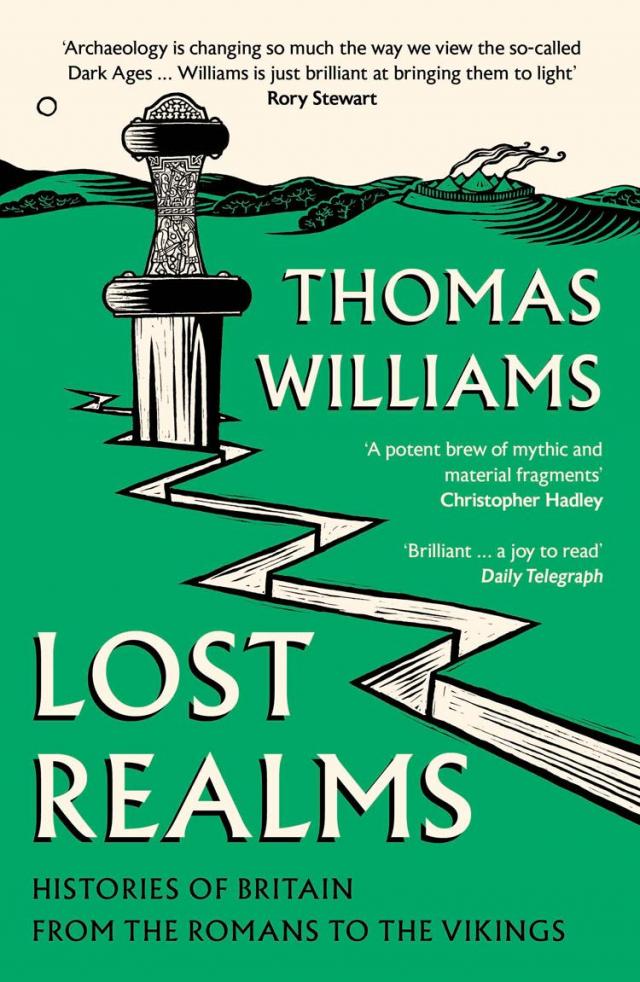
Cover illustration © Joe McLaren
Maps and illustrations by Martin Brown
Extracts from Farmer Giles of Ham by J.R.R. Tolkien (1949) reprinted with permission of HarperCollinsPublishers Ltd
Extracts from ‘Remains of Elmet’ by Ted Hughes reprinted with permission of Faber and Faber Ltd
Thomas Williams asserts the moral right to be identified as the author of this work
A catalogue record of this book is available from the British Library
Information on previously published material appears here
All rights reserved under International and Pan-American Copyright Conventions. By payment of the required fees, you have been granted the non-exclusive, non-transferable right to access and read the text of this e-book on-screen. No part of this text may be reproduced, transmitted, down-loaded, decompiled, reverse engineered, or stored in or introduced into any information storage and retrieval system, in any form or by any means, whether electronic or mechanical, now known or hereinafter invented, without the express written permission of HarperCollins.
Source ISBN: 9780008171988
Ebook Edition © August 2022 ISBN: 9780008171971
Version: 2023-08-03
Dedication
For my parents
+
MATER OPTIMA MAXIMA
PATER OPTIMVS MAXIMVS
Epigraphs
Since Brutus came to Britain many kings and realms have come and gone […] What with the love of petty independence on the one hand, and on the other the greed of kings for wider realms, the years were filled with swift alternations of war and peace, of mirth and woe, as historians of the reign of Arthur tell us: a time of unsettled frontiers, when men might rise or fall suddenly, and song-writers had abundant material and eager audiences.
J. R. R. Tolkien, Farmer Giles of Ham (1949)1
The natural vice of historians is to claim to know about the past. Nowhere is this claim more dangerous than when it is staked in Britain between 400 and 600. We can identify some events and movements: make a fair guess at others; try to imagine the whole as a picture in the fire […] But what really happened will never be known.
James Campbell, The Anglo-Saxons (1982)2
Where now the horse? Where now the men?
Where now the benefactor?
Where now the seat at the feast? Where the hall-joys?
Alas, bright beaker! Alas, burnished warrior!
Alas proud prince! How that time has gone,
dark under night’s helm, as if it had never been.
Anon., The Wanderer3
It is the middle of the Dark Ages – ages darker than anyone had ever expected.
Jabberwocky (1977)4
Contents
Cover
Title Page
Copyright
Dedication
Epigraphs
A JOURNEY IN THE DARK – Prologue
LITTLE KINGDOMS – Introduction
ELMET – West Yorkshire
HWICCE – Gloucestershire and Worcestershire
LINDSEY – North Lincolnshire
DUMNONIA – Devon and Cornwall
ESSEX – Essex and Middlesex
RHEGED – Cumbria, Dumfries and Galloway
POWYS – Montgomeryshire, Denbighshire, Flintshire, Cheshire, Shropshire
SUSSEX – East Sussex, West Sussex
FORTRIU – Nairnshire, Moray, Banffshire, Aberdeenshire
A Note on Terminology
Further Reading
Acknowledgements
Abbreviations Used in the Notes
Notes
Index
Also by Thomas Williams
About the Author
About the Publisher
A JOURNEY IN THE DARK
– Prologue –
Night is falling. Your land and mine goes down into a darkness now; and I, and all the other guardians of her flame, are driven from our homes, up out into the wolf’s jaw. But the flame still flickers in the fen. You are marked down to cherish that. Cherish the flame, till we can safely wake again.1
David Rudkin, Penda’s Fen (1974)
What happens when the rug is pulled, when all the certainties melt away and when what had yesterday felt permanent, unchanging, unchangeable, collapses at breakneck speed? And what comes after?
All ages of the past are dark because the past is a grave. It is a void that historians and archaeologists seek to fill with knowledge – with things made by long-dead hands and the ghosts of buildings long demolished, the uncanny traces of people and their lost lives, poignant in their mundanity: a used bowl, a broken glass, a clay pipe, a worn shoe, the pieces of a game scattered and abandoned. It whispers with the words captured on the skins of animals or fragments of birch bark and lines breathed by poets in fire-lit halls, frozen in ink, repeating again and again across the generations, as the bones of their authors crumble in the cold, dark earth. The more we find to fill that void, the better illuminated the past appears. It takes on three-dimensional form in standing buildings and tangible artefacts, detailed reconstructions of costume and paraphernalia. Film and television provide illusory glimpses of the irrecoverable; historical fiction and immersive histories promise time travel to places we feel we might inhabit – regardless of their many distortions and omissions. And, by and large, the further away a historical period sits relative to our own lives, the less vital and vibrant it feels – the colour footage turns to black and white and then to sepia, it freezes into still photography and then mutates into artist-mediated renderings of life: oil paintings, frescoes, manuscript illuminations, scratches on rock. Eventually it recedes altogether into darkness.
It has become fashionable in recent decades to argue that the trauma of the collapse of the Roman Empire has often been overstated, that for many people life changed little if at all, that the tales told of devastation, plague, poverty and violence were exaggerations, that the archaeological evidence for widespread and rapid civic collapse has been misinterpreted. Historians have always seen the past through the prism of their own age, in the shadow of recent memory, and the last period of relative peace experienced in the West has been remarkable for its overall stability and prosperity.* For those in Europe and North America who lived through the world wars and endured the omnipresent spectre of nuclear obliteration, however, the idea that civilizations could be annihilated, that human savagery was limitless and that the lives of individuals and of whole societies could be plunged into existential crisis in a matter of months (or even minutes) was not in doubt. For people in many other parts of the world, the proximity of trauma has seldom been out of sight. And for those who lived through the Middle Ages, death and misfortune were constant companions.
The events of the very recent past, however, have demonstrated with stunning brutality that in the blink of an eye the world can change for ever. What comes afterwards is always unknowable, but the actions and decisions of individuals and societies – sometimes spontaneous and sometimes after a prolonged period of anxiety and introspection – will set the stage for what will follow: nothing is inevitable about the path the world will take. The clarity with which that is felt in the third decade of the twenty-first century adds a complexion to this book that it did not possess at the outset; some chapters – those written later – perhaps reflect this more fully that those written earlier, though all are coloured by it to a certain degree. The kingdoms that emerged in Britain in the shadow cast by failing Empire were social experiments in responding to trauma, to the pulling of the rug, and this book is, in part, about how societies facing crisis can find very different paths through and out of it. What emerges more clearly than I had envisaged is the tension between forces that might be imperfectly described as conservative and progressive – between those who seek solace and security in the symbols and structures of the past and those who, for good or ill, see potential in the strange and the foreign, abandoning the solidity of stone walls and civilization for something as yet unmade, risking the eradication of older ways of being. Those paths may ultimately converge, but the pain of walking them leaves scars that never fully heal.
The term ‘Dark Ages’ – used vaguely for the period between the end of Roman Imperial government in Britain in c.400 and, normally, an ill-defined point between the years 600 and 800 – is widely disowned by most modern scholars. Objections are frequently raised that to single this period out as ‘dark’ is to downplay the accomplishments of the age and exoticize its mystery, while casting unwarranted shade on aspects of its social, cultural or economic history.† To me, however, the assumption that ‘darkness’ necessarily equates to ‘badness’ is lazy and a little ugly. And it is clear – in fact one of the only things that actually is clear about the period – that the most heavily Romanized parts of Britain underwent a socio-economic collapse of unusual suddenness and severity in the period when Roman rule in Britain was coming to an end. T hat this was accompanied by war and a long period of chronic instability is almost certain. For the people who lived through this and were affected by it, these must have been grim days indeed. The fact that other periods may have been more unpleasant (and therefore more deserving of the adjective ‘dark’) is neither here nor there – nobody wants to play ‘bad times’ poker (‘I’ll see your so-called Dark Ages and raise you a Black Death’).
In any case, I have always rather liked the mystery that the term ‘Dark Ages’ implies. Just as blank spaces on the map tug on the imagination of the explorer, so the darker spaces of history hold an allure that speaks to hidden facets of the human psyche. This, I think, is one of the reasons why early medieval history captured me as an undergraduate and has held me ever since. The struggle to understand the scattered and difficult sources, the possibility of genuine discovery in a world where nothing can be taken for granted, represent an endless quest where everything is on the table to be interpreted afresh and the deepest secrets still lie locked within the earth.
This book is for those who understand that the glimmer of gold in torchlight can be worth a thousand sun-drenched spires; it is a book that tells the stories of the most obscure kingdoms to have risen in Britain in the dim post-Roman dawn. Some of them died in near darkness, never to fully experience the wan light shed by the slow accumulation of historical record. Their brief lives can only be told from scraps of legend and ambiguous archaeological traces, and the writings of men who lived centuries after the history they recorded. Other realms lived long enough to experience the relative illumination of later centuries, falling into obscurity amid the tumults of the Viking Age. In all of them, however, the surviving traces of life can be related to fragments of history, the archaeology brought into a relationship with a people and the stories they told. The halls of farmer-lords can still be found as ghost marks in the earth, patches of dark soil where curling ribbons of smoke once climbed the great pillars to the roof beams they shouldered; the hill-forts of warlords and sea-lords and kings of the trade winds yet cling to the peaks of rocky outcrop and mountain fastness. The grave-fields and barrow-mounds still hold their bodies just as weathered grey stone and brittle yellow parchment bear their names – tying the landscape back to a past where lives were lived with as much vigour and joy as in any other age, where people fought and loved and toiled and suffered grief and disappointment just as cutting as our own.
Out there amid heath and hedgerow the tombs of unknown kings lie forgotten beneath stands of ash and birch – the graves of heroes whose names once rang beside hall-fires, whose horns once echoed in the hills; swords rusted, gold torn by the plough, treasure scattered over fields. Bones are dislodged from resting places, gnawed by foxes, badgers, rats; tossed and broken by grey roots questing among the dead.
And still the lords of the lost realms slumber on.‡
* This chapter was written in 2020, well before Vladimir Putin visited sweeping horror on the eastern marches of Europe. War in the Balkans in the 1990s notwithstanding, the war in Ukraine – with its origins in 2014 and its obscene flowering in 2022 – has raised a fresh phalanx of morbid visions to stalk the Western imagination.
† In 2016, the adoption of the term ‘Dark Ages’ by English Heritage for the whole of the period between 410 and 1066 sparked a furious backlash from academic historians and archaeologists. Despite some notable dissenters, the orthodox view – and one which seems now to have been adopted by English Heritage (at least online) – is that the terms ‘early medieval’ and ‘early Middle Ages’ are adequate to describe the 650 years or so prior to the Norman Conquest. There is no need, the argument runs, to insult the public intelligence by supposing that people are incapable of differentiating the ‘early’ from the ‘late’ medieval period. That, I suppose, is fair enough (though the supposed simplicity of this argument is undermined a little by the fact that medieval historians frequently distinguish the ‘Late Middle Ages’ – the period between c.1300 and c.1500 – from the ‘High’ or ‘Central’ Middle Ages – the period between c.1000 and c.1300).
‡ Parts of this prologue, in rather different form, appeared previously in an article for BBC History Magazine (March 2020).
LITTLE KINGDOMS
– Introduction –
The face of the land has changed since that time, and kingdoms have come and gone; woods have fallen, and rivers have shifted, and only the hills remain, and they are worn by the rain and the wind.
J. R. R. Tolkien, Farmer Giles of Ham (1949)1
In 1949, Allen & Unwin published a short book by Professor J. R. R. Tolkien titled Farmer Giles of Ham. It was, at surface level, a children’s story, and its genesis was in a tale of the 1930s devised for Tolkien’s own children. But it was also a story packed with knowing asides and philological in-jokes, a pseudo-medieval legend that lightly satirized the work of Anglo-Norman writers like Geoffrey of Monmouth (whose Historia Regum Britanniae – the ‘History of the Kings of Britain’ – of 1135, stuffed with tall tales and ripping yarns, laid the groundwork for the great medieval boom in Arthurian literature).2 Unlike Tolkien’s other works of fiction – the juggernauts of fantasy literature that ensured his lasting reputation – Farmer Giles was not set in Middle Earth.* Instead it was set in a place that Tolkien called the Little Kingdom, a place he situated with great specificity in Oxfordshire and Buckinghamshire.3
The contours of the Little Kingdom were intimately familiar to Tolkien. All of the locations mentioned in Farmer Giles and its abandoned sequel – Ham (Thame), Worminghall, Oxenford (Oxford), Oakley, Farthingho(e), Islip, Otmoor – are real places in the vicinity of Oxford where the Tolkien family lived. In hair-raising journeys of the 1930s, the Professor would propel his wife and children through the landscapes of the Little Kingdom in a Morris Cowley, blundering into dry stone walls and ploughing across lanes of Oxford traffic with the resounding battle cry of ‘Charge ’em and they scatter!’4 These were also the places that studded and described a landscape in which Farmer Giles (‘Ægidius Ahenobarbus Julius Agricola de Hammo’ to use his proper name) was deeply rooted; they surrounded and defined the fields where he kept his sheep and raised his crops, where he pastured his ill-fated cow Galathea; they joined the paths where he walked Garm (his dog) and took his goods to market, a countryside threatened by the depredations of giant and dragon.
Tolkien’s Little Kingdom, as drawn by Pauline Baynes.
In contrast to the book’s concrete geographical setting, Tolkien insisted that Farmer Giles was set in a ‘no-time’ – that it was a fantasy of the past: a real place that existed in an imaginary epoch.5 His antiquarian instincts, however, evidently compelled him to place the story in a vague – but carefully chosen – time frame. In his Foreword, Tolkien indicated that the Little Kingdom thrived ‘after the days of King Coel maybe, but before Arthur or the Seven Kingdoms of the English’, i.e. between the fourth and seventh centuries.†6 This places the story firmly in the ‘Dark Ages’ – albeit a wilfully anachronistic Dark Age resplendent, like the legends of Arthur and the Knights of the Round Table, in the chivalric colour of the medieval world (and crucially augmented by a blunderbuss). And what Tolkien also knew, and what his story hints at, is that the land occupied by the Little Kingdom had – in those ‘years […] filled with swift alternations of war and peace, of mirth and woe, as historians of the reign of Arthur tell us’ – been home to a people whose lives and stories were real, vital and utterly obscure.
If ever an age could be rightly described as ‘dark’ it would be the two centuries that followed the collapse of Roman authority in Britain at the beginning of the fifth century. To those who study late antiquity and the beginning of the early Middle Ages, the period between c.400 and c.600 is a time when not only historical narrative fails, but also the ability to interpret with conviction the archaeological remains. Fundamental questions about the end of Roman governance, the nature and scale of migration into Britain, the origins of kingdoms, the continuity of Christian belief and organization, even the fate and whereabouts of the Romano-British population remain largely unanswerable.