

The immortality thief, p.1
The Immortality Thief, page 1


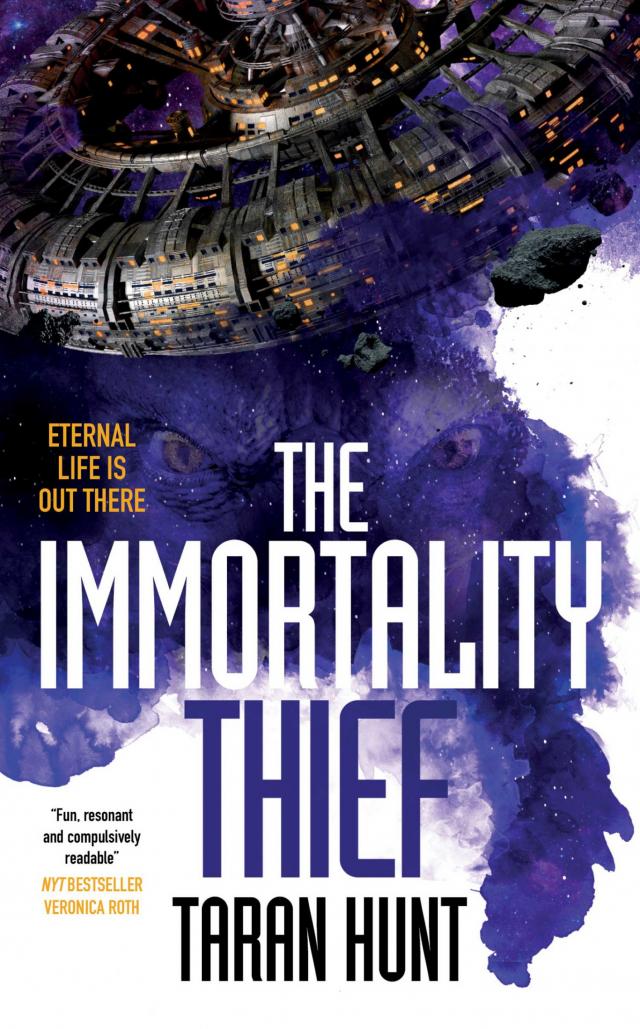
THE
IMMORTALITY
THIEF
Taran Hunt
First published 2022 by Solaris
an imprint of Rebellion Publishing Ltd,
Riverside House, Osney Mead,
Oxford, OX2 0ES, UK
www.solarisbooks.com
ISBN: 978-1-78618-514-3
Copyright © 2022 Taran Hunt
The right of the author to be identified as the author of this work has been asserted in accordance with the Copyright, Designs and Patents Act 1988.
All rights reserved. No part of this publication may be reproduced, stored in a retrieval system, or transmitted, in any form or by any means, electronic, mechanical, photocopying, recording or otherwise, without the prior permission of the copyright owners.
This is a work of fiction. All the characters and events portrayed in this book are fictional, and any resemblance to real people or incidents is purely coincidental.
A CIP catalogue record for this book is available from the British Library.
eBook production
by Oxford eBooks Ltd.
www.oxford-ebooks.com
Contents
Chapter 1
Chapter 2
Chapter 3
Chapter 4
Chapter 5
Chapter 6
Chapter 7
Chapter 8
Chapter 9
Chapter 10
Chapter 11
Chapter 12
Chapter 13
Chapter 14
Chapter 15
Chapter 16
Chapter 17
Chapter 18
Chapter 19
Chapter 20
Chapter 21
Chapter 22
Chapter 23
Chapter 24
Chapter 25
Chapter 26
Chapter 27
Chapter 28
Chapter 29
Chapter 30
Chapter 31
Chapter 32
Chapter 33
Chapter 34
Chapter 35
Chapter 36
Chapter 37
Chapter 38
Chapter 39
Chapter 40
Chapter 41
Chapter 42
Chapter 43
Chapter 44
Chapter 45
Chapter 46
Chapter 47
Chapter 48
Chapter 49
Chapter 50
Chapter 51
Chapter 52
Chapter 53
Chapter 54
Chapter 55
Chapter 56
Chapter 57
Chapter 58
Chapter 59
Chapter 60
Chapter 61
Chapter 62
Chapter 63
Chapter 64
Chapter 65
Chapter 66
Chapter 67
Chapter 68
Chapter 69
Chapter 70
Chapter 71
Chapter 72
Chapter 73
Chapter 74
Chapter 75
Chapter 76
Chapter 77
Chapter 78
Chapter 79
Chapter 80
Chapter 81
Chapter 82
Chapter 83
Chapter 84
Chapter 85
Chapter 86
Chapter 87
Chapter 88
Acknowledgements
CHAPTER ONE:
The Nameless Ship and the Dying Star
The nothing-place between leaving and arriving during faster-than-light travel isn’t really Hell. Hell is the absence of God, or the absence of other people, or something like that. FTL engines just… I don’t know, grabbed space and yanked it forward, rippling like a bedsheet tugged out of place, and our ship caught up in the folds.
But it sure as Hell felt like Hell. In the moment between the kick to faster-than-light speeds, and before the drop out, space narrowed. In the pilot’s cradle, alone, I blinked away afterimages from the brilliant flash that preceded hyperspeed, like the universe warning me STOP in the seconds before I broke the speed limit. When I blinked those ghosts away, there was nothing through the window except black.
Not for the first time, I wished Benny had chosen a ship with a little more elbow room for the pilot. There was no space in the cockpit for anyone except me. I couldn’t see the others; couldn’t even turn around to look, because then I might miss the drop-out point; I couldn’t call out to them or talk, because then I might lose my concentration, and overshoot our stop.
They weren’t saying anything, either. Like I was alone on this ship. What had I said Hell was, again? Absence?
Nothing except darkness outside the front window. Nothing to see, no walls, no floor, no ceiling. But I could feel it, the space narrowing in on me like the sod walls of some grave, claustrophobia choking me. I was alone—
The drop-out point. I switched engines and space widened out the window, blooming bright and brilliant. I controlled our drop-out, swinging around, adjusting artificial gravity, and when our speed had slowed enough that light had caught up to us, I looked out that cockpit window and saw a marvel.
We had come out not far from the salvage ship, because I was an amazing pilot whose skills were only matched by his good looks and also I’d received very precise coordinates for this salvage. The salvage ship’s ancient, pitted metal revolved before us with slow majesty in the blazing firelight of the bloated nearby star.
A star that was verging on supernova.
It was a shame I was the only one who could see it, due to the aforementioned cramped conditions. I let out my breath and said, “That spaceship really doesn’t have a name?”
Nothing but the creaking of stabilizing straps answered me. I craned my head back until I could see the other three in the little room, Benny with his eyes shut and head tipped back against the wall, Quint with her little hands gone white around her stabilizing strap, and Leah with legs braced and gun disassembled, cleaning the pieces on the bench between her thighs.
“Hey,” I said, “what’s the ship’s name?”
“It doesn’t have one,” Quint said.
“Really?” I turned back to look back out the front window; it was time to accelerate the Viper to match the salvage ship’s revolution so that we wouldn’t crash into spinning metal and be shredded like cheese on a grater. “It must have had a name once. Everything important has a name.”
The Viper jolted and, yeah, I’d changed our theta direction a little too fast, but flying a ship was like speaking a foreign language. There were all these strict rules to follow to get the grammar right, but so long as you had the gist of it intact, you could make it up on the fly and be pretty well understood.
“I knew a girl who adopted a rock once,” I said. “She drew little eyes on it. Do you know what she named it?”
“What did she name it?” Leah asked, her tone anticipating the punchline like a mortar shell.
“Roxanne.”
“Would you please shut up about names and pay attention to landing the ship?” Quint said.
Making contact with a salvage ship was the most dangerous part of getting salvage—if I was going a little too slow, or a little too fast, we wouldn’t latch: we’d bounce, and bounciness in space wasn’t the harmless fun it was in a gravity well. In space, it tended to cause hull fractures, atmospheric loss, and inevitably death. I guessed that was why Quint was so nervous. She shouldn’t have been: this wasn’t like the FTL tunnel. I was flying, so I had control. And I was good at what I did.
I extended the Viper’s gripping arms, opening like a claw as we approached the nameless vessel. All I could see out of my window now was a long horizon of scarred hull, thinned and pitted by a thousand years’ sunlight and debris so that, in places, I could see straight through to the struts and bones. An old and mighty thing. It had been abandoned for a thousand years; no one alive might remember, but this ship must have had a name.
“I’m going to call it the Nameless,” I decided.
“Call it what it is?” Leah asked.
The Viper was close enough now. With a quick command typed into the screen, I closed the gripping arms. They slammed shut, impacts reverberating through the ship as they connected. Success.
“That’s what names are,” I said, while I ran the program that would heat up the connection and open the far side ship’s airlock. “Or what they were, anyway. We—humans, I mean—use a specific set of words as names and names only, taken from the old language. Like Benny or Quint or Leah or Sean.” We could just punch through the Nameless’s hull with the Viper’s docking chute, but when there was an airlock in existence, it was easier to use it. “But originally, names were just descriptions, like Pretty, or Willow, or—”
“Sean,” Benny said, “shut up.”
The Viper was no longer rocking about. I shut its engines off. When I turned around, I found the three of them were gathering up their things, heading for the circular aperture in the ceiling that led to the primary airlock. Benny already stood beneath it, tapping something into the wall computer, handbrace glinting. Benny was an inventor. Necessity was the mother of invention and all that, and he and I had grown up in exile from an occupied homeworld, without supplies or the money to buy anything, so he’d learned the skills to make ev erything. His one-of-a-kind handbrace was one of his inventions—it contained a small-caliber, single-shot projectile weapon to be used as a last-ditch self-defense.
“Air at close to atmospheric pressure, sufficient oxygen, safe temperature range,” Benny read. “We won’t need the suits.”
He pressed a button, and I heard the airlock aperture hiss open. The air of the two ships began to mix, the breath of the Nameless disturbed for the first time in a thousand years. Then Benny, my oldest friend, the closest thing I had to family, and the last of my hometown left alive, stepped onto the ladder in the wall. His heels vanished as he climbed up and out.
Quint was next up the ladder, but she took a long time about it, her face pale as she stared up into the darkness of the other ship. Sympathy panged through me at the sight of her silent fear. Of all of us, I should feel sorry for her the least. But I knew what it was like to be frightened and alone.
“It probably won’t bite,” I reassured her. “In my experience, spaceships don’t. Not usually.”
Quint gave me a look like she thought maybe the factory had assembled me wrong, and climbed up after Benny.
“How the hell did someone like you end up here with us, anyway?” Leah asked me, but not in a way that cared. She followed Quint up and out.
That left me alone. The Viper was coffin-quiet, like it had been abandoned as surely as the Nameless had. I hurried after the others.
Frost limned the rungs of the ladder where they joined at the seam of the Nameless’s hull, exposed to the vacuum for hundreds of years and cooled almost to absolute zero before the Viper had come along and heated it up by a couple hundred degrees Kelvin. I climbed through the cold and emerged out of the floor and into dim red light. One wall of the room was a floor-to-ceiling window—or it had been, before age and decay had filmed the window over. The result was a semi-opaque piece of plastic through which nothing could be seen except the diffuse firelight of the dying star that the Nameless orbited.
That was the only light in the room. The Nameless’s computers might be—partly—functional, but the lights had burned out long, long ago. The room itself was long and hushed and dark and empty, like the antechamber to a tomb. The walls were splotched and crumbling, decay creeping dust through the flaws in their build. I coughed.
“Remember,” Quint said loudly as I emerged, “we have only a week before the sun goes nova, and we have to search this whole ship first. Our boss will let you take whatever you find on the way, but we have to find the data.”
Or else consequences, terrible consequences, fatal consequences, etc. We knew the score, Quint. I ignored her, scanning the room for anything useful, and my flashlight beam fell upon something carved into the far wall.
I hurried to the wall and fell to my knees, running my fingers over the uneven, ancient scratchings in the metal. I knew that they were letters, though they were not written in the script that I had learned as a child, nor was it written in any of the languages anyone spoke now—not my native tongue, Kystrene, or the Sister Standard that was the only language I regularly spoke anymore. This language was gone, dead, had been dead for a thousand years: Ameng. Real Ameng, right here in front of me.
I trailed my fingers over the letters, carved here a thousand years ago by someone whose dust I was probably now breathing in. A message undisturbed for a millennium until I’d come along, like it had been left specifically for me. I felt out the letters, pieced together the words.
IT IS TRUE
Something scraped to my right, probably Benny or Leah, trying to pry salvageable metal out of the decay. I bent closer to the wall and those long-forgotten letters.
WE SHALL BE MONSTERS
That scraping sound grew louder.
CUT OFF FROM ALL THE WORLD
A piece of the wall fell off beside me, clanging like a cymbal as it hit the floor. The floor hit my palms hard as I fell backwards, recoiling from the clamor.
Dirty fingers reached out from within the wall, curling around the edge. The nails were cracked and yellow. A head of thick, dark hair emerged, the locks trailing over shoulders and down the side of the wall.
The creature from inside the ship flipped out onto the floor and rose to her feet, shaking wild hair out of her face. It was a woman, the bones of her face standing out sharply, pale brown eyes large in her hungry face.
All movement in the room ceased. We stared at her as she stared at us, with just as much surprise.
Then she dropped her head back and screamed.
CHAPTER TWO:
Three Convicts and a Generous Opportunity
Let me be clear: that ship should have been empty. If that hadn’t been the case, we would’ve never been sent there.
A week before a ghost-woman screamed at me on an abandoned spacecraft, some men in suits arrived near midnight to take me from my cell. I didn’t think the Republican authorities on the planet Parnasse were prone to ‘disappearing’ illegal refugees who were accidental thieves and repentant almost-murderers, but it wasn’t totally outside the bounds of possibility. Still, I’ve spent a lot of my life being hauled around by authority figures, so I’ve learned when kicking up a fuss won’t do me any good. I followed them onto some cargo elevator that stopped between floors and emptied out into a hallway without cameras. This was the most interesting thing that had happened since the take-down a week ago, which had been full of police officers shouting orders in Sister Standard so tersely and with such heavy Republican accents that I’d almost had trouble understanding them. The guns pointed at my head and Benny’s had made their meaning clear enough, in the end.
“Where’s Benny?” I asked as we started down the hallway. I got no response.
Maybe they couldn’t speak, or couldn’t understand. I tried my question in Kystrene, and Illenich, and Patrene, and once in what I was pretty sure was the local dialect of sign language, but they gave no sign of understanding, which meant they were probably just ignoring me. Fine, I was used to being ignored. Only a handful of Kystrene had escaped the subjugation of our homeworld, and promptly been absorbed by a Republic that preferred pretending nothing had ever happened to facing the fact that they’d abandoned our planet to its fate. Averted eyes and shut doors were commonplace; a little feigned blindness wasn’t about to stop me.
My escorts paused in front of a closed door. It was a perfectly ordinary door, like every other door in the camera-less hallway, but I had some reservations about opening it.
“Did you know there are dialects of sign language?” I asked my escorts, staring at the handle for that door. “There’s a standardized version, thanks to the Ministers, but it varies by region anyway. Visual languages follow the same rules as spoken ones—”
One of my escorts turned the handle, opened the door, and shoved me inside. I stumbled into a well-appointed room. And standing in the corner was—
“Benny.”
He toyed with the standard hospital-issue hand brace that had replaced his weaponized homemade one, but when he heard my voice he looked up and his lips went thin. Such a look. It stopped me like a brick wall.
There were two other people in the finely-appointed room with us, both strangers to me. The woman sitting backwards on one of the fine leather chairs was wearing the same rough prison clothing as me and Benny. She looked like a dirty knife thrown in with the silver. I liked her immediately. Later, I would learn that her name was Leah.
The other woman was skinny, with a short, fussy haircut. She stood behind a polished wooden desk, beneath blacked-out windows, arms crossed over her narrow chest so that her tailored jacket buckled under the arms. Her name, as I would learn, was Quint.
The three of them had arranged themselves according to the fundamental law of mob bosses meeting for a parlay: each of them with their back to a different wall. Thoughtfully, they’d left the fourth wall—the one with the door— open for me.
There was a chair in front of Quint’s desk, near the dead center of the room. I shuffled over to that chair and sat down on its generous leather cushions.
Quint eyed me down the line of her narrow nose, then said, “The three of you have committed very serious crimes. Murder,” and for a heart-stopping moment I thought that meant the boy had died, but she nodded at Leah when she said it, “or attempted murder of a very important personage,” and this time she glanced at Benny and me.
So I wasn’t a murderer. Not now, not ever. I exhaled relief and glanced at Benny, only to find he wasn’t looking at me.






