

Nothing will be differen.., p.1
Nothing Will Be Different, page 1


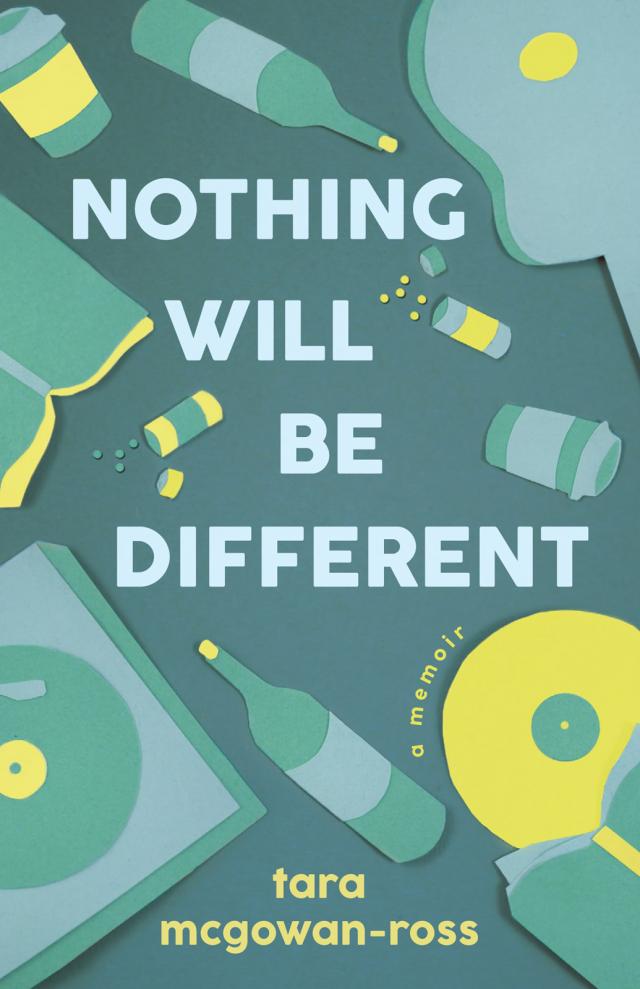
NOTHING WILL BE DIFFERENT
NOTHING WILL BE DIFFERENT
a memoir
tara mcgowan-ross
Copyright © Tara McGowan-Ross, 2021
All rights reserved. No part of this publication may be reproduced, stored in a retrieval system, or transmitted in any form or by any means, electronic, mechanical, photocopying, recording, or otherwise (except for brief passages for purpose of review) without the prior permission of Dundurn Press. Permission to photocopy should be requested from Access Copyright.
Publisher: Scott Fraser | Acquiring editor: Julie
Mannell Cover design and illustration: Laura Boyle
Printer: Marquis Book Printing Inc.
Library and Archives Canada Cataloguing in Publication
Title: Nothing will be different : a memoir / Tara McGowan-Ross.
Names: McGowan-Ross, Tara, 1992- author.
Description: Canadiana (print) 2021025811X | Canadiana (ebook) 20210259744 | ISBN 9781459748736 (softcover) | ISBN 9781459748743 (PDF) | ISBN 9781459748750 (EPUB)
Subjects: LCSH: McGowan-Ross, Tara, 1992- | LCSH: Indigenous women—Canada—Biography. | LCSH: Indigenous authors—Canada—Biography. | LCGFT: Autobiographies.
Classification: LCC PS8625.G695 Z46 2021 | DDC C811/.6—dc23
We acknowledge the support of the Canada Council for the Arts and the Ontario Arts Council for our publishing program. We also acknowledge the financial support of the Government of Ontario, through the Ontario Book Publishing Tax Credit and Ontario Creates, and the Government of Canada.
Care has been taken to trace the ownership of copyright material used in this book. The author and the publisher welcome any information enabling them to rectify any references or credits in subsequent editions.
The publisher is not responsible for websites or their content unless they are owned by the publisher.
Rare Machines, an imprint of Dundurn Press
1382 Queen Street East
Toronto, Ontario, Canada M4L 1C9
dundurn.com, @dundurnpress
for Megan & Alaska
This time everyone has the best intentions. You have cancer. Let’s say you have cancer. Let’s say you’ve swallowed a bad thing and now it’s got its hands inside you. This is the essence of love and failure.
— Richard Siken, You Are Jeff
I thought I had mono once for an entire year.
Turned out I was just really bored.
— Wayne Campbell, Wayne’s World
Contents
“Them Changes” by Thundercat.
“The King of Carrot Flowers, Pt. 1” by Neutral Milk Hotel.
“Bury My Heart at Wounded Knee” by Buffy Sainte-Marie.
“Train in Vain (Stand by Me)” by the Clash.
“If Love Is a Red Dress (Hang Me in Rags)” by Maria McKee.
“The Ruins” by Max Steiner.
“Enough to Be on Your Way” by James Taylor.
“Do They Owe Us a Living?” by Crass.
“A Box Full of Sharp Objects” by the Used.
“Un Canadien Errant” by Antoine Gérin-Lajoie.
“Pagan Poetry” by Björk.
“Blessings” by Chance the Rapper (feat. Jamila Woods).
“Miss World” by Hole.
“Love in the Time of Human Papillomavirus” by AJJ.
“Genesis” by Grimes.
“I Want You Back” by the Jackson 5.
“Die Young” by Sylvan Esso.
“Somebody up There Likes Me” by David Bowie.
“Sympathetic Character” by Alanis Morissette.
“The Best Ever Death Metal Band in Denton” by the Mountain Goats.
“The Modern Leper” by Frightened Rabbit.
“Some Unholy War” by Amy Winehouse.
“Not the Same” by Ben Folds.
“Always Be My Baby” by Mariah Carey.
“Melodies from Heaven” by Kirk Franklin.
“We Belong Together” by Rickie Lee Jones.
“Anywhere I Lay My Head” by Tom Waits.
“The King of Carrot Flowers, Pts. 2 & 3” by Neutral Milk Hotel.
“A Case of You” by Joni Mitchell.
“Dress Sexy at My Funeral” by Smog.
“Because Dreaming Costs Money, My Dear” by Mitski.
“Me & My Dog” by boygenius.
“What I Am” by Edie Brickell and New Bohemians.
Acknowledgements
About the Author
“Them Changes” by Thundercat.
August 2019. Montreal.
Eve was explaining the way the Pap test works, in a lot of detail. I was loving it. I was wondering if Ben told her I was a nerd or if she did this for everyone.
Ben was my doctor. A thin, almost gremlinish man, he was not tall but was very long — long fingers, a long and perpetually craned neck. He had a bald spot, but also very pretty dark curls. He also had extremely large, kind eyes and a very impressive bedside manner, for a doctor.
I am not a doctor hater. I admire and respect doctors. I just think that in order to get through med school you either need to be a megalomaniac or a weird nerd, which is why visits with doctors are often so uncomfortable. Ben had never made me uncomfortable. One time, I asked him to prescribe me weed (before it was legal), and he said no, and I cried — but not because he was mean, just because I admire and respect doctors, and being told no by people I admire and respect makes me embarrassed. When I’m embarrassed I cry. So, that was really not his fault. Weed was also legalized quickly thereafter. You’re not my dad, Ben.
I had recently asked Ben for a Pap test. He said that he thought it would be better if Eve did it. Eve was the nurse practitioner at his office, he explained. She was a woman and well-trained. While this would have made sense if I had ever indicated that I was uncomfortable, in any way, with a male doctor performing routine medical procedures on me, I had not — and this change of plans made me feel rejected. Why didn’t Ben want to look at my cervix? I booked an appointment with Eve, feeling both the sting of the repudiation and extreme embarrassment about how affected I was by the whole thing. Were Ben and I not at that point? The cervix point? Why did I care? I made a mental note to talk to my therapist about it, while I changed the subject by showing Ben a new mole that had recently appeared on my knee.
So there I was, with my skirt up around my hips, squatting off the end of the table so that Eve could scrape my cervix. Eve had drawn the navy-blue curtains shut around the examination table, even though we were in a closed room, which was a classy touch. Everything in Eve’s office was shades of dark blue, except for her triumphant diplomas, of which there were many. The diplomas were in big, beautiful mahogany frames. Eve’s office was neater and better decorated than Ben’s examination rooms. Eve’s clothes were nicer than Ben’s clothes. Eve was extremely helpful. Eve had an even better bedside manner than Ben.
I was less impressed by her good bedside manner, probably because she was a woman and because she’s a nurse. As she cranked my vagina open with a plastic speculum, I thought, judgmentally, that nurses had to have better bedside manners because they dealt more directly with patients. As she inserted a long swab into my vaginal canal and started to scrape my cervix, I decided that wasn’t fair, and who was I to undervalue this person’s labour? She makes less money than a doctor, after all, and was she not at least as skilled? I applauded myself, silently, for catching my critical rhetorical error as Eve deposited my cervical mucus onto a piece of glass. My leg started to cramp from holding myself half-suspended off of an examination table. As a society, we have a problem with systematically undervaluing the work of women, I thought. I have to work on my internalized misogyny. I was genuinely proud of myself for thinking these things. I miss Ben.
“All done!” said Eve.
“Oh, really?” I said, pulling my skirt down and heaving my rear end back onto the table. “So fast.”
When my underwear was back on, I asked her for a breast exam. I told her I felt myself up often, which was true, and that I had noticed a few small lumps in my left breast, and I wasn’t sure what was normal to be there and what wasn’t. I’d never had a breast exam before. She explained that my lack of breast exams were a normal result of my youth, and that most lumps were benign, and that she’d be happy to take a look. I took off my shirt and she very gently — maddeningly gently — pressed into the flesh of my breasts and lymph nodes in my armpits. I wasn’t sure if she’d ever examined a big person before. That’s just skin and a bit of fat, girl, I wanted to say, but I didn’t. She was going to have to really get in there if she was going to feel anything.
I had to really get in there, to feel it. I’d found it first when I was lying on my back, on my mattress on the floor, probably watching television. I’d been working my fingertips into the plethora of tiny aches and pains all over my body — a mass of tight tissue in my left quadricep, the tension in the soft parts between my iliac crest and the pillowy expanse of my stomach. I had moved up to my head, and worked down again: my fingers on my sinuses, trying to push the liquid out — to somewhere, I didn’t know where. My fingers making cold, shivering indentations when they found the tightness in my trapezius or the guitar string rigidity of my levator scapulae. On my chest, my hands moved the fat and breast tissue out of the way to uncover my constantly rigid pectoral muscles. That’s when they found something. It was an accident. I was on my way to do something else. I only found one, at first: it was a little bit swollen, an gry. Searching around more, I found another one in the corresponding armpit.
“Hm,” I said, on the bed. I wasn’t scared. There was no reason to be, yet. I made an appointment with Ben.
Now, Eve was doing the same thing, but while she had an embodied understanding of my breasts and the role they played in my life — unlike Ben, I guess, fine — she was exploring with altogether too much care: she didn’t want to go looking, lest she burst a blood vessel or trip a nerve. We had just met. She didn’t know how I would react.
“I don’t feel anything abnormal,” she told me, cheerfully. I told her that I usually couldn’t, either, unless I was lying down with my arm up. I adjusted my arm position, and took her smaller hand in my bigger one. I guided her hand to where the lump was. Under my left nipple, just off to the left side.
She was very close to it, but she hadn’t found it yet. I knew, from her examination pattern — one press directly in before cocking her hand to one side and then the other — that she would find it soon. Pinching a little, pressing up, assessing. “Nothing here,” she said, but she was about to find it. I waited. Her hand touched it. “Yeah, a bit of firmness but no —” Her hand moved, but the lump did not. She got a different angle, tried again, and it was still there. She stopped moving. Her fingers had traced over the lump — found its edges, its borders. The lump was sliding around under her fingers. As the lump shifted, it turned my stomach. It didn’t hurt, but the whole makeup of my breast moved as it did. There was a nervous, uneasy feeling that spread down the left side of my body. She ran her fingers over it a few times, confirming. She was thorough. “Okay,” she said, finally. “Okay, yes.”
Emboldened by evidence, she made a perimeter sweep of the immediate area. She found more, hiding: smaller lumps. Multitudinous. Ones I did not find. I felt myself start to sweat — sour, vinegar sweat. She had found a small colony of firm, round things. One was cherry-sized, and the others peas. Like a planet and two soft moons.
“There are a few things here.”
Dread arrives as sensation in your body and it is cold. Dread fills your stomach like a vase is filled with water. The coldness has a voice, and it’s calm. It’s certain. It has something to say to you from somewhere primordial, intuitive, and all-knowing. It says something is wrong with you.
“Okay.” She stopped moving her hand, and then removed it completely. “You can get dressed.”
Children who grow up in unstable environments are often better accustomed to chaos than they are to any kind of calm. There is a sick sort of pleasure I get from being approached with another person’s serious problem; this pleasure, which is also relief, is multi-faceted. First, I no longer have to focus on whatever boring thing I was previously attempting to slog through in my own life. The misery of those I love is a perfectly good excuse to slack off. Furthermore, it actually leaves me with a situation in which I can argue that to not slack off would be morally wrong. Homework, housecleaning, whatever I actually have to do at work? All that trash be damned! Somebody needs me! This is part of what I have come to understand as a saviour complex.
Children take things for granted. Whatever is demonstrated as normal they will internalize as normal. This is why it actually doesn’t matter if they have two moms, or a single dad, or a two-bedroom apartment, or a summer house, or whatever: If the adults in their life pass it off as normal, then it is. If the adults in their life pass off functional, communicative relationships as normal, a child will come to expect that as the norm. The same goes for martyrdom, overwork, charity, and hatred.
My parents tried very hard to provide me with a happy childhood so that I would internalize being happy as normal. Unfortunately for them, they were organic human animals and made of meat. When I was seven, my mother got the news that her meat was rotting. She was in the last year of her thirties. Being in your thirties seemed old when I was a child, because it was the age that my parents were. Now that my own thirties are very close, I understand what everyone was saying at the time. Too young. A baby. Too young to die.
My mother’s prognosis was extremely poor from the moment her cancer was discovered. She did not die immediately. In a way, this is a kind of mercy. There is a qualitative difference, in my mind, between a death from a non-communicable, wasting disease and a sudden accidental death. It’s not like my mother was perfectly healthy one second and then flattened by machinery the next. Perhaps most mercifully, her death was nobody’s fault. I never had to do the work of negotiating whether I felt ready to forgive a drunk driver, a murderer, or an inattentive air traffic controller. There are some things you can do to cut the risk down: quit smoking, wear sunscreen. Do not vacation at the sites of recent nuclear meltdowns. None of these things are guaranteed. People get cancer and die. People have always gotten cancer and died.
When I was living in rural Ontario and going to high school, one of my best friends was Annie, who is an oncology nurse now. She says that miraculous recoveries are a part of life in the cancer ward, but they never happen to the people whose church groups come in and pray in a circle. They don’t happen to the people who seem to deserve or expect it. They happen with a kind of absurd randomness that seems orchestrated: to the homeless man who only got off heroin for the experimental chemo treatment, who has no family and very little community, who genuinely did not expect to live and has no plans and very few prospects. Miraculous recoveries happen very rarely to the people who will leave the ward miraculously cured, stare up at the sky, and say, Dude, what the fuck, to the deaf ears of God.
Cancer isn’t responsible: it doesn’t care how morally pure or kind or hard-working or well-supported you are. It’s just a thing that happens to people, and then those people die.
I begged God on my knees to get to keep my mother just a little while longer so much and so often and so loudly and with such a fervour that if anyone was listening, somebody would have answered. I was a good little girl and I deserved to get the few things I asked for. What I got instead was the understanding that God does not listen to little girls. Children normalize what is demonstrated as normal.
I had a child’s naive hope that my mother would pull through the entire time, and in this way I understood the situation to be serious, and in this way I got to brace for her death, which is a kind of mercy. My father did a good job of making it clear that her survival was a very slim possibility. I held out hope, anyway. This remains my superpower: calculating the worst-case scenarios, accepting them, hoping for the best in spite of it all. Natalie Wynn, YouTube philosopher, highlights a cognitive distortion she calls masochistic epistemology: whatever hurts the most is true. It is a common affliction among the pseudo-intellectual: the assumption that the outcome that hurts your feelings the most must be the right one, not because of overwhelmingly convincing evidence in its favour or a lack of evidence against it, but simply because it hurts your feelings. The worst-case scenario is usually less likely than the whole range of other scenarios that are not as bad. That’s just math.
As I left Eve’s office, the forms for diagnostic imaging in my sweaty and shaky hands, I made a pretty profound realization. I’m good in a crisis, but I guess I’m only really good in the crises of others. In this one — not yet even confirmed crisis, requiring more evidence, not really worth panicking over, if you think about it — I was going to lose my fucking shit.
I reacted in a more collected way to the news my mother was dead than I did to the news that I had a very common breast abnormality that, in combination with my family history, made diagnostic imaging a good idea. I do not know if that means I was more emotionally mature at twenty-seven than I was when I was nine, or less so. I had two and a half years to brace for my mother’s death, which was a mercy. When I met my current boyfriend, Sandy, he was still grieving: his friend Rosemary had died suddenly a few years earlier from a brain aneurysm. Nobody’s fault. Nothing anyone could have done. She didn’t hit her head, she didn’t have any symptoms before. It was just one of those Judas-body, random malfunction things. She was twenty-seven.
I never met Rosemary, but I think about her all the time. My mother died and it was very sad, and it changed me forever. But was it a tragedy, necessarily? The way a Greek tale of hubris or betrayal is a tragedy? Is Rosemary’s death a tragedy, or was it just horrible? Is there a lesson to be learned? Any kind of takeaway, other than some platitude about the fundamental impermanence and ultimate fragility of life on earth? Usually, when I think about Rosemary, the only conclusion that I reach is that a brain aneurysm is a crazy, scary, stupid way to die.






