

1812, p.1
1812, page 1
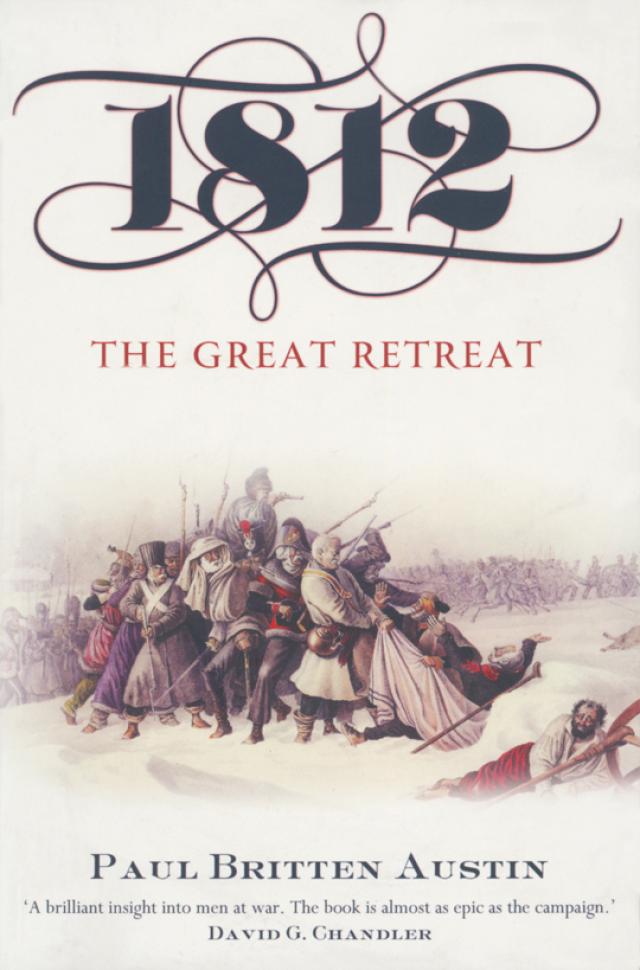


1812
THE GREAT RETREAT
‘The habit of victory cost us even dearer in retreat. The glorious habit of always marching forwards made us veritable shoolboys when it came to retreating. Never was a retreat worse organised.’
Caulaincourt
‘Extreme misery knows not the law of humanity. One sacrifices everything to the law of self-preservation.’
Louise Fusil, at the Berezina
‘I have never, to this day of writing in 1828, seen an account of the retreat that could be described as exaggerated. Indeed I’m sure it would be impossible to exaggerate the misery endured by those who took part in it.’
Lieutenant Vossler
‘For the honour of humanity, perhaps, I ought not to describe all these scenes of horror, but I have determined to write down all I saw And if in this campaign acts of infamy were committed, there were noble actions, too.’
Sergeant Bourgogne
1812
THE GREAT
RETREAT
PAUL BRITTEN AUSTIN
Greenhill Books
First published in Great Britain in 1996 by
Greenhill Books, Lionel Leventhal Limited
www.greenhillbooks.com
This paperback edition published in 2012 by
Frontline Books
an imprint of
Pen & Sword Books Ltd
47 Church Street
Barnsley
South Yorkshire
S70 2AS
Copyright © Paul Britten Austin, 1996
The right of Paul Britten Austin to be identified as the author
of this work has been asserted by him in accordance with the
Copyright, Designs and Patents Act 1988
ISBN 978-1-84832-695-8
All rights reserved. No part of this publication may be reproduced, stored
in or introduced into a retrieval system, or transmitted, in any form, or
by any means (electronic, mechanical, photocopying, recording or
otherwise) without the prior written permission of the publisher. Any person
who does any unauthorized act in relation to this publication may be liable
to criminal prosecution and civil claims for damages.
CIP data records for this title are available from the British Library
For more information on our books, please visit
www.frontline-books.com, email info@frontline-books.com
or write to us at the above address.
Printed and bound by CPI Group (UK) Ltd, Croydon, CR0 4YY
CONTENTS
PREFACE
SOME IMPORTANT EYEWITNESSES
MAPS
THE EVENTS SO FAR
PHASE ONE: TO SMOLENSK`
Chapter 1 ‘A Word Unknown in the French Army’
Chapter 2 Borodino Revisited
Chapter 3 Getting Through at Viazma
Chapter 4 Handmills at Doroghobouï
Chapter 5 Snow
Chapter 6 Disaster at the Wop
Chapter 7 How Witebsk Was Lost
Chapter 8 Smolensk Again
PHASE TWO: TOWARDS THE BEREZINA
Chapter 9 The Icy Road to Krasnoië
Chart: Movements of the Various Corps, 13–20 November
Chapter 10 The Guard Strikes Back
Chapter 11 ‘Marching, Marching, Marching …’
Chapter 12 Ney’s Amazing Exploit
Chapter 13 The Terrible News at Toloczin
PHASE THREE: ACROSS THE BEREZINA
Chapter 14 Struggles for the Borissow Bridge
Chapter 15 ‘How Ever Shall We Get Through?’
Chapter 16 Two Fragile Bridges
Chapter 17 Partonneaux Surrenders
Chapter 18 Holocaust at the Berezina
Chapter 19 Two Prisoners
PHASE FOUR: BEYOND THE BEREZINA
Chapter 20 Cortège through the Snows
Chapter 21 The Emperor Quits
Chapter 22 ‘The Very Air Seemed Frozen’
Chapter 23 Panic and Chaos at Vilna
Chapter 24 Ponari’s Fatal Hill
Chapter 25 Ney’s Last Stand
TWO EPILOGUES
NOTES
INDEX
To the English-speaking world’s
two greatest Napoleonic scholars of our century,
Professor David Chandler, D. Litt. (Oxon)
and
Colonel John R. Elting (USA. Rtd)
this volume is dedicated in admiration and gratitude
for all their kindness and generosity.
PREFACE
I have really nothing to add to the prefaces of the first two volumes of this work: 1812 – the March on Moscow and 1812 – Napoleon in Moscow – except to say that this volume completes the drama of the Russian disaster, as experienced by the invaders and described by them in their own words. For my translation and other methods of presenting my ‘word film’ the patient reader should turn to the prefaces of those volumes.
The story has of course been told innumerable times. But apart from Sergeant Bourgogne’s immortal classic, whether the sheer magnitude of the event has wearied authors or their publishers, it has always been, for understandable reasons, in résumé. As the reader will see, there are many first-hand accounts; indeed the body of material I’ve drawn on, some 160 participants, has been almost too great, and the fewer the survivors the more detailed their narratives become. First and last my project has been to reconstitute, in maximum close-up, a fragment of past time. Even this, of course, is an illusion. The most objective and circumstantial account adds up to only a millionth part of the reality. Hundreds, perhaps thousands, of other participants must have kept diaries that perished with them in the snows. The mind boggles at the task that would have presented itself if they hadn’t! The relevant surviving details have been what has fascinated me. If some are too gruesome for the tender-minded reader I can only suggest he – or she – skip them; but not their implications. To have omitted them would have been intellectually dishonest. Bellum dulce inexpertis, says Erasmus: ‘How charming is not war to those who’ve never been in it!’
Despite the ever-growing mass of first-hand material (I’ve used no others, and new memoirs are always being unearthed), I’ve tried to let the whole compose itself into what is, I hope, a kind of outsize symphony, whose first brilliant bars were struck by all the trumpets and drums of the Imperial Guard at the Niemen on that Midsummer’s Day of 1812 – only to end in the few survivors’ frozen ’cello tones of horror and despair.
Lastly, on a personal note. My book has taken almost 25 years to compose. If I’ve persisted – I might almost say had the fortitude – long enough to complete it, it’s not been because of any abiding obsession with military history as such; but because of the striking and manifold glimpses into human nature it affords, until at times the 1812 story has even seemed to be a tragic paradigm of human existence: – the outset’s overweening optimism, not to say arrogance – the flawed calculations – the horrific results – the raw egoism of survival – the staunchness of some, the cowardice and fatuity of others, the heroism and true greatness of a few – the friends left by the wayside … Homo lupus hominem – the leopard, alas, hasn’t changed its DNA, as our own ‘unforgivable century’ has all too amply shown. No philosopher of the pessimist school could want a better instance of what Dr Johnson called ‘the vanity of human wishes’, here geometrically demonstrated by what might be called the aesthetic of its own historical logic. I’ve had to make nothing up.
My gratitude goes to my publisher Lionel Leventhal for his devotion to a project which in the upshot has run to as many words as there were men in the Grand Army. It was in his office, long ago, our project was conceived. And with it – and with me – he has had almost half a working lifetime’s patience. We are both of us grateful to three experts who have given the text their critical attention: namely, Philip J. Haythornthwaite, Digby Smith and John R. Elting, all themselves distinguished authors in the Napoleonic field. Their keen eyes and immense knowledge have eliminated many an error, larger or smaller. I should also particularly like to thank Assistant Professor Algirdas Jakubcionis of Vilnius University for his ready help in suggesting and providing illustrations; and, once again, Peter Harrington of Brown University, Providence, Rhode Island, USA, for helping with the illustrations.
Dawlish, S. Devon, 1996
SOME IMPORTANT EYEWITNESSES
Pierre Auvray, captain, 23rd Cheval, Corbineau’s brigade, II
Dragoons. Corps.
Louis Begos, captain adjutant-major, Dedem van der Gelder, general of
2nd Swiss Infantry Regiment. brigade, ex-diplomat, attached to
Vincent Bertrand, carabinier IHQ.
sergeant, 7th Light Infantry, François Dumonceau, captain commanding
Gérard’s division, I Corps. a company of the 2nd
Honoré Beulay, sous-lieutenant, 36th (‘Red/Dutch’) Guard Lancers,
Line, Partonneaux’s division, IX Colbert’s lancer brigade.
Corps. Victor Dupuy, colonel, 7th Hussars,
Hubert Biot, captain, ADC to Bruyère’s division, 1st Cavalry
General Pajol. Corps.
Guillaume Bonnet, captain, 18th B. T. Duverger, captain, paymaster to
Line, Razout’s division, III Davout’s I Corps.
Corps. Henri-Pierre Everts, major, 33rd Line,
Jean-François Boulart, major, Guard Dufour’s division, I Corps.
artillery. Baron A.-J.-F. Fain, Napoleon’s
A.-J.-B.-F. Bourgogne, sergeant, Second Secretary.
Fusiliers-Grenadiers, Young G. de Faber du Faur, major, commanding
(Middle) Guard. reserve artillery, Ney’s
Paul de Bourgoing, lieutenant, 5th III Corps.
Tirailleurs of the Guard, interpreter Raymond Faure, surgeon,
to General Delaborde, Grouchy’s 3rd Cavalry Corps
Young Guard. (prisoner).
Heinrich von Brandt, captain, 2nd Fezensac, duke, colonel, 4th Line,
Regiment, Vistula Legion. Razout’s division, III Corps.
Jean-Marc Bussy, voltigeur, 3rd Swiss, Charles François, ‘the Dromedary of
Merle’s division, II Corps. Egypt’, captain commanding the
Jean Calosso, regimental sergeant- 30th Line’s grenadier company,
major, 24th Chasseurs à Cheval, Morand’s division, I Corps.
Castex’s brigade, II Corps. Jean-David Freytag, general of
V. E. B. Castellane, captain, orderly brigade, III Corps.
officer at IHQ. Louise Fusil, actress, travelling with
Armand de Caulaincourt, general, IHQ.
Master of the Horse, responsible Gaspard Gourgaud, baron, colonel,
for IHQ transports and the 1st officier d’ordonnance, IHQ.
courier service. Lubin Griois, colonel of horse
Désiré Chlapowski, colonel, 1st Polish artillery, 3rd Cavalry Corps.
Guard Lancers, Colbert’s lancer J. L. Henckens, NCO, acting adjutant
brigade. -major to the 6th Chasseurs à
Jean-Nicholas Curély, regimental Cheval, Chastel’s division, 3rd
sergeant-major, 20th Chasseurs à Cavalry Corps.
Dirk van Hogendorp, baron, general, 23th Chasseurs, Castex brigade,
ADC to Napoleon, governor of II Corps.
Vilna province. Albrecht von Muraldt, lieutenant, 4th
Porphyre Jacquemot, lieutenant, 5th Bavarian Chevaulegers,
Company, 5th Artillery Ornano’s light cavalry brigade,
Regiment, at Vilna. attached to IV Corps.
Henri de Jomini, baron, general, military Amédée de Pastoret, marquis, war
theorist, governor of commissary at Witebsk.
Smolensk city. Pierre Pelleport, viscount, colonel, 18th
von Kalchreuth, lieutenant, 2nd Line, Razout’s division, III Corps.
Prussian hussars, Niewievski’s François Pils, ‘grenadier‘, artist, bat-
brigade. man to Marshal Oudinot, II
Bellot de Kergorre, war commissary in Corps.
charge of a Treasury wagon, A.-A. Pion des Loches, major, Guard
marching with IHQ. foot artillery.
Captain Eugène Labaume on staff of Planat de la Faye, lieutenant, secretary
Prince Eugène’s IV Corps, to General Lariboisière,
author of the first published artillery staff.
account of the campaign (1814). F.-R. Pouget, baron, general, governor
D.-J. Larrey, baron, Surgeon- of Witebsk.
General, IHQ. D.-G.-F. Dufour de Pradt, bishop,
Cesare de Laugier, adjutant-major of ambassador at Warsaw.
the Guardia d’Onore of the Jean Rapp, general, ADC to
Kingdom of Italy, IV Corps. Napoleon.
Thomas Legler, lieutenant, 1st Swiss Roch-Godart, baron, general, governor
Regiment, Merle’s division, II of Vilna city.
Corps. L.-V.-L. Rochechouart, émigré count,
L.-F. Lejeune, baron, general, until serving under General Langeron
Borodino one of Berthier’s in Tchitchakov’s army.
ADCs; thereafter chief-of-staff to Franz Roeder, captain, Hessian
Davout. Footguards.
C. F. M. Le Roy, lieutenant-colonel, François Roguet, baron, general,
85th Line, Dessaix’s division, I commanding 2nd Division,
Corps. Imperial Guard.
M.-H. de Lignières, count, captain, Heinrich von Roos, surgeon, 3rd
1st Guard Foot Chasseurs. Württemberg Chasseurs.
G. L. de Lorencez, general, chief-of- Abraham Rosselet, captain, 3rd Swiss
staff to Marshal Oudinot, II Regiment, Merle’s division, II
Corps. Corps.
J.-E.-J.-A. Macdonald, marshal, Duke M.J.-T. Rossetti, colonel, ADC to
of Taranto, commanding X Murat.
Corps. N. T. Sauvage, lieutenant of the
A.-A.-A. Mailly-Nesle, count, sous- Train, VIII Corps.
lieutenant, 2nd Carabiniers, riding Philippe de Ségur, count, general,
with IHQ. assistant prefect of the Palace, in
Marcelline Marbot, colonel of the charge of IHQ’s mules.
T.-J.-J. Séruzier, baron, colonel of Jakob Walter, private in a
horse artillery, 2nd Cavalry Württemberg infantry regiment,
Corps. III Corps.
Roman Soltyk, count, captain, R. Warchot, captain, 8th Polish
attached to IHQ’s Topographical Lancers.
Department. C.-A.-W. Wedel, count, general, VI
Karl von Suckow, captain, Corps.
Württemberg cavalry, III Corps. Sir Robert Wilson, general, the
Maurice Tascher, lieutenant of chasseurs British government’s liaison officer
à cheval. at Kutusov’s headquarters.
F.-A. Teste, baron, general, governor J.-H. Zalusky, captain, 1st Polish
at Viazma. Guard Lancers.
Augaste Thirion, regimental
sergeant-major, 2nd Cuirassiers,
Saint-Germain’s division, 1st For bibliographical details of these
and other sources I refer the reader
to the comprehensive bibliographies
in 1812 – The March on
Moscow and 1812 – Napoleon in
Moscow. Any additional sources are
given in the Notes.
Cavalry Corps.
L.J. Vionnet, major, Fusiliers-
Grenadiers, Young (Middle)
Guard.
H. A. Vossler, lieutenant, Prince
Louis of Prussia’s Hussars.
Note:
First references to the eyewitnesses
whose accounts make up this ‘documentary’
of Napoleon’s retreat from Russia appear in
italic.
THE EVENTS SO FAR
In the midsummer of 1812 Napoleon had crossed the Niemen with nine army corps: a third of a million men, the largest and most redoubtable, not to say multi-national, army in European history. To effect liaison between their two corps the Russians, refusing him the battle he sought, had hastily withdrawn into the interior until, on 14 August, they’d stood and fought at Smolensk, which had gone up in flames. A pyrrhic victory for the French. The main ‘Moscow’ army had already lost so many men and horses en route that what should have been the crucial battle (Borodino, 7 September) had been indecisive. Moscow, evacuated by Kutusov and occupied by the French (14 September), had been set in flames by its governor Rostopchin.
For five illusory weeks Napoleon waited in the Kremlin, hoping that the Tsar would make peace, while his advance guard at the Winkovo camp had literally starved. On 18 October the Russians attacked it, and only Murat’s prompt action had saved it from annihilation. Next day Napoleon had marched out southwards for Kaluga and the unravaged Ukraine with some 110,000 men and a vast baggage train glutted with the spoils of Moscow. On 24 October 22,000 Italians, Frenchmen and Croats of Eugène’s IV Corps (‘The Army of Italy’) had run into and defeated 70,000 Russians at Malojaroslavetz. Once again Kutusov withdrew, and in the dawn mists next day Napoleon himself was within an ace of capture by Cossacks. Reluctantly deciding the Grand Army had ‘done enough for glory’ he’d ordered a retreat via the devastated Mojaisk–Viazma road to Smolensk, where he hoped to go into winter quarters before fighting a second campaign in the spring of 1813. ‘Towards midnight the two armies turned their backs on each other, marching in opposite directions.’
PHASE ONE
TO SMOLENSK
CHAPTER 1
‘A WORD UNKNOWN IN THE FRENCH ARMY’
‘Suddenly everyone seemed indifferent’ – ‘the retreat of the wounded lion’ – the Cossacks – the loot of Moscow – contents of a wagon – plight of the wounded and prisoners – Mailly-Nesle keeps singing – Ney’s corps at Borowsk – Dumonceau sacrifices his cart – a cock goes into Le Roy’s cookpot – Davout’s protest – Napoleon as seen by Dedem – growing food shortage – an imperial outburst – plight of the Mojaisk wounded






