Solastalgia, p.1
Solastalgia, page 1


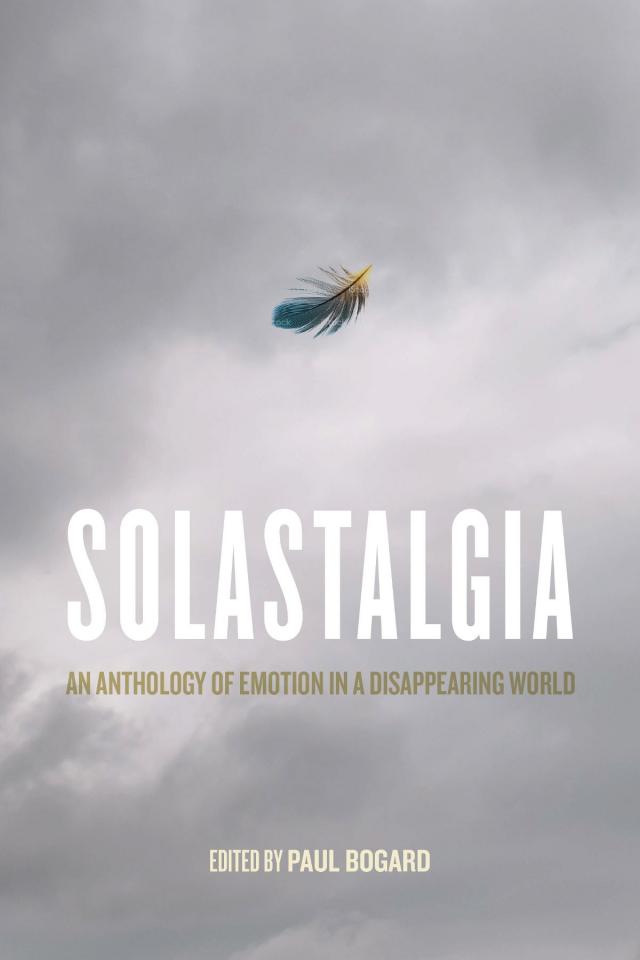
SOLASTALGIA
SOLASTALGIA
An Anthology of Emotion in a Disappearing World
Edited by Paul Bogard
University of Virginia Press
Charlottesville and London
University of Virginia Press
© 2023 by the Rector and Visitors of the University of Virginia
“Fireflies” © 2023 Scott Sanders; “A Shared Lament” © 2023 Meera Subramanian
All rights reserved
Printed in the United States of America on acid-free paper
First published 2023
9 8 7 6 5 4 3 2 1
Library of Congress Cataloging-in-Publication Data
Names: Bogard, Paul, editor.
Title: Solastalgia : an anthology of emotion in a disappearing world / edited by Paul Bogard.
Description: Charlottesville : University of Virginia Press, 2023.
Identifiers: LCCN 2022036008 (print) | LCCN 2022036009 (ebook) | ISBN 9780813948843 (paperback) | ISBN 9780813948850 (ebook)
Subjects: LCSH: Solastalgia. | Global environmental change—Psychological aspects. | Climatic changes—Psychological aspects. | Environmental psychology. | Grief. | Loss (Psychology)
Classification: LCC BF353.5.S65 S6 2023 (print) | LCC BF353.5.S65 (ebook) | DDC 155.9—dc23/eng/20221006
LC record available at https://lccn.loc.gov/2022036008
LC ebook record available at https://lccn.loc.gov/2022036009
Cover art: Background, patternpictures.com; feather, Boonchuay_Promjiam/istock.com
For Amalie, that you know we loved this world
One of the penalties of an ecological education is that one lives alone in a world of wounds. Much of the damage inflicted on land is quite invisible to laymen. An ecologist must either harden his shell and make believe that the consequences of science are none of his business, or he must be the doctor who sees the marks of death in a community that believes itself well and does not want to be told otherwise.
—Aldo Leopold, A Sand County Almanac (1949)
None of those emotions really get to the heart of what I truly feel. None of them are big enough. If I’m honest with myself, what I truly feel is . . . love. Hear me out. I don’t mean any simple, sappy kind of love. I don’t mean anything cute or tame. I mean living, breathing, heart-beating love. Wild love. This love is not a noun, she is an action verb. She can shoot stars into the sky. She can spark a movement. She can sustain a revolution.
—Mary Annaïse Heglar, “But the Greatest of These Is Love” (2019)
Contents
Foreword by Glenn Albrecht
Acknowledgments
Introduction
Part I. Grieve and Give Thanks
What If She Had Lived?
Laura Erin England
On Elegy
Kathryn Nuernberger
Two Hearts, Two Minds
Kathryn Miles
Grief and Fire
Suzanne Roberts
Other Rookeries
Joan Naviyuk Kane
A Shared Lament
Meera Subramanian
Part II. Remember and Imagine
Elegy at the Edge of Infinity
Lauren K. Alleyne
Blue
Roopali Phadke
Whistler of the North
Cynthia Belmont
The Strangest Sea
Angela Pelster
On Memory and Survival
Nickole Brown
What You Studyin’ On: An Environmental Statement
Sean Hill
A Return to Feeling
Holly Haworth
Part III. Love, Get Angry, and Love Some More
Rage, Rage against the Dying
Kathleen Dean Moore
Why I Write for Birds
J. Drew Lanham
The Practice of Anger in a Warming World
Genevieve Guenther
The Dying Elm
Ken Hada
A New Word to Describe New Feelings
Susan Clayton
Affirming Abundance
Priscilla Solis Ybarra
Soliphilia in Beaverland
Ben Goldfarb
Part IV. Bring New Life into a Disappearing World
Wild Lessons from Poisoned Water
Douglas Haynes
Mourning Songs Are Love Songs
Leah Naomi Green
The Imprint Theory of Childhood
Jennifer Westerman
What the Living Do
Erica Cavanagh
Choosing a Different Future
Priya Shukla
How Do You Feel Today?
Marco Wilkinson
One Path to Solastalgia
Paul Bogard
Part V. Take Action and Take Care
Step-by-Step Instructions
Janisse Ray
How to Love a Burning World
Jennifer Atkinson
This Will Be
Elena Passarello
On Time
Taylor Brorby
Why Turn Inward Just as the Planet Needs Us Most?
Sarah Jaquette Ray
Smoke, Cracked Corn, and a Helicopter Rescue
Alison Hawthorne Deming
Fireflies
Scott Russell Sanders
Notes on Contributors
Foreword
I think I was around six years old when I was first accused of moping. My family had just returned from a week’s holiday at Manjimup, the home of my maternal grandparents. Manjimup is a timber town located about three hours’ drive southwest of Perth, the capital city of Western Australia. Manjimup gets its name from an Indigenous word for a meeting place and a place of water and bullrushes. For me, it was a place where you can meet birdfriends.
Immediately on our return home I would find a place of solace somewhere in my house or garden and visibly mope. My mother noticed it and gently scolded me for being so aloof and rooted to the same spot. I would maintain this ridiculous moping for at least a few days and of course there was an element of theatrical drama attached to it. I was punishing my parents for removing me from Manjimup. I wanted them to know where I felt at my happiest and just how unhappy I was at no longer being there.
The reason for that happiness revolved around my core biographical and formative elements: the influence of my grandparents, the fecundity of their farm, and the richness of nature that was woven into and surrounding it. My grandmother introduced me to the life of birds, grandfather to the world of wood, the farm to self-sufficiency and the surrounding environment as a place of nature-wonder and addictive immersion.
The farm and its surrounding forest and bushland were full of wildlife. Quite apart from the trees, among the tallest flowering plants in the world, there was the huge diversity of animal and insect life. Australia is famous for its brightly colored parrots and cockatoos, and this sector of Western Australia had more than its fair share.
Small birds such as wrens and finches also caught the eye while motorbike frogs sat on top of every fence post that provided shelter under the rosemary hedge farm garden perimeter. However, it was mainly the proximity to birds that created a life-long calling for me.
It was one bird in particular that caught my attention. The grey fantail (Rhipidura albiscapa), although not colorful and rather smallish, is an aerial acrobat as it catches insects on the wing. It fans its tail and spreads its wings in an attempt to intimidate the insects in close proximity to fly into its trap of a beak.
It is a fearless flycatcher as it will come very close to humans and swoop around the body. It is also known to land on people’s heads in nesting season to take strands of hair directly from the scalp. Despite gaudy parrots and other beautiful bush birds, it was this species that was to become my bird totem.
As a boy, I thought that the intimacy this bird shared with me was special and that no one else had such close encounters with it. I would chatter to it in bird language, and we would commune as if I had my own personal Peter Pan or Fairy Queen as my bush-walking companion. The grey fantail personally invited me into the world of birds.
Not all of my bird experiences at Manjimup were as communal as my contact with the fantail. A mixture of the intensely life-affirming and the inevitable life-destroying (watching a goshawk take out a western rosella parrot in the farm orchard) was enough to give even a child a glimpse into what I would later call the “psychoterratic,” or Earth-psyche relationships. There was a spectrum of emotions ranging from the sublime to the terrifying that could envelop my childhood experiences of nature.
The melancholia I experienced at my return to suburban Perth must have been the first manifestation of those aspects of my personality, built around the positive and negative dimensions of nature and immersion in the processes of life. I was able to distinguish positively reinforcing Earth emotions from negative ones at a very early age.
That sensitivity (if it can be called that) stayed with me for the rest of my life. The grey fantail can be found in many parts of Australia and it is common in eastern Australia where I have resided for the last forty years. As an adult amateur bird person, I found out that the childhood close encounters with this magic bird were simply it “using me” as an extension of its fan, sweeping and disturbing the ground so that it could catch flies. Despite that revelation, it remained my special bird totem.
It was John Gould (the British birdman) and his wife Elizabeth (ornithological artist) who first alerted me to the avifaunal importance of the Upper Hunter Region of New South Wales (
Elizabeth Gould produced a beautiful rendition of the grey fantail, one of the precious few she was able to complete for the folio edition of The Birds of Australia (1848) before, at the age of thirty-seven, she died of puerperal fever after childbirth back in her home of London, England, in 1841. Her artistry captured what her husband described: “While in the air it assumes a number of lively and beautiful positions, at one moment mounting almost perpendicularly, constantly spreading its tail to the full extent, and frequently tumbling completely over in the descent.”
Elizabeth Gould depicted the essence of my totemic connection to Manjimup, and the confluence of birds and place again became of overwhelming importance to me. My “bird brain” wanted me to reconnect to where the Goulds resided in the Upper Hunter, a farmhouse called Yarrundi, or “place of possums.” With my family, I made a pilgrimage there. However, instead of finding rainforest, bowerbirds, and fantails, we encountered over 200 square miles of open-pit coal mining.
The earthly equivalent of a metastasizing cancer was terraforming the entire landscape into massive open-cut mines using machinery that could literally move mountains. No room here for the delicacy of a fantail in a land dominated by exploding the “overburden” and its removal by gargantuan electric shovels. The emotions of place were being “moved.”
The emotion of solastalgia, or the lived experience of the desolation of a much-loved landscape, was conceived in this context. The contradiction between the tiny bird and the open cuts was irreconcilable and a new psychoterratic term had to be created to explain this form of algia (pain, sorrow, or grief).
Grey fantail, by Elizabeth Gould, from The Birds of Australia (1848)
Solastalgia is now, unfortunately, a concept that is increasingly well known in this era of climatic and environmental desolation. From the Hunter Valley to the whole Earth heating as a result of fossil fuel–fired anthropogenic warming, the emotions of sense of place are being assaulted by these negative transformational forces.
Because its victims still hold within them a love of “home,” the emotion of solastalgia also stimulates a response that opposes the forces that threaten one’s sense of place. Working with like-minded people to oppose the causes of the distress is cathartic. The act of repairing and restoring damaged landscapes has the potential to repair damaged psyches. The pain of solastalgia is potentially reversible.
The essays so artfully chosen by Paul Bogard for this anthology help us navigate the “age of solastalgia.” They all offer insight into the relationships between home, in all of its forms, and our emotional literacy and health. I thank Paul for providing this example of “sumbiotude,” or working with others, to bring to fruition a pioneering anthology united by the theme of solastalgia. It has been my pleasure to read the wonderful contributions, and I live in anticipation of the positive impact they will have in this troubled world.
It is my hope that the grey fantail will prevail in a future state where humans reenter the rest of life in nature. Their bravado will have to be matched by humans who feel and see that the joie de vivre is worth more than the wealth of all the coal mines in the world. Grey fantails already know this.
Glenn Albrecht
Acknowledgments
My thanks first to Angie Hogan and all the good folks at the University of Virginia Press who have helped bring this book into the world. To Miles Silman and the Center for Energy, Environment, and Sustainability (CEES) at Wake Forest University for supporting this book’s creation. And to Glenn Albrecht for his hospitality, his foreword, and most of all, his word.
To my new colleagues at Hamline University, thanks for welcoming me. Thanks especially to Mike Reynolds for all he does on behalf of our community. Thank you to friends and former colleagues at James Madison University. A special thank you to Ann and Bruce Johnson who shared their home with me.
My gratitude to the writers who contributed to this collection—without them, this book would not exist. Special thanks to Cynthia Belmont, Douglas Haynes, and Jennifer Westerman for generously supplying essays for the original proposal.
To David Swirnoff and Joshua Powell, thank you for the continued conversations. To Caroline and to my parents, thank you for everything. And to Amalie, how wonderful you are here.
Finally, I give thanks for my friend, Hanna Cooper, who died far too young. I will always be grateful that we reconnected in time to have several long talks about living with the knowledge that we will lose so much of what we love—and so, how to love even more.
Introduction
The distress caused by environmental change; the homesickness we feel while still at home; the lived experience of the desolation of a much-loved landscape. All of these are ways that Glenn Albrecht has defined the word he created to describe this emotion so many feel in response to finding our beloved world so impacted, under threat, and certain to suffer radical change. To feel solastalgia is to feel pain, sorrow, and grief (from the Greek algos), but it is also to recognize that the source of this pain is our love for the places of which we are part. And in that love lies the energy to defend the world we have known and to create the future we want our children, grandchildren, and those who follow to know.
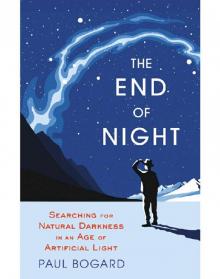
When I first found the word a decade ago, I mostly identified with having a word to describe my grief. In The End of Night I wrote, “Already in Australia they’re speaking of solastalgia, about missing a loved place that still exists but to which the old birds and plants and animals no longer come.” Next to the loss of my family, this was “the darkness I fear most, this sadness at the ongoing destruction of the wild world.” In the years since, though, I’ve found there is more to the emotion this word describes.
Part of this discovery came when I traveled to eastern Australia to meet Glenn Albrecht in October of 2019. From the moment Glenn and his wife, Jill, picked me up outside the Newcastle train station, their blue sedan packed with groceries and red wine, and we headed toward the property near Duns Creek they call Wallaby Farm, they were the kindest of hosts. Over the course of my stay, they fed me well, indulged my desire to see kangaroos, and took me on field trips both wonderful (to see lyrebirds) and heartbreaking (to see the massive open-pit coal mines of the Upper Hunter Valley). And all along we talked of solastalgia.
For Glenn, the word has its roots in a Western Australia childhood full of wildlife and wild places that made him the person he is today, a self-described “bird-loving environmental philosopher trying to understand Earth-human relationships.” In his book Earth Emotions: New Words for a New World, Glenn explains that he has “been in love with birds for as long as I can remember,” that “grief and mourning for the death of the nonhuman was locked into my childhood,” and that during these early years, he developed the “sense of kinship to a nonhuman being” that he will “carry with me for the rest of my life.” When he moved across the vast “sunburnt country” to the verdant Hunter Valley of New South Wales, those feelings bloomed.
But the idyllic existence his new home promised was soon disrupted by the reality of the area’s open-pit coal mines. Albrecht began to hear from long-time residents of the Upper Hunter their despair over the destruction caused by the mines. He realized “these people were losing the solace or comfort once derived from their relationship to a home that was now being desolated by forces beyond their control.” But when he went to describe their feelings, he found the English language lacking.
“Nostalgia,” missing a time or place where you used to be, didn’t carry the meaning he desired. He was aware of the Hopi word koyaanisqatsi, meaning “life out of balance or disintegrating.” He knew of uggianaqtuq meaning “friend acting strangely,” which the Inuit increasingly use to describe the weather. He knew that Indigenous peoples around the world had suffered the trauma of removal from beloved homelands (for Aboriginal Australians, the 1788 arrival of British colonizers marked the start of a destruction that haunts the country still). He was aware that this feeling was ancient and ubiquitous. But, as he writes, “it was clear that the English language had no word to describe what I felt.”