Petterils corpse, p.1
Petteril's Corpse, page 1


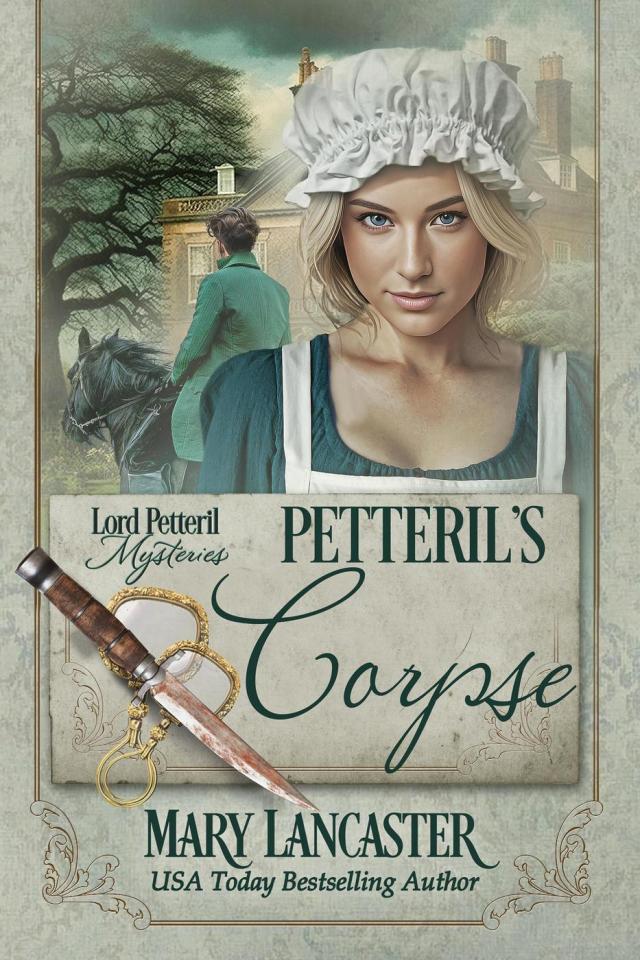
Petteril’s Corpse
Lord Petteril Mysteries, Book 2
Mary Lancaster
Petteril’s Corpse
All Rights Reserved © 2023 by Mary Lancaster
No part of this book may be reproduced or transmitted in any form
or by any means, graphic, electronic, or mechanical, including
photocopying, recording, taping, or by any information storage or retrieval system, without the written permission of the publisher.
Table of Contents
Title Page
Copyright Page
Chapter One
Chapter Two
Chapter Three
Chapter Four
Chapter Five
Chapter Six
Chapter Seven
Chapter Eight
Chapter Nine
Chapter Ten
Chapter Eleven
Chapter Twelve
Chapter Thirteen
Chapter Fourteen
Chapter One
Lord Petteril gazed up at the sky, calculating how long it would take for the rain to arrive. His horses, beautifully matched greys, shifted restlessly, shaking their heads, bored at standing still so long and, no doubt, looking forward to their next meal. Petteril, who still thought of himself by his Christian name of Piers, knew how they felt.
He sniffed the air, as though he might smell rain approaching, but all he caught was the earthy scent of forests and, somewhere in the distance, a hint of burning wood.
He sighed. “You had better come out,” he called to a large rhododendron bush close to the path, nestling between two young elm trees. “Or we’ll all get soaked.”
The bush moved, leaves fluttering and causing Piers to hope, but otherwise nothing happened.
“Do you need help?” he enquired.
“No,” said the bush defiantly.
“Then hurry up. I don’t choose to arrive at my ancestral acres in the guise of drowned rat with semi-drowned servant.”
Nothing happened. The bush remained still and silent. He could almost imagine it was glaring at him.
Piers sighed. “Ape,” he said warningly.
The bush moved and a grumpy figure in a blue calico dress squeezed out between it and the elm tree. Under one arm she clutched a bundle of grey-ish clothing. Her other hand held a scrap of white linen. The dress fitted her shape and height perfectly, though clearly not her mood. She scowled through her tangle of short, golden-fair hair and marched across to the curricle.
Controlling the twitch of his lips, Piers leaned over and stretched down one hand to help her up. She jerked out of his reach, snapping, “I can manage, for Gawd’s sake, I been jumping up and hanging onto the back of this thing for weeks.”
“Then get on with it,” Piers commanded. “Or you’ll have to jump up on the back again.”
“I’d rather,” she muttered, clambering onto the seat beside him with no grace whatsoever, and roundly cursing her skirts. With unnecessary force, she shoved the roll of clothes into the carpet bag at her feet.
Piers handed her a comb from his pocket and took the white, linen cap from her clutching fingers. Ungraciously, she dragged the comb through her locks, and he plonked the cap on her head. She tossed the comb onto the seat between them and with quick, deft fingers, tied the strings beneath her chin.
“I look ridiculous,” she muttered.
She didn’t. She looked like a sullen, respectable, awkwardly pretty girl of some indeterminate lower class, in an old fashioned dress. Her age could have been anything between sixteen and twenty summers. Ape was April once more,
“You’ll do,” Piers replied. “If you stop sulking and can avoid challenging the boot boy to a wrestling match.”
“Who’s the boot boy?” she asked suspiciously.
“I have no idea.”
“I could be the boot boy,” she said with such regret that he nudged her.
“No, you couldn’t. You’re a girl.”
The trouble was, she had taken on the guise of a boy so long ago that she didn’t even think of herself as female anymore. Her skirts irked her, and she walked and talked like Ape, the street urchin she’d been when Piers first encountered her burgling his house some four weeks ago. For reasons that still were not clear to him, he had employed the child in his own stable until he had realized how unsuitable the arrangement was for one neither child nor boy. The only way he had got her to agree to living as a girl again was to promise her she could make the change between London and his country seat of Haybury. Even so, she had stretched it out until the last moment. They were a bare five miles from his house, Haybury Court.
She sniffed. “I won’t fit in.”
That was probably true. Mrs. Park, his London housekeeper, had managed to civilize her to some degree, but Ape/April still tended to swear like a sailor and do what she wanted rather than what she was told.
“It will be an adjustment,” he allowed. The thread of an idea was working through his mind, but he would have to meet the staff first and, more to the point, consult Ape—April—once she had stopped sulking.
He flicked the reins, and the horses moved on.
“Can you smell burning?” April asked suddenly.
“Someone burning garden waste. The village is just beyond the wood.”
She shook her head, not with impatience but unease that was almost dread. “No, there’s more n’ wood. It’s like...plague.”
“Plague!” He blinked at her. “What on earth do you mean?”
“Maybe not plague but, you know, sickness. When people get ill, and everyone catches it and loads of ’em die and they have to burn their clothes in—” She broke off, her eyes widening. “That’s it. It’s burning clothes. Who’d burn clothes if they didn’t have plague?”
It made an uneasy kind of sense. April had grown-up in the crowded slums of the east end docks and St. Giles, where bouts of illness were devastating to people already poor, exhausted and malnourished.
Piers sniffed the air again and turned his head into the wind. “It’s not in the village either. It’s too close.”
He pulled up the horses once more and from habit, April jumped down to go to the horses’ heads while he alighted. However, without a word, Piers looped the reins around a tree and strode off toward the smoky smell, April at his heels.
“There.” She pointed past him to a small clearing, where smoke issued in a lethargic kind of way from an indeterminate heap.
They walked toward it. There was no fire left, only a pile of ash and a few singed, smoking rags. Piers, glancing around the clearing, saw another, much worrying sight only a few feet away. He swerved toward it.
A man, naked as the day he was born, lay face down on the gravelly ground. Quickly, Piers crouched beside him, reaching for his wrist and searching for a pulse, but he already knew he wouldn’t find one. The flesh was chillingly cold and stiff and had been dead for some time.
Piers released the rigid wrist and sat back on his heels. The dead man had a full head of dark brown hair, cut fashionably short. What Piers could see of his face looked to be about Piers’s his own age, six-and-twenty, and the body looked trim and fit. Death had taken him tragically young, which was upsetting in itself. What bothered Piers more was the dried blood staining the ground around him.
April swore.
Hastily, Piers rose and began to unbutton his coat.
“Don’t use your coat,” April commanded, already running back the way they had come. “I’ll bring a blanket.”
While she was gone, Piers heaved the man over far enough to see the knife buried to the hilt in his chest. He let the man fall back as April’s returning footsteps thudded through the undergrowth. Tripping over her skirts, she all but threw the horse blanket over the corpse.
“That’s blood on the ground, isn’t it?” she said in a detached sort of way.
“I think so, yes.”
“He wouldn’t burn his clothes before killing hisself, would he? And laying hisself out so undignified.”
“Unlikely,” Piers agreed. He drew the blanket a few inches farther up to cover the dead man’s head, then turned and walked back to the remains of the fire, which he poked with his toe.
“Can’t have been an accident, neither,” April remarked.
“No.”
“Someone croaked him. Look at the way his hand’s reaching, as if he were trying to crawl. He didn’t just stab hisself and lie down to die.”
He could have changed his mind when it was too late. A tragedy that paralyzed Piers because he understood it only too well. There, but for the grace of... Unexpectedly, April took his hand, tugging him away. Her grip was surprisingly gentle, as if she knew the bleak, black memories conjured into his brain. She probably did.
“You can’t do nothing for him,” she said briskly, letting him go as soon as he began to stride toward the horses and the curricle. “’Cept find out who he is.”
“And who—er... croaked him,” Piers said. “I wonder who the magistrate is around here?”
“Might be you.” Her smile was crooked. “Wouldn’t that be something?”
APRIL—SHE SUPPOSED, reluctantly, that the name had more dignity than Ape which had served well enough for the back streets of St. Giles—was concerned for his lordship. Throughout her life, she had seen death in many forms, including by violence. It wasn’t that she didn’t care the poor cove was dead. She just cared more that Lord Petteril wouldn’t think it was suicide.
Which it could have been. Despi te what she’d said to him, she suspected a disturbed and desperate person might just decide to leave the world as they came into it. He could have fallen on the knife whose hilt she had seen sticking out of his chest. And he was a nob. April could tell by the cut of his hair and the smoothness of his hands. And young, surely still in his twenties. These similarities to Petteril were not lost on her and she didn’t want his lordship reverting to old ideas or states of mind.
So, forgetting about her annoying skirts, she passed the rest of the journey speculating who the dead man was and why anyone would have burned his clothes.
“Waste,” she commented. “Good money in decent clothes.”
“Not worth it if you’re caught selling a dead man’s rig,” Lord Petteril pointed out.
“Suppose,” she said doubtfully. “Why d’you think he burned ‘em, then?”
“Anger, hatred. Or to make it harder to identify the victim.”
“Can’t be hard in a place like this. There’s no other people.”
To April, this was the most surprising thing of all about the countryside they had passed through since leaving London. Vast swathes of fields and forests, hedges, meadows, with no buildings, no people, only animals. Much of it was very pretty, but in truth it made her uneasy.
They beat the oncoming rain to the viscount’s house, Haybury Court, but only just. April barely noticed the weather for her sheer awe at the size of the dwelling which came suddenly into view as the horses swept up a somewhat neglected driveway marred by creeping weeds and uneven stones.
“Cor,” April breathed. It made Lord Petteril’s London residence look like a cottage. A massive stone building like a castle at the top, but with huge number of elegant windows that gleamed, even in the grey gloom. It had pillars and carvings in the stone and extended even around the corner she could see. A ruin of some other building, with foliage growing out of it, could be seen in the grounds, surrounded by gardens and bright, colourful spring flowers. “It’s a bloody palace. Did you live there?”
“No. Spent quite a lot of time here as a boy, though. A few Christmases, most summers. Haven’t been back for a long time. Six or seven years.”
His handsome face was veiled, hiding whatever he felt about the place. He had inherited it and the title after the deaths of his father, brother, uncle and two cousins. The family had bad luck by anyone’s standards.
“Do they know you’re coming?” April asked, a shade nervously.
“Well, I certainly wrote to the housekeeper and told her so.” He glanced at her. “You’ll come in the front door with me, and I’ll speak to Mrs. Hicks about you.”
“I’d rather work in the stables,” April said. “I never cleaned anything else in my life.”
“Nonsense. I saw you wash your face only yesterday.”
She stuck her tongue out at him and was gratified to see the twinkle of an incipient smile in his eyes.
“You don’t stick out your tongue out at Lord Petteril,” he said gravely.
“And I don’t call you mister, and I don’t swear, and I don’t wear boy’s clothes.” She sighed and he nudged her with one arm before bringing the horses to a snorting halt by the front door.
“It’s an adventure,” he said, and she had to swallow her scornful reply as a buxom woman sailed down the front steps at the same time as a couple of grooms loped round from the far side of the house.
“My lord, welcome!” beamed the woman, presumably the housekeeper.
“Mrs. Hicks. A pleasure to see you again.”
April quickly grabbed her bag and scrambled out of the curricle before he did something daft like lift her down—which he’d done once on the journey while his mind was clearly somewhere else. When he’d noticed, she wasn’t sure which of them had been more embarrassed.
A manservant also emerged to take the bags.
“Most of my baggage will follow with my valet and groom,” Lord Petteril said, seeing Mrs. Hicks’s surprise. “They should be here by midday.”
The two grooms—an older man, all weather-beaten and lined with a game leg, and a young lad, tugged their caps at his lordship, dividing their awed attention between him and the grey horses.
April sneaked a quick pet on the near horse’s neck before the grooms led them off.
“Come in out of the rain, my lord,” Mrs. Hicks urged. She cast a curious, unfriendly look at April, especially when she trotted after them up the curved steps and through the impressive, tiled portico, and huge front door.
Inside was even more amazing, a huge hall with two fireplaces, bigger even than the drawing room of the London house which April had once peeked inside. A grand staircase led upward and, speechless, April climbed after Lord Petteril and the housekeeper.
“Tell, me, Mrs. Hicks,” his lordship said, “who is the local magistrate these days?”
“Still Mr. Lindon, sir, though there’s no denying Mr. Alleyn would like the honour. Now, Mr. Piers, I mean, my lord, they’re bringing tea to the morning room, so just go in...”
“Come with me, Mrs. H.,” he urged. “I need to send a quick note to Mr. Lindon. And we need to talk about staff.”
She opened wide, scandalized eyes. “Before you’ve had refreshment, my lord?”
His lip twitched. “Indeed.”
He obviously remembered the place well enough, for he paused outside a particular door and bowed Mrs. Hicks inside. April glared at him and his eyes gleamed as he turned and preceded her into the morning room—another huge apartment with large windows giving a fine view of the grey sky and the gardens.
Lord Petteril went straight to the elegant desk beneath one window and without sitting, pulled paper, ink and pen towards him. He inspected the pen’s nib and appeared satisfied.
“Have you adequate staff, Mrs. Hicks?” he asked and, bending his long person, he commenced writing with a speed that left April slack-jawed. She could write her name now, and all the letters of the alphabet but she could never imagine making the words flow across the page as quick as thought.
“I took on another couple of girls from the village who’re giving satisfaction,” Mrs. Hicks pronounced. “So, I’ve plenty to keep the house as it should be and look after your lordship. Where we’re short is male staff. Old Mr. Clarke—the butler, if you recall—retired years ago and with his lordship coming down so seldom, he was never replaced. Got Harry to do the heavy work, but I suppose you might want a couple of footmen as well as a butler if you’re staying. Gardens and grounds could use some work as I’m sure you saw, but there’s only old Ribble and his boy and it’s too much for them.”
“Indeed, I shall speak to Ribble,” Lord Petteril said, still writing. It fascinated April that he could converse and apparently understand at the same time. “But you have enough female staff?”
“Quite.” She cast a hostile, triumphant glance at April.
But April rejoiced. Maybe she could work in the stables after all. Or even the gardens though she didn’t know the first thing about plants and flowers.
“You planning on staying, my lord?” Mrs. Hicks asked.
“For some time, at least,” he replied, finishing his letter with a flourish and replacing the pen in the stand. “This is April,” he said, waving one hand toward her. “I am training her to be my assistant.”
Mrs. Hicks stared at him. So did April. He appeared oblivious, shaking sand from an elegant little pot over his paper and then blowing it off.
“Assistant in what?” Mrs. Hicks demanded.
“Whatever is required. A secretary at this moment. I still have my university interests, after all... She will require accommodation. The room on the top landing seems suitable.
“What, Nurse’s old room?”
“Unless Nurse is still in it.”
“Nurse died years ago, as you know very well, Mr. Piers!”
“Then I imagine it is free. Have it made up for April, if you would be so good.” He folded the letter. “And send someone over to Lindon Grange with this as quickly as possible. It is important. And here is tea. Wonderful.”
Mrs. Hicks took the letter like one in a trance, then she blinked and walked past the maids ferrying in trays of tea and scones and sandwiches.
April stood awkwardly, still in the cloak Petteril had given her, while he sprawled in an armchair and politely thanked the maids who were secretly if avidly observing him. April waited until they had gone, leaving the door open, before marching up to him.