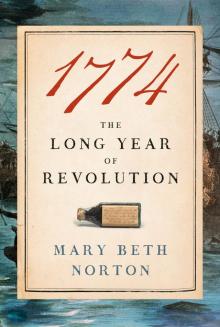
1774, p.1
1774, page 1


ALSO BY MARY BETH NORTON
Separated by Their Sex: Women in Public and Private in the Colonial Atlantic World
In the Devil’s Snare: The Salem Witchcraft Crisis of 1692
Founding Mothers & Fathers: Gendered Power and the Forming of American Society
Liberty’s Daughters: The Revolutionary Experience of American Women, 1750–1800
A People and a Nation: A History of the United States (co-author)
The British-Americans: The Loyalist Exiles in England, 1774–1789
THIS IS A BORZOI BOOK PUBLISHED BY ALFRED A. KNOPF
Copyright © 2020 by Mary Beth Norton
All rights reserved. Published in the United States by Alfred A. Knopf, a division of Penguin Random House LLC, New York, and distributed in Canada by Penguin Random House Canada Limited, Toronto.
www.aaknopf.com
Knopf, Borzoi Books, and the colophon are registered trademarks of Penguin Random House LLC.
Library of Congress Cataloging-in-Publication Data
Names: Norton, Mary Beth, author.
Title: 1774 : the long year of Revolution / Mary Beth Norton.
Other titles: Long year of Revolution
Description: First edition. | New York : Alfred A. Knopf, 2020. | “This is a Borzoi book” | Includes bibliographical references and index. |
Summary: “A book on the American Revolution that looks at the critical ‘long year’ of 1774, and the revolutionary change that took place from December 1773 to mid-April 1775, from the Boston Tea Party and the first Continental Congress to the Battles of Lexington and Concord.”—Provided by publisher.
Identifiers: LCCN 2019021556 (print) | LCCN 2019981577 (ebook) | ISBN 9780385353366 (hardcover) | ISBN 9780385353373 (ebook)
Subjects: LCSH: United States—History—Revolution, 1775–1783. | Boston Tea Party, Boston, Mass., 1773. | United States. Continental Congress. | Lexington, Battle of, Lexington, Mass., 1775. | Concord, Battle of, Concord, Mass., 1775. | American loyalists.
Classification: LCC E208 .N635 2020 (print) | LCC E208 (ebook) | DDC 973.3—dc23
LC record available at https://lccn.loc.gov/2019021556
LC ebook record available at https://lccn.loc.gov/2019981577
Ebook ISBN 9780385353373
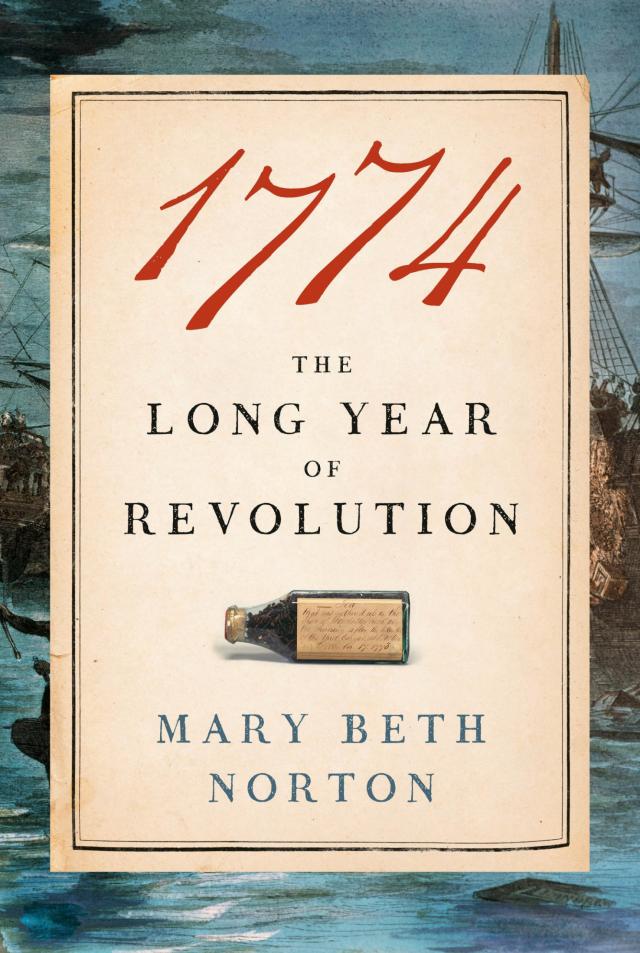
Cover images: (bottle) Boston Tea Party tea leaves, collected by T. M. Harris, Dec. 1773. Massachusetts Historical Society, Boston, Massachusetts, USA / Bridgeman Images; (background) Boston Tea Party (detail). Bettmann / Getty Images
Cover design by Jenny Carrow
v5.4
ep
For Martha Farnsworth
and
To the Memory of Mary Elizabeth Lunny Norton
Come, come, my brave boys, from my song you shall hear,
That we’ll crown Seventy-four, a most glorious year.
—THE NEW-YORK JOURNAL, AUGUST 18, 1774
I almost wish to live to hear the triumphs of the Jubilee in the Year 1874, to see the medals, pictures, fragments of writings, &c., that shall be displayed to revive the memory of the proceedings of the Congress in the year 1774.
—DUNLAP’S PENNSYLVANIA PACKET, NOVEMBER 14, 1774
Contents
Cover
Also by Mary Beth Norton
Title Page
Copyright
Dedication
Epigraph
Acknowledgments
Introduction
1: That Cursed Tea
2: Divided Sentiments
3: This Barbarous Edict
4: Times of Perplexity, Danger, and Distress
5: Expecting Great Things
6: A Ferment Throughout the Continent
7: The Brink of a Precipice
8: A Constant State of Hot Debate
9: All Our Liberties at Stake
Afterword
Notes
Bibliography
Illustration Credits
ACKNOWLEDGMENTS
Any project that one has thought about for as long as I have thought about this book (since approximately 1972) has racked up the need for many acknowledgments. Over the years, students in my regularly taught undergraduate lecture course, Age of the American Revolution, helped to clarify my ideas, but special thanks are due to the enrollees, both graduate and undergraduate, in my 2012 seminar on the Revolution, and especially Tim Sorg, who generously shared research notes with me. A conversation with Holly Brewer as I began to think seriously about the shape of the book turned out to be crucial to its conceptualization. I also employed students as research assistants; thanks to the graduate students Molly Reed and Jacqueline Reynoso; and to the undergraduates Rachael Comunale, Caroline Estill (a Dartmouth student whose hometown is Ithaca), and Anne Powell. Rachael and Anne spent many hours transcribing innumerable political broadsides, a source that turned out to be more important than I anticipated; I am particularly grateful to them.
The audiences of talks based on my research supplied useful feedback; I thank attendees at St. Joseph’s University, Drayton Hall, West Virginia University, the Omohundro Institute, and other participants in two conferences: Constitutional Convention: 225th Anniversary of the Ratification at the University of Georgia in 2013, and Propaganda, Persuasion, and the Press and the American Revolution, 1763–1783 at the University of Hong Kong in 2016, sponsored by the Thomas Jefferson Memorial Foundation. My longtime friend, the late Pauline Maier, also participated in the Georgia conference. She strongly encouraged me to pursue this topic, and I had looked forward to receiving feedback from her as well, but her early death in August 2013 dashed those hopes.
As was true many years ago when I wrote my dissertation, I appreciated the wise counsel of Bernard Bailyn on an early draft of chapter 1. Special thanks go to my Cornell colleagues, who participated in a discussion of a draft of chapter 2 at our Comparative History Colloquium, where I benefited notably from the comments of Aaron Sachs, Robert Travers, and Rachel Weil. Michael McDonnell kindly read the entire penultimate manuscript. J. B. Heiser critiqued many of the chapters, identifying passages that needed clarification and amplification for readers who were not historians or specialists in the revolutionary period.
I could not have completed the extensive research required for this book without the assistance of librarians and archivists in many repositories. As always, I owe a great deal to Cornell’s Olin and Kroch Libraries, where Virginia Cole, Katherine Reagan, and the now retired Peter Hirtle and Anne Kenney, along with the interlibrary loan staff, supplied help above and beyond what any historian could reasonably request or expect. I also appreciated the ability to consult the online databases America’s Historical Newspapers (Readex) and Accessible Archives, to both of which Cornell subscribes. At Columbia University, I relied on Susan Hamson; at the New-York Historical Society, on Edward O’Reilly and Tammy Kiter; at William and Mary, on Amy Schindler; and on Mary Jo Fairchild at the South Carolina Historical Society. The staffs of the reading rooms of the Library of Virginia in Richmond, the Alderman Library at the University of Virginia, the Massachusetts Historical Society, the New England Historic Genealogical Society, the Boston Athenaeum, and the New York Public Library were unfailingly helpful, as were those at the Map Room of the National Archives at Kew and the Asia and Africa Room at the British Library, at both of which problems with inadequate indexes caused me to need additional assistance. At the Huntington Library, where I spent a month reading original pamphlets published between late 1773 and early 1775, Jaeda Snow and Alisa Monheim efficiently saw to it that I had access to multiple copies of the same publications, which proved eye-opening in their revelation of different printings, even if the pamphlets did not supply the marginalia I sought.
At other archives, I did not visit in person but nevertheless received copies of relevant documents from helpful staff members: Graham Duncan (South Caroliniana Library); Katherine Wilkins (Virginia Historical Society); Steve Rice (Connecticut State Library); Barbara Austen (Connecticut Historical Society); Sarah Bost (University of North Carolina–Chapel Hill); and Stephanie Fong (Newberry Library).
Apart from librarians and archivists, I thank James Fichter of the University of Hong Kong, with whom I have shared many conversations in person and online about tea controversies in 1773 and 1774; and the National Park Service staff at the Cape Cod National Seashore (George Price, the superintendent; Bill Burke, cultural resources program manager; and Chris Anderson, ranger), who ensured I was able to visit the probable site of the December 1773 wreck of the William. My friend Heather Huyck, retired from the Park Service, was essential in facilitating that visit.
My thanks too go to Victoria Wilson, my editor at Alfred A. Knopf, who offered guidance with a light hand; her assistant, Marc Jaffee; the designer, Betty Lew; and the meticulous copy editor, Ingrid Sterner.
Finally, this book is dedicated in part to my good friend Martha Farnsworth (Riche), a former director of the U.S. Census Bureau, who for years has joined me on travels to Caribbean islands and more recently to Italy. She and I bonded quickly when we first met in Ithaca years ago, especially after we learned we were both proud graduates of the University of Michigan. The other dedicatee is my mother, who died in August 2018 shortly before her 105th birthday. She too was a loyal University of Michigan graduate (class of 1935), and she inquired frequently abo ut the progress of this book. Alas, she did not live to see it in print.
INTRODUCTION
The year 1774 dawned sixteen days after the Boston Tea Party, and by the time its twelve months ended, the royal provincial governments were in disarray, the First Continental Congress had convened and adjourned, and the battles at Lexington and Concord were just three and a half months in the future.
That sentence opened the first chapter of my first book, published in 1972. My research on Loyalist exiles during the Revolution convinced me that events in 1774 were critical to the development of the movement for independence, and I have remained convinced of that conclusion ever since. This book is the belated result of that conviction.
In 1774, the phenomenon known as loyalism first appeared, as did the term “Loyalist.” The emergence of people who called themselves Loyalists signaled an important change in the colonial political climate, for their presence implied the existence of the opposite phenomenon: people who were openly disloyal. Before 1774, most politically aware Americans were united in criticizing policies about colonial taxation and governance that Parliament adopted after the end of the Seven Years’ War in 1763. Conservatives and radicals debated methods of resistance, but well into the 1770s free colonists uniformly identified themselves as loyal subjects of King George III and gloried in their membership in the British Empire. For revolution to occur, that identification as loyal Britons had to change: some men and women had to start thinking differently about America’s relationship with the empire, while others persisted in retaining their traditional loyalty to the Crown. I have come to term the period of dramatic change “the long 1774”—that is, the sixteen months between December 1773 and mid-April 1775. The unprecedented events that occurred in the English colonies in North America during those months are the subject of this book.
Almost all historians who study the Revolution as a whole have focused on the revolutionaries—the men who led resistance to Great Britain starting in the mid-1760s. For such scholars, developments in 1774 appear to be of a piece with previous occurrences. The Stamp Act riots of 1765, opposition to the Townshend Acts in 1767–1770, the Boston Massacre of 1770, the Gaspee incident of 1772: all seem to lead inexorably, if not almost inevitably, to the revolutionary war that followed. When historians have concentrated on events preceding the outbreak of fighting, they have devoted considerably more attention to Massachusetts than to the rest of eastern North America.
Yet a focus on those who remained loyal to the empire points up the significance of events in 1774 throughout the colonies, not just in Massachusetts. The evolving tactics pursued by colonial opponents of British policies began to cause new divisions in popular opinion, everywhere leading to increasing political polarization. Still, almost all scholars who have studied the Loyalists have confined their attention specifically to that subject, rather than venturing to approach the wider topic of the Revolution as a whole from the perspective of their previous work on those loyal to the Crown.
This book, by contrast, has been shaped by my long-standing interest in the Loyalists. Rather than viewing the months between December 1773 and April 1775 with the common implicit or explicit assumption that resistance leaders commanded a people largely unified around a radical agenda, it reveals the many debates, disagreements, and disruptions that characterized the period in all the colonies, from New Hampshire south to Georgia. Instead of privileging the viewpoints of men like Samuel Adams and focusing almost exclusively on his province of Massachusetts, it gives voice to such moderate colonists as Joseph Reed and John Dickinson of Pennsylvania and details the disputes that roiled New York throughout the year. It pays attention to the opinions of colonial officials and others who sent regular reports to London about political circumstances in their colonies. It also analyzes the writings of the Loyalist pamphleteers, who first published their vehement dissents while the Continental Congress was in session in September, and examines how more radical authors responded to Loyalists’ arguments.
I aim, in short, to include the views of all of those who participated in formal political discourse in the colonies in 1774, regardless of their gender, race, or place of residence. I sought evidence in a variety of libraries, from the National Archives of the United Kingdom to the Huntington Library in San Marino, California, and many universities and state historical societies. The narrative has been constructed from the published and unpublished correspondence of political leaders and ordinary folk alike; from pamphlets and broadsides; from the official records of colonial governments and their revolutionary successors; and from newspapers with reports of local meetings and other activities, along with essays expressing a wide range of opinions. Because of the emphasis on formal political discourse, it devotes less attention to those who are often termed “the people out of doors,” although it does not exclude them entirely from consideration. As will be seen in the following pages, people who did not leave written records of their opinions nevertheless revealed their ideas through their actions.
The book’s basic narrative is perhaps deceptively familiar. It begins in October 1773, when seven ships carrying East India Company (EIC) tea sailed from Great Britain to North America under the terms of the recently adopted Tea Act, which for the first time allowed the EIC to sell its tea directly to colonists. Five arrived in the ports of Boston, Charleston, and Philadelphia in December, while another wrecked on Cape Cod. The other vessel, blown far off course by an Atlantic gale, did not reach New York until April after spending the winter in Antigua. In Charleston, customs officers seized and stored the tea; in Philadelphia and New York, the ships were not allowed to enter the harbor; and in Boston, famously, men crudely disguised as Indians destroyed the tea. Subsequently, colonists had to await Britain’s reaction to the fate of the ships. News of that reaction first arrived in mid-May, with further details trickling in over the next few months. Americans learned that Parliament had closed the port of Boston until the tea was paid for, then followed up with a series of punitive laws known as the Coercive Acts.
During the summer of 1774, Americans everywhere discussed the appropriate response to such parliamentary measures, leading to the convening of the (First) Continental Congress in September. Before adjourning in late October, the congressmen adopted resolutions on the controversy and, more important, called for the creation of a series of local committees to enforce a trade boycott of Great Britain. Throughout the rest of the year, the committees worked to establish their legitimacy and, in conjunction with newly elected provincial congresses, began to challenge the authority of the existing colonial governments. By the first months of 1775, many people were expressing the belief that war would begin in the spring, and those predictions proved correct when clashes occurred at Lexington and Concord in mid-April.
That story is well known to historians. The debates and disagreements that lay behind it have commonly been ignored, with the partial exception of some local and state-level studies.
Although the Bostonians’ destruction of the tea is usually presented as unproblematic, it was not. Many colonists, including such prominent men as George Washington and Benjamin Franklin, believed that the destructive act was unwise.
The plan to elect a congress to coordinate opposition tactics came not from radical leaders but from conservatives who hoped for reconciliation with Britain. Then missteps by colonial governors obeying shortsighted directives from London helped to turn a body that could possibly have been the moderating force conservatives sought into one that went in a different direction.
Extralegal bodies formed by towns, counties, and provinces as directed by the congress encountered many obstacles to their exercise of authority, including doubts and hesitations from their own members.
The most vocal advocates of the freedom of the press and of the right to dissent in 1774—both key values for modern Americans—were not revolutionaries but Loyalists, who complained loudly and long about being denied the ability to publish their views freely.