The dark lord, p.1
The Dark Lord, page 1


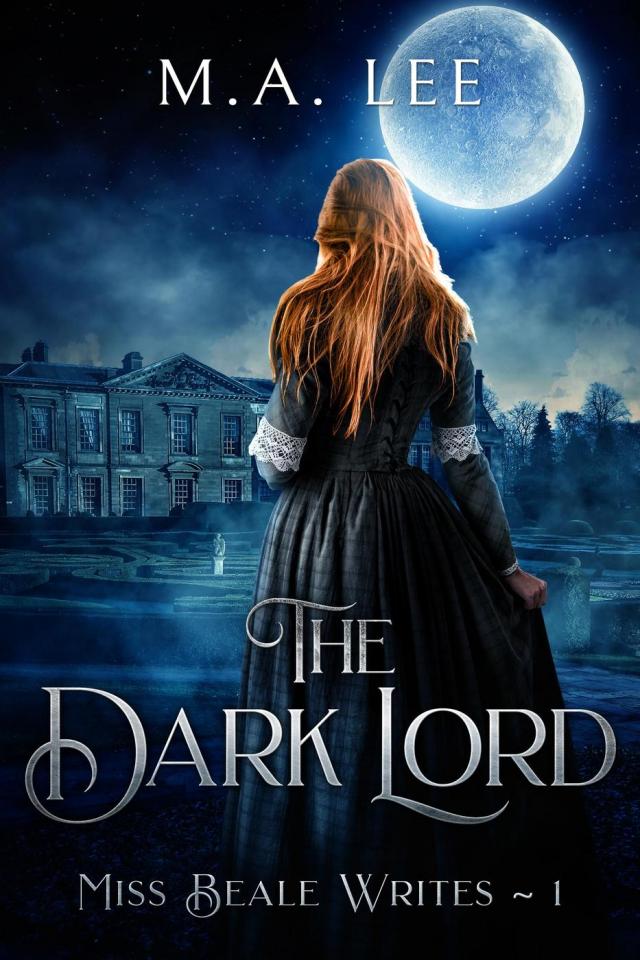
The Dark Lord
Miss Beale Writes
by
M. A. Lee
Table of Contents
Title Page
The Dark Lord (Miss Beale Writes)
Fiction by M.A. Lee
To the Reader
~1~
~2~
~3~
~4~
~5~
~6~
~7~
~8~
~9~
~10~
Thank You!
Hearts in Hazard by M.A. Lee
The Into Death series
Sign up for M.A. Lee's Mailing List
Further Reading: The Hazard with Hearts (book 12)
The Dark Lord
Copyright © 2022 Emily R. Dunn /
Doing Business as M. A. Lee & Writers’ Ink
First electronic publishing rights: March 2022
All rights are reserved.
No part of this book may be used or reproduced in any manner whatsoever without written permission, except in the case of brief quotations embodied in critical articles and reviews. The unauthorized reproduction or distribution of this copyrighted work is illegal. No part of this book may be scanned, uploaded, or distributed via the Internet or any other means, electronic or print, without the author’s or Writers’ Ink permission.
NOTE FROM THE AUTHOR
This book is a work of fiction. The names, characters, places, and incidents are products of the writer’s imagination or have been used fictitiously and are not to be construed as real. Any resemblance to persons, living or dead, actual events, locale or organizations is entirely coincidental. The author does not have any control over and does not assume any responsibility for third-party websites or their content.
Published in the United States of America
Cover Image licensed through ShutterStock
www.writersinkbooks.com
winkbooks@aol.com
Fiction by M.A. Lee
12 Books of the Hearts in Hazard series
A Game of Secrets
A Game of Spies
A Game of Hearts
The Dangers of Secrets
The Dangers for Spies
The Dangers to Hearts
The Key to Secrets
The Key for Spies
The Key with Hearts
The Hazard of Secrets
The Hazard for Spies
The Hazard with Hearts
Into Death ~ Post World War I
Digging into Death
Christmas with Death
Portrait with Death
the Miss Beale Writes series
a touch of gothic, a touch of mystery
The Dark Lord
The Captive in Green (coming soon)
The Prisoner of Stone (coming after)
The Red Monk (coming later)
The Bride in Black (a title change) (coming later)
Moonlight on Silver Spurs (coming later)
To the Reader
When I wrote The Hazard of Hearts in 2020, I incorporated a sly character, a novelist, sister to the atrocious doctor, by name of Miss Beale. I listed six titles that Miss Beale had written. All had either a gothic tone or a touch of mysterious history. Then I proceeded to close out the Hearts in Hazard series and look for other things.
Yet those titles haunted me. I should have anticipated that they would. The Dark Lord. The Captive in Green. The Prisoner of Stone. How could those titles fail to haunt someone? My bird-flitting mind proceeded to hatch story ideas for each of the titles even though I had other writing to seize my concentration.
The Dark Lord clamored to be next. I was even a third of the way into a different novella for my fantasy pen name. Then I walked to my desk, and when I looked up, I had 3,000 wonderful words that I never intended to write. And my hand cramped from holding the pen.
Last Christmas, I had a dozen different tasks that had to be completed, yet The Dark Lord continued to haunt me. And The Captive in Green began to demand her own story. Why am I surprised at this turn of events?
Herewith, The Dark Lord. The other novellas in the Miss Beale Writes series will gradually trickle out. Each will be a suspenseful stand-alone, some with touches of the gothic, all with a mysterious recurring character—for that is the taste of the character of Miss Beale.
Enjoy!
~ M.
~1~
“You’re not to look at `im.”
That order about meeting her future employer certainly surprised Elizabeth. “I beg your pardon?”
The whiskered withered man did not himself look at her. He hadn’t stopped or even hesitated as he led her along the back hall. The dark paneled walls absorbed the light from the few sconces. On a sunny day, windows would admit the radiant sun and warm the shadowed interior. On this rainy day, the wind created a chilling numbness, and gloom dominated, oppressive and unwelcoming.
“He don’t like being gawked at,” the older man said. “You keep your head down, eyes on the floor.” He muttered something else.
“My apologies,” Elizabeth was forced to say, not daring to let anything slip in her quest for a new position. She’d traveled up from London, jounced along in badly sprung coaches, squeezed between smelly passengers, her savings eking away at every overnight stop. The service agency hadn’t guaranteed a position. Apparently, Baron Harcourt wished to interview any potential employee. “I did not hear what you said, good sir.”
“I said ‘It’ll be lucky if’n you last the first week’.”
“I am stronger than I appear.”
“Aye, well, that’s to be seen. The others didn’t last.”
“Do all servants follow that rule, sir?”
“The ones that want to keep their positions.”
That certainly depressed her. Keeping her eyes down constantly—she didn’t know if that were possible. She’d never followed such a rule. Indeed, her father had always warned her and her mother to keep their eyes up and open, watching fellow wayfarers for potential trouble, spying the land for potential ambuscadoes. Following the drum had entailed heightened caution, and since she’d entered service five years ago, she found that the wiser course.
A housekeeper would be expected to assume her responsibilities quickly. “What is the number of staff?”
“His lordship will tell you.” The man stopped before a door with matched panels, triple circles carved inside each square. He didn’t knock, just opened the door and stepped back. “His lordship will be up from the stables momentarily. Stand before his desk. Don’t touch nothing!”
He’d shut the door before she gained the rug.
Eyes down, she shivered. Rain had seeped through the dove-grey redingote she wore like a uniform. The fire behind smoked a little, but the heat didn’t penetrate her wet clothes. She dreaded to think what her hair looked like. She could feel tendrils plastered to her neck and her cheeks. The old man had taken her boiled wool cloak and her soaked hat, its shape lost to the steady rain. Without the cloak, she had immediately chilled.
A half-hour passed, tolled by the great clock in the entrance hall. The fire’s heat started to penetrate her clothing. Elizabeth no longer shivered incessantly. And she had memorized the rug’s pattern.
She peeked around her.
Bookcases covered any wall space that wasn’t devoted to the hearth, to windows, or to the large map behind his lordship’s desk. She read York and Sheffield and guessed that it depicted the north of England. The wealth of books in this isolated corner of the moorland surprised Elizabeth. The bindings looked weathered by time and many hands.
A long table occupied the floor beneath the window wall. The rainy panes gave a blurred view of the desolate moor rising behind the house. Behind her was the cheerily dancing fire that fought the room’s chill. The desk before her was cluttered with three open ledgers and spills of spindled paper, a neat stack of foolscap to the left of the blotter. In the baron’s chair, a grey cat licked its paws.
The cat couldn’t be bothered to examine her.
But a greymalken! For the strangest reason, that cat gave Elizabeth hope.
Little else about this opportunity gave her hope. The agency’s director had doubted she would be acceptable. He’d presented her detriments: too young, too pretty, too well-dressed, too quick with her opinion. She could change only the last of those, and she refused to rid her wardrobe of perfectly suitable clothes.
Then the director had presented Feldstone Grange’s detriments: too remote, too unfriendly to Londoners, too detailed with his requirements for the housekeeper position. Elizabeth didn’t intend to remain long-term; once her father and brother returned from the war, she would keep their lodgings. Until then, she needed work to occupy her, and the salary at the Grange would build a tidy nest egg. She didn’t inform the director of her plans.
Until the coach dropped her in Widderby and the wagon trundled over a long road to the Grange, she hadn’t really understood the word remote. The old Greystone manor perched on a rising hill before the massive moor. Should the baron refuse her employment, they would have to offer her supper and breakfast and a place to lay her head before sending her back to Widderby. The land around the Grange looked well tilled, with pastures of cattle and sheep.
The moor brooded over everything, rocky and barren of all but heather. On this early spring day, frigid wind blew from the heights. The slaty clouds hinted at snow.
That old man had taken one look at Elizabeth without her rain-draggled bonnet and judged her incapable of the housekeeper’s p
She had inquired in London before she set out and again at Sheffield, York, and Thirsk, but little could she discover about the baron. The family had held Feldstone Grange and the region for centuries. Burnt-out ruins lay closer to Widderby. “New manor,” the carter had declared once the ruins came in view.
She had studied the blackened walls, the towers at the corners, reminiscent of the Tower of London. The pub host had said the Grange would be the grey-stoned building after the ruins. After the fire, the family had returned to the old Grange, with its sturdy stones.
Long and stolid, windows scattered along its breadth of the building. Multiple chimneys smoked at one end while no smoke drifted from the others. The Grange would be a nightmare for a maid to clean. Half-flights of stairs must access twisted passages. Damp rooms had hearths that would barely dissipate the cold. The unused end of the building would still need to be checked regularly.
Once inside, the entrance hall removed many of her fears about the house. Square and dominated by a stair with one landing, its painted walls held the weapons that often decorated old houses. Banners and family portraits brightened the entrance. Vividly painted doors led to four other rooms. She had looked around with obvious enjoyment. Several sconces and candelabra cast away the day’s gloom. While the flagstones looked dull and heavy, painted panels beneath the stairway led to a crossing for a back hall and more vividly painted doors. The stairs led to a well-lit open salon with corridors to either wing.
The décor would be the influence of the current baron and his father, perhaps his grandfather. Elizabeth had learned that the current Lord Harcourt had served king and country for several years, leaving the Grange to the tending of his steward. His father’s death in the previous year had recalled him to England. He’d spent the following Season in London, searching for a bride, only to return without one. He had no siblings, just a cousin. Beyond that, she’d discovered nothing about her potential employer.
She could assume, however. Whatever Lord Harcourt was like, he’d obviously been desperate for a housekeeper. The agency director complained that she would be the sixth in as many months. He had no explanation for their departure. That whiskered old man had claimed she wouldn’t last a week. She wished to prove him and the agency director wrong.
The grey cat jumped onto the desk then to the floor. It prowled close to Elizabeth without nearing her then curled up before the fire.
A boy came in to renew the fire with coals. He started when he spotted her then ducked his head. He didn’t look at her again. He lighted a lamp at the desk then scurried out.
Gawking, the older man had said. She must remember to avoid that.
Full dark came. The rising moor looked a blacker bulk against the starry night.
Then the door opened once again.
Elizabeth straightened her spine. Mindful of a good impression, she stared at the rug.
“Hicks,” the man shouted into the hall. He waited, then footsteps approached. “Has she been standing here this whole while? I daresay she was soaked through when she arrived.”
“Aye, your lordship, she were.” The voice belonged to the whiskered man.
“Did you think to give her hot tea? Fetch a pot. Bring something sustaining.”
“Aye, your lordship.”
Mr. Hicks left, his steps quickly muffled. The baron passed her with quick strides, speaking as he neared. “My apologies. They did not inform me that you had arrived until I came in from the fields.” He sat in his seat.
“I have not waited that long, Lord Harcourt. An hour and a little more, that is all.”
“Nevertheless—.” He didn’t complete that. In the upper edge of her vision, she saw the ledgers shifted. Papers rustled. “Miss Elizabeth Fortescue. You are applying for the housekeeper position?”
“Yes, my lord.”
“You do not look old enough to have worked in five different households in five years. You must have started very young.”
Her gaze lifted before she could control it. She saw a long narrow face, a flash of dark eyes, and a faded scar slashing down his cheek, a sword cut, obviously gained in battle. Long dark hair, the ends still wet, flowed over his wide shoulders. His white linen shirt looked stark against his tanned skin. Handsome, except for the scar. From her days following the drum, she knew the nature of sword wounds: garish red and inflamed for several months, even after the fever left.
Lord Harcourt didn’t catch her look, for he was staring at the papers that the agency had sent, the one with her qualifications, the second with her recommendations. Elizabeth quickly returned her gaze to the rug and answered his comment about her age. “I entered service as a housekeeper at fifteen, my lord.”
“Fifteen!”
“My father’s man-of-business gave me shelter when I returned from Portugal. His household was woefully mismanaged. When the housekeeper left, I assumed the management of it, and he proceeded to pay me.”
“That is Mr. Severest? His recommendation is glowing. I assume the housekeeper didn’t like your attempts to correct her mismanagement. Why did you leave his employment?”
“His wife returned from Ireland. She’d spent several months there, assisting her elderly parents.”
“You stayed with Mr. and Mrs. Francis Beauchamp for ten months.”
“Until her confinement ended and she was able to resume management of their household.”
“The Tremaines give an adequate recommendation, certainly not glowing.” He glanced up, catching her peeking. She saw his mouth twist before she dropped her gaze.
“Lady Tremaine dismissed me after a few months. My interactions with her family were ... difficult, shall we say?”
“A son?” he hazarded.
“No, my lord. Their children were too young to have any interactions with me.”
“Tremaine himself? Sir Henry Tremaine?”
She didn’t respond. Sir Henry Tremaine’s attentions were not worthy of mentioning—although she did not encounter difficulties from Lady Tremaine until she asked that she not take orders from him. Lord Harcourt did not need to know that.
When he realized she wasn’t going to answer, he asked, “Lady Millingrove? I see the agency listed you were there over a year and a line is here from a Chesterton, yet her ladyship does not provide a recommendation.”
“She is deceased, my lord. Last quarter. At her solicitor’s request I remained in employment there until the house was purchased.”
“You did not wish to work for the man that purchased the house?”
“No, Lord Harcourt.”
He settled back into his chair, his gaze assessing. She could clearly envision what he saw. A woman of 20, rain-bedraggled, her red hair still darkened by the water, her skin pale and lightly freckled. Her youth he’d complained of. What else would he find to reject her application? Not her qualifications, certainly.
“Where is your family?”
“My father and my brother are both in Portugal. My father is a field officer.”
“Major Fortescue? I believe I have heard of him.”
“He recently received a promotion to major, my lord. My brother is a lieutenant on Colonel Wellesley’s staff.”
“Where is your mother, Miss Fortescue?”
“No longer with us, my lord.”
“The occasion of your return from Portugal?”
She nodded without answering. He returned to studying the agency’s letter. “Lord Harcourt,” she thought it wise to say, “I am more than qualified for this position. I managed our household in Portugal after my mother fell ill. You see my recommendations here in England. Please do not prejudge me based upon my youth. I will say frankly that I need this opportunity, and apparently you need a housekeeper.”
His mutter sounded like something her brother Alexander would say.
The door opened, admitting a maid with a tea tray. “Here,” he said, “on the desk,” and he dropped the ledgers to the floor. She winced at the loud thuds.
The maid slid the tray onto his desk. A ceramic teapot with steam coming from the spout, two cups, two small plates, and a larger plate with an array of sandwiches. Her mouth watered. A fresh chill shivered her. The maid went out. She’d kept her eyes on the tray the entire time. Not once had she looked at her master.