

The roof, p.1
The Roof, page 1


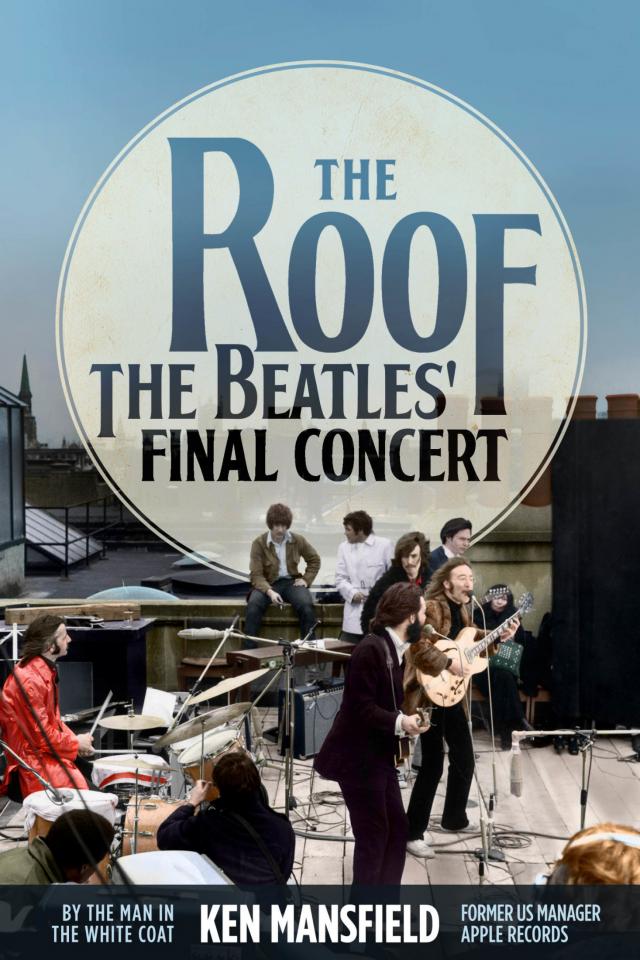
Echoes from
across the pond and the past…
“There is something quite Lennonesque about Mansfield’s soul-searching—his tales are astonishingly clear and vivid.”
—KEVIN GIORDANO, BarnesandNoble.com
“Ken Mansfield and I unknowingly shared the experience of the famous Apple rooftop session. Ken was not only working for the Beatles through their heyday, he was also their trusted friend. There is no one better equipped to tell the Beatles’ story truthfully—and more important—factually, from the inside.”
—ALAN PARSONS, Alan Parsons Project, Multi-Platinum producer and engineer to the Beatles/Pink Floyd
“Ken Mansfield worked in our offices in London and we crashed at his pad in Hollywood. We all hit it off immediately and he became an instant member of the Apple team. Even the Beatles took to him straight away. He is one of the few insiders left that bore witness to the highs and lows of those insane days when we ruled the world.”
—JACK OLIVER, former president, Apple Records (1969–1971)
“Ken Mansfield brings us a new and closely personal perspective not only on the Beatles, but on a whole cast of characters. I lived through those Apple years with Ken and we became friends. It is a pleasure to experience so much of it all again through the accuracy of his storytelling and the clarity of his memory.”
—PETER ASHER, Peter & Gordon/A&R chief, Apple Records/producer-manager (James Taylor, Linda Ronstadt, Carole King)
“Ken has a unique gift. He can take you in the room and have you sit with the folk he knows and make you one of the gang, part of the plan. And considering these folk include the Beatles, that is some doing. I respect the affection he has for our game, and what he brought to it will get you.”
—ANDREW LOOG OLDHAM, manager and producer, Rolling Stones
A POST HILL PRESS BOOK
ISBN: 978-168261-757-1
ISBN (eBook): 978-1-68261-758-8
The Roof:
The Beatles’ Final Concert
© 2018 by Ken Mansfield
All Rights Reserved
Published in association with the literary agency, WTA Services LLC, Franklin, TN.
Cover design by Ryan Truso
This is a work of nonfiction. Events, locales, and conversations are reconstructed from the author’s memory. These stories have been retold as faithfully as possible, but all stories are those of the author and as such may be subject to discrepancies in details from actual events. However, in all cases, the author has attempted to assure that the essence of events and dialogue are as accurate as possible.
No part of this book may be reproduced, stored in a retrieval system, or transmitted by any means without the written permission of the author and publisher.
Post Hill Press
New York • Nashville
posthillpress.com
Published in the United States of America
In Dedication and
Fond Remembrance
Alexis Mardas
Alistair Taylor
Billy Preston
Brian Epstein
Debbie Wellum
Derek Taylor
Doris Troy
George Harrison
George Martin
Jackie Lomax
John Lennon
John Tavener
Larry Delaney
Linda McCartney
Mal Evans
Maureen Starkey
Michael Gibbins
Neil Aspinall
Peter Ham
Ron Kass
Stanley Gortikov
Tom Evans
Not a bad apple in the bunch.
Something in the way they moved…me.
A TaBleau of Content
PROLOGUE: Colorado From Here
INTRODUCTION
FIRST FLOOR
The News That Day
Four Bar Intro
SECOND FLOOR
Planting the Apple Seed
Over There
The Cart Before the Corps
Apple Blossoms
US to UK
The Apple Meetings
THIRD FLOOR
The Mayfair District
3 Savile Row
FOURTH FLOOR
Building Pressure
The Calm After the Storm
Sgt. Preston, Holy Heart of The Band
FIFTH FLOOR
Roofer Madness
Set ’Em Up, Jo Jo
THE ROOF
A Day on The Roof
Moving Pictures
And the Band Played On…
Taking It to the Roof
Street Scene
Missing in Action
BRICKS AND MORTALS
Rough Mix
Rooftop Redhead
Get Back Girl
Oliver With a Twist
Gentle Giant
EPILOGUE: I Went into a Dream
Endnotes
Acknowledgments
CONTRIBUTING FACTORS
CONTRIBUTING EDITOR
Marshall Terrill
HISTORICAL CONSULTANTS
Bruce Spizer
Mark Lewisohn
Robert Rodriguez
Stefan Granados
GENERAL EDITOR
Cara Highsmith
The Roof: The Beatles’ Final Concert original text also includes some updated material and excerpts from Ken Mansfield’s 2007 release The White Book which is currently out of print. For more Apple-related stories and visuals, visit The White Book’s website at www.fabwhitebook.com.
PROLOGUE
The Northern Idaho Panhandle, 1946
I look down at feet covered with the dust from fields and dirt roads. I look up from my beginnings here on the edge of northern Idaho’s great Camas prairie. I am nine years old and this soil and the spaces within a few-mile radius are all I know. I look out at vastness and can feel timeless dimension. Our nearest neighbor is a quarter-mile away and we only see them when one of us needs help. I’m common; we’re dirt poor, and we live far away from the small sawmill town down by the rivers. My companions are the fields, ravines, streams, a bothersome younger brother, and a dog named Blackie. Our toys are things we find abandoned alongside the country roads on our long walks to the local schoolhouse and usually have something to do with sticks, stones, or string. Life is simple. I am bored. I have no idea how blessed I am growing up here.
I am different, but don’t know why I know that. Something is missing, deeply needed, or waiting in the distance. There’s something beyond these windswept hills, but I haven’t experienced enough of life to imagine what it could be.
I can’t get enough music. I live for the handful of programs that feature records two or three times a week on our local radio station—lots of weather and farm news, but the scheduling is short on songs. Neil McCracken, who lives over in the orchards, told me about this new invention called television, and so at night I stare at the small light bulb on the radio dial trying to get a glimpse of the bands and singers coming out of that little box.
I scan the Andrew Wyeth world around me, taking in vast wheat fields and canyons leading to the apparent rivers far off in the distance. The view before me opens north and west toward a vast panorama of untouched terrain. My dad likes to brag that we can see Colorado from here, even though it is in the other direction. I turn and look down the rutted dirt road that leads away from this isolated place as it makes its way out into and across the Nez Perce Indian Reservation lands that border our home. This is the vantage spot that always captures me. Mesmerized, I stare at that road to somewhere and something that I am not even trying to discover—distant people and events I can’t even fathom. I am only nine years old for crying out loud…what do I know? I want a bicycle and the joy of discovering more than one treasure in a Cracker Jack box, not a philosophical adventure. I know now that I was sensing other places and experiences that weren’t even in my conceptual vocabulary. It was a pulling, a calling out, a magnetic draw…a beckoning.
Kenny!…Kenny!!…KENNY!!! I am being called home for dinner and even though there is nothing for the sound to bounce off of, my name echoes across the barren landscape until it finds me in the distance. It is a hot summer day, and yet I am drawn to a deeper warmth—my mom and her meatloaf. I turn away from somewhere else…for now.
My dad gives thanks for our daily provision. We eat in silence.
After dinner, I am given an apple for dessert. I take it outside and sit on the ground beneath an open window where I can hear my mom teaching my little brother his alphabet.
A is for Apple.
INTRODUCTION
Someone asked me how I could write an entire book about one event, a happening that lasted less than an hour. But that event was more than just a matter of forty-two minutes—there was so much more.
I was there. My story is an intimate account of an exhilarating time that took place from 1968 to 1970. There are scores of books with facts and details about Apple and the Beatles, but this is about much more than that. Not only did I go up to the roof with them, I also had the privilege of becoming part of Apple’s creative evolution and can uniquely share the sequence of events leading to that historic moment. It was Rock ‘n’ Roll providence that led me to 3 Savile Row in London’s aristocratic Mayfair district and into the Beatles’ realm. The day I walked up a few stairs from that fabled street and passed through the wondrous door into the Beatles’ magical world and their brand-new home, my life was changed forever.
There were only a few of us who witnessed the concert on the roof up-close that day, each leaving that place with deep, life-long impressions that no biographer or researcher can understand or portray in distant words. My intent is for you to experience the depth of those feelings through my eyes. I tell this story from a unique standpoint: as a young man who came from far away to witness one of Rock ‘n’ Roll’s most historic events from just a few feet away. I now see the incidents leading up to the moment of their last live appearance as a tapestry being created over time, until one day the last threads were tied off with the thrust of timelessness in a final performance on a cold rooftop.
You can’t weave a tapestry without material. Some are woven with thread, some with colorful stories, some with elements brought from many different places, and even some that bring rich mixtures of the unusual onto an ethereal canvas of vast dimensions. Tapestries are not always created with a purpose. Sometimes scattered pieces find a place without intention, and then a magic moment integrates them into an artistic masterpiece.
That’s what happened on January 30, 1969, when a beloved band and a few of their mates climbed to the top of their Apple Corps headquarters at 3 Savile Row to share a final concert together. It seems inconceivable that an enduring, beautiful creation of tenacious art could find a dirty, old rooftop as its palette, where destined innovation, ragged threads, and vibrant yesteryears from unrelated spaces were blended together by four incredible artists into a moment that will never become unraveled in the hearts and minds of a generation.
Being there among the blessed few who witnessed that momentous event was surreal. About a dozen of us remain, and we are eternally bonded together by that moment.
I have purposely written this book from the heart, taking a less clinical approach so the reader can experience a more personal connection to those times. I talk about what I felt, pass on what I observed, and repeat what I heard at the time from workmates who shared in these events. I even include some unsubstantiated hearsay to round things out. I admit I get warm and fuzzy and even winsome in my recollections. There was something so incredible about all that went on in London, and even LA, leading up to that day, and I treat it with great respect. My primary purpose is to let it be known that at the core of the apple there were real people—everyday people—who, through odd coincidence, became almost folkloric to those who were enamored by their happenstance…common, good, exciting, and unique people thrown together by benevolent fate to share the experience of a lifetime.
I present these remembrances for two distinct audiences. First, I have in mind the aficionados, the researchers, the ones who have lived and died with the events of this band—those who know all there is to know about the Beatles from listening, learning, loving, and leaving no stone unturned when it comes to all things to do with the Fab Four. I want to share the essence of what it was like to experience being there in addition to knowing about it. I have purposely avoided having trivial minutiae as the driving factor here. Instead, the feel of the phenomenon became my guiding light so the entire experience could be enjoyed and understood more deeply. Those of you who have explored this subject so thoroughly over the years deserve this expansion of insight.
And second, I extend an invitation to the wide-ranging everyday fans—those who have reveled in the joy of the most famous band in musical history and followed four guys who so beautifully invaded our ears, eyes, hearts, and lives with their unique offerings. The Beatles not only gave us songs to sing, but also left us with unforgettable melodies and lyrics that have measured the timelines of our lives for decades. It’s hard not to hear “Yesterday” on the radio today without being taken back to a meaningful point in our lives…a reliving of moments with special places and memorable people that touched and changed us along the way. I sincerely invite you into the wondrous realization and understanding of how much there was to each of us during those times and how special it all was. What I discovered there is probably not what you may have expected. These were real people—maybe more like us than you ever imagined.
It is with great reverence, joy, and humility I share this experience with you.
C’mon, let’s go up on the roof.
Peace and love,
Ken Mansfield
Former US Manager Apple Records
It wouldn’t be appropriate for me to set the stage for this story without first setting the stage for the era of the late 1960s.
Some consider this a magical time in history; although, many have thought it was the end of times. There is a lot of truth in both remembrances.
Speaking as an American, the year 1968 proved to be one of the most volatile years in the twentieth century, starting with the assassinations of Martin Luther King, Jr. and Robert Kennedy. A hail of bullets and tear gas from the National Guard marred the Democratic National Convention in Chicago, while on the other side of the country, the Black Panthers in Oakland began baring their claws and flashing their shotguns. Anarchy and confusion were everywhere. Thousands of college students openly and defiantly burned their draft cards to protest the Vietnam War. Revolution was in the air, and the youth of the day threatened to topple the government.
Even in a pretty staid place like the Capitol Records Tower, the music culture was changing before our eyes, and so were we. I can even pinpoint the exact dates when this seismic shift took place: June 16–18, 1967.
The Monterey Pop Festival was not just the first major rock festival in the world, it became the model for future festivals—Woodstock in particular.
This is easier to picture today now that we have similar festivals as models, but imagine seeing, for the first time, the thousands of flower children, hippies, peaceniks, free lovers, and freer spirits who attended this festival over a three-day period. I’m talking about a very large gathering of mostly stoned people occupying a small space of the universe at one time. In those seventy-two hours, there was nothing but music and good “vibes” filling the confines of the festival grounds. Everybody was blissed out and enjoying the tranquility of the weekend. There were no fights, no one overdosed or died, and no one was hurt. I learned later that this makeshift mini-city had no arrests during the three-day festivities. In fact, the Monterey deputy chief of police was quoted in a local paper as having said, “We’ve had more trouble at PTA conventions.”
The irony in this situation is that Capitol Records had a reputation for being a fairly “straight” company in those days when it came to our artist roster. Much of the time I felt like a lonely voice in the wilderness when I would try to turn their attention to some of the bands playing the Sunset Strip clubs and other hole-in-the-wall rock joints in LA. For example, I wanted to sign artist Rick James and put together a racially-mixed group around him called Snow Black. Admittedly, it was very risqué for Capitol, but I wanted the company to take a chance on the vibrant street scene taking place in LA at the time. I felt that such a move would open the door to us attracting more contemporary bands to the label, and not doing so meant we held no appeal to the cutting-edge bands. Capitol was a very successful label, famous for its roster of top-tier acts, but times were changing, and we needed to climb down from our high “tower” and get down to street level because we were looking at the possibility of becoming the old folks home for once famous artists. There was a new game in town and the players had new moves and tight grooves, and it was time we started dancing as fast as we could.
In all honesty, as a company, we were vaguely aware of the Monterey Pop Festival that was coming up. It was happenstance that it was decided at the last minute that a few of us would attend the festival. One of the great things about being with Capitol was having major clout in everything we set out to do. Even though we made last-minute plans, we ended up with good accommodations at a nearby hotel and fifth-row center seats at the festival for the entire three days.






