The great fire, p.1
The Great Fire, page 1


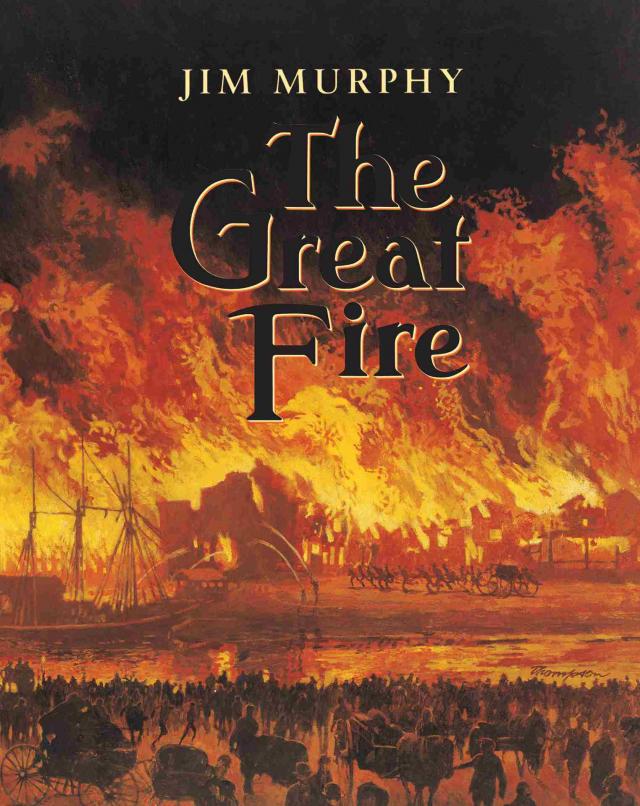
THE GREAT FIRE OF 1871 was one of the most colossal disasters in American history. Overnight, the flourishing city of Chicago was transformed into a smoldering wasteland. The damage was so profound that few people believed the city could ever rise again.
It all began one Sunday evening when a small fire broke out inside the O’Leary’s barn. The panic was slow to build at first. People ignored the danger signals, and even the fire department was unable to locate the fire. This city, built of wood, was connected by hundreds of miles of wooden sidewalks and roads. In time, wild flames, fueled by a steady wind, engulfed everything in their path. As people took to the crowded streets, hours of mounting chaos, fear, and panic followed before the relentless flames were halted. When at last they were, a new kind of drama was only just beginning. Nearly 100,000 people were homeless and searching through the burnt rubble for their families.
By weaving personal account of actual survivors together with the carefully researched history of Chicago and the disaster Jim Murphy constructs a riveting narrative that recreates the event with drama and immediacy. And finally, he reveals how, even in a time of deepest despair, the human spirit triumphed, as the people of Chicago found the courage and strength to build their city once again.
For Janet and Arthur —
good neighbors and good friends —
and for their son Lucas,
whose smile can light up a room.
About The Great Fire
Title Page
Dedication
Introduction
1 • A City Ready to Burn
2 • “Everything Went Wrong!”
3 • “The Dogs of Hell Were Upon the Housetops”
4 • “A Surging Ocean of Flame”
5 • “Chicago Is in Flames”
6 • “The Ghost of Chicago”
7 • Myth and Reality
Bibliography and Sources
Index
Acknowledgments
About the Author
Copyright
THE FIRE that swept through the heart of Chicago began on Sunday night, October 8, 1871. The Great Fire would burn for the rest of Sunday, all of Monday, and into the early hours of Tuesday with little real opposition.
During these thirty-one hours of terror, over 100,000 people were forced to flee the consuming flames. Many survivors wrote about their harrowing experiences in books, newspaper and magazine articles, or letters to friends and relatives. You will meet a number of survivors in this book, most of them just once or twice and only briefly. Several individuals have slightly longer accounts, including Catherine and Patrick O’Leary, in whose barn the fire began; James Hildreth, an ex-alderman who decided that the best way to save Chicago was by blowing up parts of it; and Julia Lemos, a widow who single-handedly saved her five small children and her elderly parents. Finally, you will be able to follow four characters in great detail. In order of appearance they are Joseph E. Chamberlin, a twenty-year-old reporter for the Chicago Evening Post; Horace White, the editor in chief of the Chicago Tribune; Alexander Frear, who was visiting relatives at the time of the fire; and Claire Innes, a twelve year old whose family had only recently moved to the city. Through the eyes of all these people you will see the fire from many distinct vantage points, and feel a wide range of emotions as the hot breath of the fire draws nearer and nearer.
IT WAS SUNDAY and an unusually warm evening for October eighth, so Daniel “Peg Leg” Sullivan left his stifling little house in the West Side of Chicago and went to visit neighbors. One of his stops was at the shingled cottage of Patrick and Catherine O’Leary. The one-legged Sullivan remembered getting to the O’Learys’ house at around eight o’clock, but left after only a few minutes because the O’Leary family was already in bed. Both Patrick and Catherine had to be up very early in the morning: he to set off for his job as a laborer; she to milk their five cows and then deliver the milk to neighbors.
Sullivan ambled down the stretch of land between the O’Learys’ and their neighbor, crossed the street, and sat down on the wooden sidewalk in front of Thomas White’s house. After adjusting his wooden leg to make himself comfortable, he leaned back against White’s fence to enjoy the night.
The wind coming off the prairie had been strong all day, sometimes gusting wildly, and leaves scuttled along the street; the sound of laughter and fiddle music drifted through the night. A party was going on at the McLaughlins’ to celebrate the arrival of a relative from Ireland. Another neighbor, Dennis Rogan, dropped by the O’Learys’ at eight-thirty, but he, too, left when he learned the family was in bed.
Fifteen minutes later, Sullivan decided to go home. As the driver of a wagon, he would need every ounce of strength come morning. It was while pushing himself up that Sullivan first saw the fire — a single tongue of flame shooting out the side of the O’Learys’ barn.
(Preceding image) 137 De Koven Street — where it all began. The original cottage in front with the door open was the portion Catherine and Patrick O’Leary rented to Patrick McLaughlin. The O’Leary family lived in the addition in back with the window boarded up. Note the wooden sidewalk. (Chicago Historical Society)
Sullivan didn’t hesitate a second. “FIRE! FIRE! FIRE!” he shouted as loudly as he could. Running clumsily across the dirt street, Sullivan made his way directly to the barn. There was no time to stop for help. The building was already burning fiercely and he knew that in addition to five cows, the O’Learys had a calf and a horse in there.
The barn’s loft held over three tons of timothy hay, delivered earlier that day. Flames from the burning hay pushed against the roof and beams, almost as if they were struggling to break free. A shower of burning embers greeted Sullivan as he entered the building.
He untied the ropes of two cows, but the frightened animals did not move. On the other side of the barn, another cow and the horse were tied to the wall, straining to get loose. Sullivan took a step toward them, then realized that the fire had gotten around behind him and might cut off any chance of escape in a matter of seconds. The heat was fiercely intense and blinding, and in his rush to flee, Sullivan slipped on the uneven floorboards and fell with a thud.
He struggled to get up and, as he did, Sullivan discovered that his wooden leg had gotten stuck between two boards and come off. Instead of panicking, he began hopping toward where he thought the door was. Luck was with him. He had gone a few feet when the O’Learys’ calf bumped into him, and Sullivan was able to throw his arms around its neck. Together, man and calf managed to find the door and safety, both frightened, both badly singed.
A shed attached to the barn was already engulfed by flames. It contained two tons of coal for the winter and a large supply of kindling wood. Fire ran along the dry grass and leaves, and took hold of a neighbor’s fence. The heat from the burning barn, shed, and fence was so hot that the O’Learys’ house, forty feet away, began to smolder. Neighbors rushed from their homes, many carrying buckets or pots of water. The sound of music and merrymaking stopped abruptly, replaced by the shout of “FIRE!” It would be a warning cry heard thousands of times during the next thirty-one hours.
(Preceding image) An overhead view of Chicago as it appeared before the Great Fire. Lake Michigan is in the foreground, and the Chicago River branches left and right. The South Side is on the left, while the North Side is to the right. (Harper’s Weekly, October 21, 1871)
(Preceding image) The Chamber of Commerce Building before the fire. It was one of many buildings the citizens of Chicago pointed to with pride. Many of the fancy details (such as those above the clock) were really carved out of wood. In addition, the mansard roof was made of tar and wood. (Author’s collection)
* * *
Chicago in 1871 was a city ready to burn. The city boasted having 59,500 buildings, many of them — such as the Courthouse and the Tribune Building — large and ornately decorated. The trouble was that about two-thirds of all these structures were made entirely of wood. Many of the remaining buildings (even the ones proclaimed to be “fireproof”) looked solid, but were actually jerry-built affairs; the stone or brick exteriors hid wooden frames and floors, all topped with highly flammable tar or shingle roofs. It was also a common practice to disguise wood as another kind of building material. The fancy exterior decorations on just about every building were carved from wood, then painted to look like stone or marble. Most churches had steeples that appeared to be solid from the street, but a closer inspection would reveal a wooden framework covered with cleverly painted copper or tin.
The situation was worst in the middle-class and poorer districts. Lot sizes were small, and owners usually filled them up with cottages, barns, sheds, and outhouses — all made of fast-burning wood, naturally. Because both Patrick and Catherine O’Leary worked, they were able to put a large addition on their cottage despite a lot size of just 25 by 100 feet. Interspersed in these residential areas were a variety of businesses — paint factories, lumberyards, distilleries, gasworks, mills, furniture manufacturers, warehouses, and coal distributors.
Wealthier districts were by no means free of fire hazards. Stately stone and brick homes had wood interiors, and stood side by side with smaller wood-frame houses. Wooden stables and other storage buildings were common, and trees lined the streets and filled the yards.
The links between richer and poorer sections went beyond the materials used for construction or the way buildings were crammed together. Chicago had been built largely on soggy marshland that flooded every time it rained. As the years passed and the town developed, a quick solution to the water and mud problem was needed. The answer was to make the roads and sidewalks out of wood and elevate them above the waterline, in some places by several feet. On the day the fire started, over 55 miles of pine-block streets and 600 miles of wooden sidewalks bound the 23,000 acres of the city in a highly combustible knot.
(Preceding image) This picture of Chicago in 1820 shows the open prairie stretching to the horizon. (Author’s collection)
(Preceding image) Chicago was built on marshland as this scene from 1833 makes clear. As the city grew in size, the roads, sidewalks, and buildings were gradually raised to alleviate the muddy conditions. (Author’s collection)
Fires were common in all cities back then, and Chicago was no exception. In 1863 there had been 186 reported fires in Chicago; the number had risen to 515 by 1868. Records for 1870 indicate that fire-fighting companies responded to nearly 600 alarms. The next year saw even more fires spring up, mainly because the summer had been unusually dry. Between July and October only a few scattered showers had taken place and these did not produce much water at all. Trees drooped in the unrelenting summer sun; grass and leaves dried out. By October, as many as six fires were breaking out every day. On Saturday the seventh, the night before the Great Fire, a blaze destroyed four blocks and took over sixteen hours to control. What made Sunday the eighth different and particularly dangerous was the steady wind blowing in from the southwest.
* * *
It was this gusting, swirling wind that drove the flames from the O’Learys’ barn into neighboring yards. To the east, a fence and shed of James Dalton’s went up in flames; to the west, a barn smoldered for a few minutes, then flared up into a thousand yellow-orange fingers. Dennis Rogan had heard Sullivan’s initial shouts about a fire and returned. He forced open the door to the O’Learys’ house and called for them to wake up.
Moments later, Patrick emerged from the cottage, still half asleep. “Kate!” he screamed the moment he saw what was happening. “The barn is afire!”
Their first action was to get their children out of the house and into the street safely away from the fire. The barn was already engulfed in flames, so Patrick and a group of neighbors began pouring water on the cottage. It would catch fire several times during the night, but the flames would be smothered before they could get out of control. Strangely enough, the cottage on the O’Leary property would survive with little damage.
At about this time William Lee, who lived down the block from the O’Learys’, went into his seventeen-month-old son’s room to see why the child was crying. After comforting his son, Lee went to fasten the window blind. Outside, he saw a crimson night sky lit up by flames and flying embers. Already some of those embers were landing in his yard and igniting the grass and leaves.
Lee hesitated a moment before shouting to his wife to take care of the baby and rushing out of the house. He ran the three blocks to Bruno Goll’s drugstore, determined to do what no one else in the neighborhood had thought about doing: turn in a fire alarm. At this point, the fire was barely fifteen minutes old. What followed was a series of fatal errors that set the fire free and doomed the city to a fiery death.
(Preceding image) Goll’s drugstore to which William Lee raced to turn in a fire alarm. The picture is badly scratched, but someone has drawn a big arrow to point out the fire alarm box. No one in the picture has been identified, but it is possible that the man to the right is Bruno Goll. (Chicago Historical Society)
(Preceding image) Street map of sections destroyed by the fire. While the map shows only a small portion of the actual city of Chicago, this area was the chief business and cultural center, and housed nearly one third of its citizens.
WHEN WILLIAM LEE reached Goll’s drugstore, he was gasping for air and frantic. In a breathless voice, Lee demanded the key to the alarm box that was mounted on the outside of the store. Bruno Goll refused to hand it over, insisting that a fire truck had already passed.
Lee had no time to argue with Goll. He was too concerned about the safety of his family, so he hurried back to them almost immediately. He got there just in time to see the fire taking hold of his neighbor’s shed and fence, while the breeze blew a rain fire on his property. Two things were very clear to Lee: First, despite what Goll had said, no fire engines had arrived, and, second, his house was about to catch fire.
Lee’s wife grabbed the baby and carried him outside, while Lee rounded up a few valuables and some food and put them in a cloth sack. The family fled to a vacant lot a block away where they spent the night watching the fire’s terrible march. Oddly enough, the singed calf that “Peg Leg” Sullivan had helped escape came and stood by the Lees until dawn.
(Preceding image) A steam pumper and crew race to a fire. (Author’s collection)
As for Goll, he claimed later at the official inquiry into the fire that he had waited for Lee to leave and then turned in the alarm. Goll also insisted he turned in a second alarm when another man appeared ten minutes later to announce that the fire was spreading rapidly. Whether Goll lied about sending the alarms or whether the alarm box failed to work will never be known. What is clear, is that no alarm was recorded at the central alarm office in the Courthouse at the point when the fire was still containable.
A few minutes after the second man hurried away, Goll took off his apron, carefully extinguished the store’s gaslights, and left, locking the door behind him. Like thousands of other people, he was on his way to De Koven Street to watch the fire.
While this was happening near the fire, more errors were taking place a mile and a half away. Chicago had recently renovated its fire alarm system, making it one of the best in the nation. Each firehouse had a watchman who scanned the immediate neighborhood for flames or smoke during the night. Overlooking the entire city was a watchman in the cupola of the Courthouse, one hundred feet above the ground. If a fire was spotted, an alarm was telegraphed (either from the firehouse or from one of the many alarm boxes situated around town) to the Courthouse; the Courthouse watchman then relayed the location of the blaze to the firehouses nearest to it. For added security, the giant Courthouse bell was also rung. Because of the drought, special Insurance Patrols had been organized and Benjamin Bullwinkle was appointed to head them. These patrols roamed the streets at night, ready to put out small fires with chemical extinguishers and turn in alarms for bigger blazes. While this system sounds very cumbersome to us, back in 1871 it was considered quite speedy and efficient.
(Preceding image) A side view of a steam fire engine that was designed and manufactured by L. Button & Son in Waterford, New York. Steam is created in the upright tubular boilers on the left, then channeled through copper pipes to the pumping engine at the front of the machine. This contraption weighed four thousand pounds but could throw water two hundred and thirty feet. (Author’s collection)
On duty at the Courthouse that night was forty-year-old Mathias Schaffer. Schaffer was showing some visitors around the tower when one of them pointed to smoke in the distance. Schaffer glanced at the smoke, but dismissed the sighting. It was just the smoldering embers from the previous night’s fire, he assured them. Nothing to worry about.
Several minutes passed before Schaffer looked up from what he was doing and saw flames leaping wildly into the black sky. The light was from a different fire after all; he’d been fooled because this new blaze was almost directly behind the still-flickering remnants of the Saturday October 7 fire.
He studied the flames, trying to determine their exact location. This wasn’t easy because of the distance and tall buildings between him and the flames. In addition, the moonless sky was made even murkier by the swirling, smoky haze. Schaffer signaled down the speaking tube and had his assistant strike Box 342. This sent engines rumbling through the streets — to a location almost a mile away from the O’Learys’ barn.
(Preceding image) With a statue of George Washington seemingly pointing the way, a steam engine clatters along a dark street. Since the boiler’s coal fire was burning to make steam, residents had to be on the lookout for potentially dangerous sparks and cinders that often fell in the street. (Author’s collection)