The dark side of the moo.., p.1
The Dark Side of The Moon, page 1


21-01-2024
ISBN 0-88733-022-3
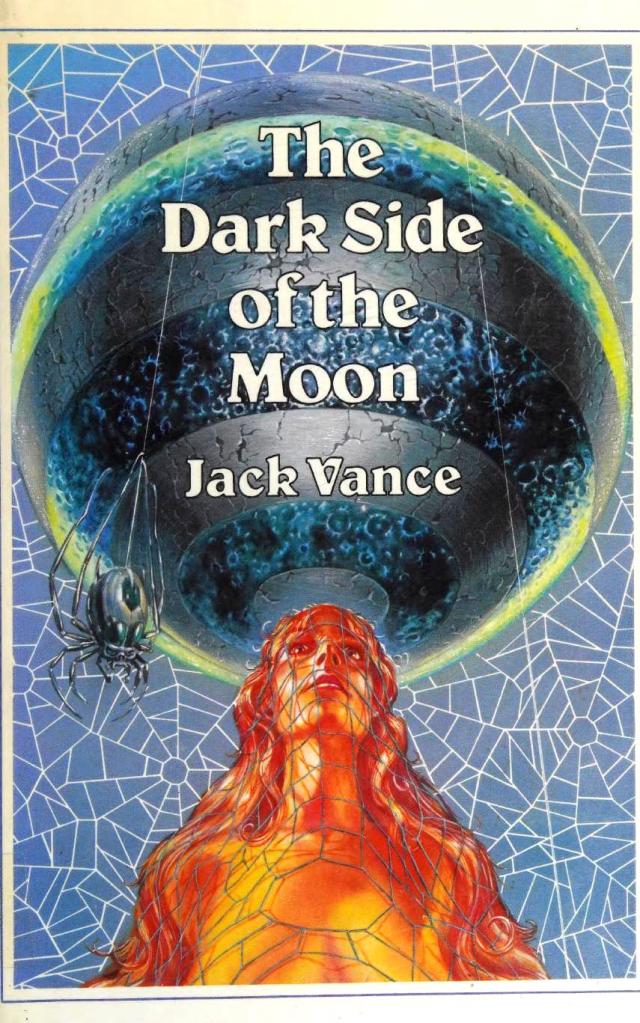
The Dark
Side of the Moon
Stories of the Future with an Introduction by
JACK VANCE
An old woodcutter woman, hunting mushrooms up the north fork of the Kreuzberg, raised her eyes and saw the strangers. They came step by step through the ferns, arms extended, milk-blue eyes blank as clam shells. When they chanced into patches of sunlight, they cried out in hurt voices and clutched at their naked scalps, which were white as ivory, and netted with pale blue veins.
The old woman stood like a stump, the breath scraping in her throat. She stumbled back, almost falling at each step, her legs moving back to support her at the last critical instant. The strange people came to a wavering halt, peering through sunlight and dark-green shadow. The woman took an hysterical breath and put her gnarled old legs to flight.
A hundred yards downhill she broke out on a trail; here she found her voice. She ran, uttering cracked screams and hoarse cries, lurching from side to side. She ran till she came to a wayside shrine, where she flung herself into a heap to gasp out prayer and frantic supplication.
UNDERWOOD-MILLER
San Francisco, California
Columbia, Pennsylvania
The Dark Side
Of the Moon
The
Dark Side
of the
Moon
Stories of the Future
by
Jack Vance
UNDERWOOD-MILLER
San Francisco, California
Columbia, Pennsylvania 1986
THE DARK SIDE OF THE MOON
Signed edition: ISBN 0-88733-021-5
Trade Edition: ISBN 0-88733-022-3
Copyright © 1986 by Jack Vance
Introduction © 1986 by Jack Vance
Dustjacket art © 1986 by Ned Dameron
An Underwood-Miller book by arrangement with the author. No part of this book may be reproduced in any form or by any electronic or mechanical means including information storage and retrieval systems without explicit permission, except by a reviewer who may quote brief passages. For information address the publisher, Underwood-Miller, 651 Chestnut Street, Columbia, PA 17512.
Printed in the United States of America
Typesetting by Metro Typography, Santa Cruz, California
Editorial Assistance: Ross Voyles. Book Design: Underwood-Miller.
All Rights Reserved
First Edition
Contents
Introduction
INTRODUCTIONS ARE THE BANE of a writer’s trade, at least for this writer. I have already composed two for this collection and both have been discarded, on grounds of excessive frivolity. Herewith: the third version.
As I look over the Table of Contents, I move up and down the gamut of emotions, from enthusiasm and pride to indifference. There are stories here forty years old, which I barely remember. Since I refuse to re-read them, my opinions are not to the point.
Well then; as for the stories I do recall:
Planet of the Black Dust was my second story in print. I can remember the mood I wanted to generate but little else. Same with Phalid’s Fate, my third in print, although I have never forgotten the name of the protagonist “Ryan Wratch.” I selected this name because I did not want to call him “Curt Wilson” or “Kent Stevens” or “Dirk Weston.” In a sense, I straddled two horses, “Ryan” being an OK name, while “Wratch” is overkill. I plead youth, inexperience and good intentions.
DP appeared originally in a magazine called Avon Science Fiction and Fantasy Reader. The editor was so affected by the story and believe so fiercely in its thesis, that he added an emotional coda to the last paragraph, thereby beating a very dead horse. I have deleted the editor’s extraneous remarks in this present version. The story was written at a quaint little village in the Austrian Tyrol, where, as I vividly recall, I was stung by a bee while sitting on the sunny balcony of the hotel. Could this have established a mood for the story, which is definitely morose? I think not.
I might mention that Norma and I revisted this village, Fulpmes, last year, and found a graceless modem town lacking every trace of its old romantic atmosphere. Sad to say, the situation is about the same, almost everywhere else in the world. Perhaps it is over-ingenuous to complain that romance is dead; still, I fear that a good case might be made, especially among young people.
Alfred’s Ark and First Star I See Tonight are two of my favorites. Alfred’s Ark tells you all you need to know in regard to the human condition. Background for First Star was assimilated during my association with Palomar astronomer Robert Richardson (“Philip Latham”), during the time we both wrote CAPTAIN VIDEO scripts for television. There are dark and sinister aspects to the astronomer’s life of which the public is unaware; this story, so I am told, prompts astronomers to nod in grim corroboration and look over their shoulders.
The Phantom Milkman derives from a rainy evening and several batches of rum punch in an old farm-house behind Kenwood, California, where the Vances and the Frank Herberts had taken up residence prior to departure for Mexico. Someone …or something…had delivered a quart of milk to the doorstep that morning. All day Norma and Beverly had been attempting to resolve the mystery, without success. We discussed the affair long into the night, and at last decided that in the absence of trained and experienced investigators, it might be fool-hardy to proceed further.
As for Parapsyche: ? ? ? I had been doing some reading in the field of psionics and decided to expatiate upon my own theories, using a story for the vehicle. The theories are as sound as any others in the field…which means that no one will want to use them for pitons while scaling El Capitan. Need I say more? I have quite forgotten the story itself, save that it involves a clergyman.
Before my first sale: The World-Thinker (not included here), I wrote an epic novel in the style of E. E. Smith’s cosmic chronicles. My own epic was rejected everywhere. I finally broke it into pieces and salvaged a few episodes for short stories. I think that The Temple of Han (originally The God and the Temple Robber) was one of these altered episodes.
As for the other titles, I can’t come up with any recollections or insights, and hence will say nothing whatever.
Just for fun and since I have the chance, I’d like to dedicate this book to the unique and charming
Janet Miller
First lady of Columbia, Pennsylvania
Jack Vance
December 28,1985
The Dark Side
Of the Moon
Sulwen’s Planet
1
PROFESSOR JASON GENCH, Professor Victor Kosmin, Dr. Lawrence Drewe, and twenty-four others of equal eminence filed from the spaceship to contemplate the scene on Sulwen Plain below. The startled mutterings dwindled to silence.
Even a hollow facetiousness met no response. Professor Gench glanced sidelong toward Professor Kosmin, to encounter Professor Kosmin’s bland stare. Gench jerked his gaze away.
Boorish bumbling camel, thought Gench.
Piffling little jackanapes, thought Kosmin.
Each wished the other twelve hundred and four light-years distant: which is to say, back on Earth. Or twelve hundred and five light-years.
The first man on Sulwen Plain had been James Sulwen, an embittered Irish Nationalist turned vagabond space-wanderer. In his memoirs Sulwen wrote: “To say I was startled, awed, dumbfounded, is like saying the ocean is wet. Oh, but it’s a lonesome place, so far away, so dim and cold, the more so for the mystery. I stayed there three days and two nights, taking pictures, wondering about all the histories of the universe. What had happened so long ago? What had brought these strange folk here to die? I became haunted, obsessed; I had to leave….”
Sulwen returned to Earth with his photographs. His discovery was hailed as “the single most important event in human history.” Public interest reached a level of dizzy excitement; here was cosmic drama at its most vivid: mystery, tragedy, cataclysm.
In such a perfervid atmosphere the “Sulwen’s Planet Survey Commission” was nominated, confirmed, and instructed to perform a brief investigation upon which a full-scale program of research could be based. No one thought to point out that the function of Professor Victor Kosmin, in the field of comparative linguistics, and that of Professor Jason Gench, a philologist, overlapped. The Director of the commission was Dr. Lawrence Drewe, Fellow of Mathematical Philosophy at Vidmar Institute: a mild wry gentleman, superficially inadequate to the job of controlling the personalities of the other members of the commission.
Accompanied by four supply transports with men, materials, and machinery for the construction of a permanent base, the commission departed Earth.
2
Sulwen had grossly understated the desolation of Sulwen Plain. A dwarf white sun cast a wan glare double, or possibly triple, the intensity of full moonlight. Basalt crags rimmed the plain to north and east. A mile from the base of the crags was the first of the seven wrecked spaceships: a collapsed cylinder of black-and-white metal two hundred and forty feet long, a hundred and two feet in diameter. There were five such hulks. In and out of the ships, perfectly preserved in the scant atmosphere of frigid nitrogen, were the corpses of a squat pallid race, something under human size, with four arms, each terminating in but two slender fingers.
The remaining two ships, three times the length and twice the diameter of the black-and-white ships, had been conceived and constructed on a larger, more flambo yant, scale. Big Purple, as one came to be known, was undamaged except for a gash down the length of its dorsal surface. Big Blue, the other, had crashed nose-first to the planet and stood in an attitude of precarious equilibrium, seemingly ready to topple at a touch. The design of Big Purple and Big Blue was eccentric, refined, and captious, implying esthetic intent or some analogous quality. These ships were manned by tall slender blue-black creatures with many-horned heads and delicate pinched faces half-concealed behind tufts of hair. They became known as Wasps and their enemies, the pale creatures, were labeled Sea Cows, though in neither case was the metaphor particularly apt.
Sulwen Plain had been the site of a terrible battle between two spacefaring races: so much was clear. Three questions occurred simultaneously to each of the commissioners: ~
Where did these peoples originate?
How long ago had the battle occurred?
How did the technology of the ‘Wasps’ and ‘Sea Cows’ compare with that of Earth?
There was no immediate answer to the first question. Sulwen’s Star controlled no other planets.
As to the time of the battle, a first estimate derived from the deposition of meteoric dust suggested a figure of fifty thousand years. More accurate and technical determinations ultimately put the time at sixty-two thousand years.
The third question was more difficult to answer. In somewhat comparable histories Wasp, Sea Cow, and man had come by different routes to similar ends. In other cases, no comparison was possible.
There was endless speculation as to the course of the battle. The most popular theory envisioned the Sea Cow ships sweeping down upon Sulwen Plain to find Big Blue and Big Purple at rest. Big Blue had lifted perhaps half a mile, only to be crippled and plunge headlong to the surface. Big Purple, with a mortal gash down the back, apparently had never left the ground. Perhaps other ships had been present; there was no way of knowing. By one agency or another, five Sea Cow ships had been destroyed in that final encounter.
3
The ships from Earth landed on a rise to the southeast of the battlefield, near to the location where James Sulwen originally had put down. The commissioners, debarking, lumbered out to the nearest Sea Cow ship: Sea Cow D, as it became known. Sulwen’s Star hung low to the horizon, casting a stark pallid light. Long black shadows lay across the putty-colored plain.
The commissioners studied the ruptured ship, inspected the twisted Sea Cow corpses, then Sulwen’s Star dropped below the horizon. Instant darkness came to the plain, and the commissioners, looking over their shoulders, returned to their own ship.
Later, after the evening meal, Director Drewe addressed the group: “This is a preliminary survey. I reiterate the obvious because we are scientists: we want to know! We are not so much interested in planning research as in the research itself. Well … we must practice a certain restraint. For most of you, these wrecks will occupy many years to come. I myself, unfortunately! am a formalist, a mathematical theorist, and as such will be denied your first-hand opportunity. Well, then, my personal problems aside: temporarily we must resign ourselves to a state of ignorance. The mystery will remain a mystery, unless Professor Gench or Professor Kosmin is already able to read one of the languages.” Here Drewe chuckled; he had intended the remark jocularly. Noticing the quick, suspicious glance exchanged by Gench and Kosmin, he decided that the remark had not been tactful. “For a day or two, I suggest a casual inspection of the project, to orient ourselves. There is no pressure on us; we will achieve more if we relax, and try to realize a wide-angle view of the situation. And by all means, everyone be careful of the big blue ship. It looks as if it might topple at a breath!”
Professor Gench smiled bitterly. He was thin as a shrike, with a gaunt crooked face, a crag of a forehead, a black angry gaze.41 ‘No pressure on us,’ ” he thought. “What a joke!”
“ ‘Relax!’ ” thought Kosmin, with a sardonic twitch of the lips. “With that preposterous Gench underfoot? Hah!” In contrast to Gench, Kosmin was massive, almost portly, with a big pale face, a tuft of yellow hair. His cheekbones were heavy, his forehead narrow and back-sloping. He made no effort to project an ingratiating personality; nor did Gench. Of the two, Gench was perhaps the more gregarious, but his approach to any situation, social or professional, tended to be sharp and doctrinaire.
“I will perform some quick and brilliant exposition,” Gench decided. “I must put Kosmin in his place.”
“One man eventually will direct the linguistics program,” mused Kosmin to himself. “Who but a comparative linguist?”
Drewe concluded his remarks. “I need hardly urge everyone to caution. Be especially careful of your footing; do not venture into closed areas. You naturally will be wearing work-suits; check your regenerators and energy levels before leaving the ship, keep your communications channels open at all times. Another matter: let us try to disturb conditions as little as possible. This is a monumental job, there is no point rushing forth and worrying at it like dogs. Well, then: a good night’s rest and tomorrow, we’ll have at it!”
4
The commissioners stepped out upon the dreary surface of the plain, approached the wrecked ships. The closest at hand was Sea Cow D, a black-and-white vessel, battered, broken, littered with pale corpses. The metallurgists touched analyzers to various sections of hull and machinery, reading off alloy compositions; the biologists began to examine the corpses; the physicists and technicians peered into the engine compartments, marveling at the unfamiliar engineering of an alien race. Gench, walking under the hulk, found a strip of white fiber covered with rows of queer smears. As he lifted it, the fiber, brittle from cold and age, fell to pieces.
Kosmin, noticing the effect, shook his head critically. “Precisely what you must not do!” he told Gench. ‘A valuable piece of information is lost forever.”
Gench drew his lips back across his teeth. “That much is self-evident. Since the basic responsibility is mine, you need not trouble yourself with doubts or anxieties.”
Kosmin ignored Gench’s remarks as if he had never spoken. “In the future, please do not move or disturb an important item without consulting me.”
Gench turned a withering glare upon his ponderous colleague. “As I interpret the scope of your work, you are to compare the languages after I have deciphered them. You are thus happily able to indulge your curiousity without incurring any immediate responsibility/’
Kosmin did not trouble to refute Gench’s proposition. “Please disturb no further data. You have carelessly destroyed an artifact. Consult me before you touch anything further.” And he moved off across the plain toward Big Purple.
Gench, hissing between his teeth, hesitated, then hastened in pursuit. Left to his own devices, Kosmin was capable of any excess. Gench told himself, “Two can play that game!”
Most of the group now assembled stood about Big Purple, which, enormous and almost undamaged, dominated Sulwen Plain. The hull was a rough-textured lavender substance striped with four horizontal bands of corroded metal: apparently a component of the drive-system. Only a powdering of dust and crystals of frozen gas gave an intimation of its great age.
The commissioners walked around the hull, but the ports were sealed. The only access was through an opening provided by the gash along the top surface. A metallurgist found exterior rungs recessed into the hull: he tested the structure: they seemed sound. While all watched he climbed to the ruptured spine of the ship, gave a jaunty wave of the hand and disappeared.
Gench glanced covertly at Kosmin, who was considering the recessions with lips pursed in distaste. Gench marched forward and climbed. Kosmin started as if he had been stung. He grimaced, took a step forward, put one of his big legs on the first insert.