

Faun over me a sapphic m.., p.1
Faun Over Me: A Sapphic Monster Romance (Camp Cryptid), page 1
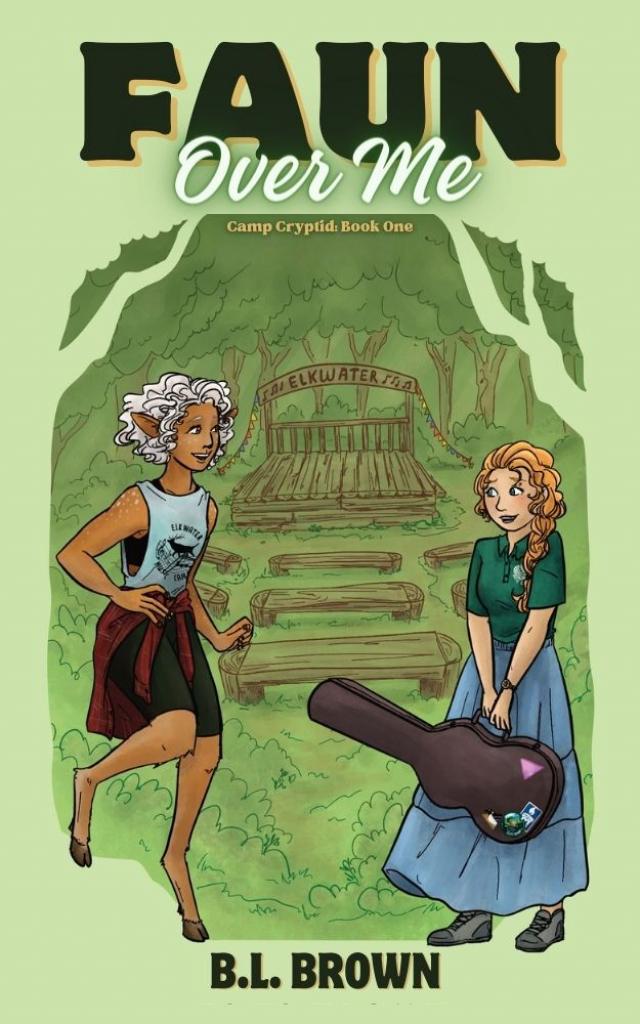


Copyright © 2024 by B.L. Brown
All rights reserved.
No part of this publication may be reproduced, distributed, or transmitted in any form or by any means, including photocopying, recording, or other electronic or mechanical methods, without the prior written permission of the publisher, except as permitted by U.S. copyright law. For permission requests, contact britta@goodintentpress.com.
The story, all names, characters, and incidents portrayed in this production are fictitious. No identification with actual persons (living or deceased), places, buildings, and products is intended or should be inferred.
Book Cover by Whitney Brown
Illustration by Lindsey Staton
ISBN 979-8-9879716-9-7 (pbk)
ISBN 979-8-9879716-8-0 (ebook)
1st edition 2024
If you see something in the woods, no, you didn't
Contents
Dedication
Content Warnings
Map
1. Cricket
2. Avery
3. Cricket
4. Avery
5. Cricket
6. Avery
7. Cricket
8. Avery
9. Cricket
10. Avery
11. Cricket
12. Avery
13. Cricket
14. Avery
15. Cricket
16. Avery
17. Cricket
18. Avery
19. Cricket
20. Avery
21. Cricket
22. Avery
23. Cricket
24. Cricket
25. Avery
Epilogue
Also by B.L. Brown
Thanks, y'all!
About the Author
To every daughter who was told to speak softly and dress pretty: I hope you burn brightly and love loudly.
Content Warnings
While the tone of Faun Over Me is lighter in spirit than Witch of the Demesne and Witches of C.R.O.W., the characters in these pages live in a world much like our own. As such, there are references to and instances involving the following topics and potential triggers. Please take care of yourselves.
XO – B.L. Brown
Religious trauma, Evangelicalism, dead-naming, emotionally abusive parent, on-page sexual acts (consensual), conscious and unconscious biases, homophobia, queerphobia, racism
1
Cricket
Sweetgum and mountain ash bowed and tussled, their branches creaking and groaning beneath gale-force winds. Rain fell in heavy sheets, obscuring the deer trail, and the only light came in intermittent bursts as lightning cracked overhead.
An exceptionally bright flash revealed the snaggled, clawed ends of a branch, and Cricket ducked low, narrowly avoiding having her eyes gauged out. She stumbled over a root, pinwheeling her arms to stay upright.
“Oak and ivy!” Her hoof came down on a mud slick, and Cricket skidded forward, barely grasping the thin trunk of a sapling cottonwood to stop her fall. She raised her free hand, shielding her eyes from the rain and squinting through the dark. She had to keep moving; had to get to the camp and out of this storm. Had to get walls and a door between her and whatever it was that stalked her through the woods. Her ears swiveled, seeking the sound of snapping twigs and thudding footfalls over the howl of the wind and pouring rain.
Nothing.
Nothing but the rain and the wind and the thudding of her heart in her ears.
She pushed off the cottonwood and darted across the clearing. Lightning cracked, illuminating the woods in an all-too-brief flash of white light—not so brief that she missed the looming shadow in the trees.
“Fuck.” Her ears snapped back. Adrenaline surged through her legs, sending her bolting across the tiny hollow. She ducked under branches and leaped over boulders and roots, running on sheer instinct alone.
Gods, she had to be close. Please, let her be close. She’d been running for hours, ever since that argument with her parents. As the crows flew, the camp was only eighteen miles away, an easy distance for a faun in good weather. And the trail well-known: up the ridge to Bald Knob, north for a ways, then down into Shavers Fork Valley before summiting Barton Knob and descending into Elkwater. Two hours on well-traversed deer trails frequented by their border patrol.
But in the rain? And with a monster snapping at her heels?
Gods, please, please let me be close.
She launched herself at a boulder blocking the path, grabbing onto slick, moss-covered roots dripping down the granite side. The flat hammered points of her fingercaps pinched the roots, her hooves scrabbling against stone as she hauled herself up.
Thunder rolled, a deep, visceral rumble Cricket felt in her gut, and a series of staccato lightning flashes followed, strobing across the sky and casting long, dreadful shadows over the stone. Jagged, bent shadows like fingers, or claws, or …
Antlers?
She jerked her head around, her grip on the roots failing at the sight of a beast looming at the edge of the hollow. Coarse stone scraped her arms as she fell, landing hard on her ankle. Pain barked up her leg, and she bit her tongue to keep from crying out.
Taller than an elder faun, the beast’s shoulders filled the space between the trees. Lightning illuminated a bone-white brow half hidden in the branches crowning its skull, giving the illusion of eight-point antlers.
Cricket bleated, fear pressing her back against the boulder. She couldn’t look away. Logic told her to run, to bolt, to use the adrenaline burning in her veins to escape, but she was caught by the same prey instinct that kept her family hiding in the woods. Frozen beneath the direct glare of a predator. Unable to act. Unable to move.
“Please,” she whimpered. Granite dug into her back, and her hair whipped in the wind, lashing against her cheeks and brow. Thunder rolled and rumbled, joining the trembling in her limbs, and only when the accompanying lightning sizzled away did she realize it wasn’t thunder she heard but a low, warning growl.
She should have listened to her mother. She should have stayed home and tried to reason with her parents when they had all calmed down, but no – she had to do what she always did and act rashly, and now she was going to be mauled to death by the same monster that had been terrorizing the people of Green Bank.
So many people had left, so many homes and properties snatched up by some company out of Georgia, and with every sale, the faun were pushed into smaller and smaller areas, forced out of the woods they had made their home over the last fifteen years. Seeing the county assessor tromping through her woods was the last straw. With his clipboard and surveyors’ maps, his presence and the little strips of neon pink he tied to branches could only mean one thing: the little sliver of the Monongahela her family called their home had been sold, and Cricket had had enough.
Enough packing up her den, enough rolling the reed mats and disassembling the thatch roof. Was it too much to ask to live somewhere and put down roots? To live somewhere long enough that she knew every trail and hollow in the wood with her eyes closed?
She’d begged them to consider living in a house with a foundation and walls, to become part of something instead of staring in through the windows. Instead of being forced out, she wanted them to elbow their way in, and they refused time and time again until Cricket had had enough.
Her cousin had left. Ten years ago, they had wandered into the woods and found all the things Cricket wanted for herself: a home, a place where they could live and breathe and grow. A wife. A life.
And now she’d have none of that because, like a doe-eyed dumbass, she’d run out into a storm and gotten herself chased by the very monster that had started all of their problems.
“Oh, Gods,” she blubbered.
“No Gods,” a voice rasped, brought to her ears by a sharp gust of wind. Musk and the faint scent of wintergreen tickled her nose as branches snapped, trees groaning and bending in the storm. “Not in this world.”
“Please,” Cricket begged again, eyes stinging from the rain and unshed tears. “I don’t want to die.”
“Then run.”
Lightning flashed, half-blinding Cricket and freeing her from the predator’s spellbinding gaze. She launched to the side, hissing at the pain in her injured leg as she darted through the trees. A cruel snapping of teeth clashed at her back, the monster giving chase.
This was stupid, this was so stupid. Every faun knew you never ran from a predator once sighted. It only delayed the inevitable. Still, Cricket ducked under branches and leaped over roots, tripping over her own hooves and splashing across flooded streams. She didn’t risk looking back, didn’t want to see how close the monster may be, or worse, find that it had vanished altogether, returned to stalking her silently and unseen. So she ran through the pain in her leg, scrabbled upright when she fell, and let thin, whip-like branches snap at her back.
Rocks and stones scraped her knees; her denim jacket snagged on twigs and thorns. She shrugged it off, wriggling free from brambles and lurching forward. The metallic tang of blood rose over the aether of the storm, and Cricket mentally cursed the trail she was no doubt leaving behind. She should stop and find a place to hide. Wait out the storm and the monster, but to stop now meant certain death.
The rain halted abruptly, the wind died down, and another roll of thunder rumbled ominously overhead. Silence followed, the woods utterly still and calm.
The dim glow of electric light sparkled through the trees—a house or a gas station.
Humans. Help.
Cricket risked a glance back, missing the upturned root. Her hoof caught, and she tipped off balance, landing hard on her shoulder and rolling down a hill. The lights whirled and spun, trees twisting as lightning strobed across the sky.
Her head jolted against a fallen trunk, and the last thing Cricket heard before the darkness closed in was a single, mournful howl.
2
Avery
“They’re just kids, Avery.” Director Murray leaned back in her chair, the wicker creaking as her weight settled. “Treat them like you would any other band geek battling acne and raging hormones.”
“I do!” Avery leaned forward, wringing her hands together in her lap. “I mean—I’m trying to. I’ve just never been around this many mons-” At Director Murray’s raised eyebrow, Avery caught herself. “Inhumans.”
“See? You’re getting better already.”
“But that’s the problem, Director Murray,” she whined. “I keep slipping and offending them, and then I second-guess myself for the rest of the class. How am I an effective teacher if I can’t even speak appropriately to them?”
“Well, first of all, stop thinking of our campers as a ‘them.’ We’re an ‘Us’ at Elkwater Music Camp.” Director Murray spun the gold ring on her finger, frowning slightly. “Second of all, you’re an incredible teacher and an even better musician. I wouldn’t have offered you the job if you weren’t; and third, for the love of God, stop calling me Director Murray.”
Avery opened her mouth, closed it, then muttered, “I still don’t know why you hired me.”
“Because you were the best-qualified candidate.” Director Murray’s frown deepened. She sat forward and placed her elbows on the desk between them, hazel eyes pinned on Avery. “Because you applied.”
“But—”
“No more buts, Avery,” she sighed. “You graduated from the composition track at Messiah. You’re a poly-instrumentalist who spent the last four summers counseling at a band camp in Virginia, which, come on. You couldn’t have applied to work for me earlier?” Avery opened her mouth to argue, but at the director’s pointed look, she decided the question was rhetorical. “I should probably be asking why you finally did decide to apply for a job here.”
Avery’s only response was a quiet squeak.
“You knew we were an integrated camp when you applied, Avery, and that told me you were the right person for the job.” Director Murray smiled and eased back, gesturing to the framed pictures decorating the walls. Happy teens grinned in one photograph with their arms slung around wolven and naga. In another, gnomes sat on the shoulders of human boys, tiny fingers poised on piccolos and flutes. A group of musicians—furred, scaled, and fleshy—perched on logs and tree stumps around a fire, mouths frozen open in song. Photograph after photograph of musicians of multiple species marching in a field, collaborating on music, and grinning in the dining hall. So unlike the childhood she had known and entirely the one she had desperately wanted. “Stop being so hard on yourself and focus on what’s most important: these kids are here to learn. From you.”
Avery smoothed the front of her skirt and scuffed the toe of her white tennis shoe along the worn woven rug, feeling the weight of Director Murray’s gaze on her. “I’m just scared that I’ll—”
“Ah.” The director stood, setting palms on the desk and leaning over the paperwork she had been reviewing when Avery knocked on her door. “There it is.” Her eyes narrowed, darting over Avery in quick assessment. “That’s your father talking, Payne. Not you.”
“I—”
“There’s nothing to be afraid of in this camp. Everyone here earned their spot through talent and hard work. It’s what we all have in common. Think about that, yeah? These kids earned a place, just like you earned your job as my Assistant Director.”
Avery dropped her eyes to her lap, staring at the grass stains on the knees of her skirt and biting her lips to keep from blurting the truth: that she’d only applied for the job after an argument with her dad. That she was piggybacking on Director Murray’s reputation for churning out top-tier musicians and using this job to get a spot in Carnegie Mellon’s graduate program. That she was using this camp and the director’s goodwill to further her own aims, and was using this summer to live the life she never got to. That she couldn’t sleep at night because of the guilt and fumbled chords during the day because she was drowning under the pressure. That the storm last night had seemed to mimic her own inner turmoil until she thought she was going to burst. That she—
“I know you grew up in an area that was … affluent,” Director Murray continued. “I did, too; I know how close-minded it can get, but you’re here, regardless of your reasons for applying. That matters.”
Avery swiped the back of her hand under her nose, blinking tears away before raising her head. Director Murray had resumed her seat, fingers laced on the desk. Though her face was calm, her mouth closed but soft, there was a tension in her arms and shoulders. From her years spent as a camper, a counselor, assistant director, and finally director, Director Murray was tanned and lean, toned in the way of an Appalachian thru-hiker. She kept her shaggy pixie cut swept back from her face, the ends of the short style bronzed from the sun. Small lines clung to the corners of her eyes and mouth, earned from summers on the field and evenings spent laughing and smiling.
Avery wondered what it was like to be so carefree when surrounded by so many mons—no. Inhumans.
Back home, in Harrisburg, it wasn’t exactly rare to see them, but just as Director Murray said, she had grown up in an affluent area, surrounded by people who looked, spoke, and existed like her: human, white, and Christian.
Elkwater Music Camp was the furthest from home Avery had ever been, not in terms of distance but in lifestyle and culture. Messiah wasn’t an integrated campus, and whenever she traveled to Philly or New York with her family, they were ushered from their car to the hotel, paraded about like a Christian Right Von Trapp Family, and ushered out of sight. The most diversity Avery had ever experienced was from playing softball as a teenager. Even then, the team was entirely human, as were those of the other private schools they played against.
Sure, she had seen inhumans. She wasn’t a flower in the attic or anything weird like that. It was just that people like her didn’t associate with inhumans like them … until now.
“I want to be here,” she said. “I want this job, I want to teach these kids, but I—”
“There’s those buts again,” Director Murray smiled. “The campers have only been here for two weeks, and you did great during onboarding with the counselors and staff. Take it each day at a time, pick a different kid in each class, and give them some special attention. Learn how the unique qualities they each bring can help them excel in music, and you’ll have done your job.”
Avery exhaled, blowing a stream of air at a curling wisp of her hair. “Okay.”
“And maybe sit with the other counselors at dinner?” Director Murray added. Avery straightened, a tendon in her neck pinching. “It hasn’t gone unnoticed …”
“They don’t want to sit with me.”
“Says who?”
“I—no one.” She dropped back in her chair, arms crossed. “But—”
“No more buts, Avery, Jesus.” Avery flinched, and Director Murray dropped her head back, groaning. “Ugh, sorry. Look.” she rose and stepped around the desk, cuffing Avery on the shoulder with a loose fist. “I know this is a lot, and I respect how you addressed this in your interview, but don’t give up after two weeks. A lot of these kids and counselors have grown up in this camp. I marched at OSU with Nurse Almaden, and your roommate has been a counselor here for as long as I can remember. We’ve got you at a disadvantage, but it’s not one you can’t overcome. You’re here, and you’re coming to me when you need to talk it through. Keep doing that, and next summer this’ll be as common as a chord progression in C.”
Avery huffed. “You’re saying that like you know I’m coming back next year.”






