

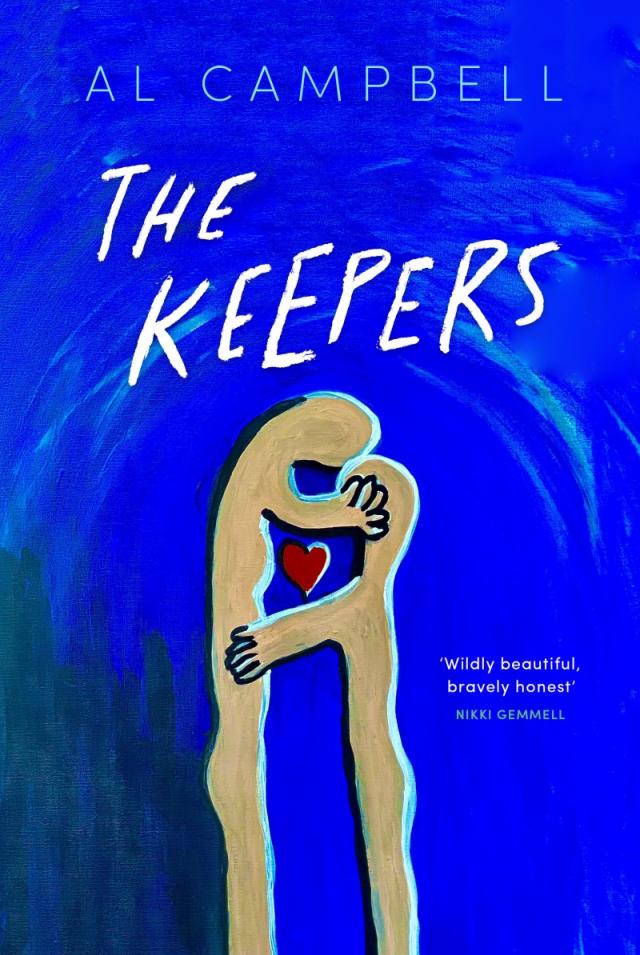
The keepers, p.1
The Keepers, page 1


Born in Brisbane, Al Campbell is a mother and full-time carer. Long ago she studied a bit, acted a bit, and pulled a lot of beers. Her first-ever publication was in Overland in 2020, followed by a story in Signs of Life – an anthology. The Keepers all but begged her to write it, given it is about issues – and people – that matter to her more than anything.
Book club notes are available at www.uqp.com.au
For Rupert and Frazer
Nothing is performed by demons; there are no demons.
– Siddhartha, Hermann Hesse
Scrapbook #12
abc.net.au, 23 April 2018
Special needs group pays tribute to 11yo Sydney boy with autism killed by train after escaping from respite care
A disability care service provider says it is cooperating with a police investigation into the death of a young boy with severe autism who was hit and killed by a train in Sydney’s south.
The 11-year-old boy died after he escaped from a respite care facility at Oatley just after 7:00pm yesterday.
His carers alerted authorities and a police search was set up involving Polair and the dog squad.
The boy’s body was found at the Oatley train station two hours later.
Police confirmed on Monday morning that the child, who was non-verbal, was hit by a train.
Civic Disability Services Limited confirmed the child was from its short-term accommodation facility for children and young people.
It said family members had been informed of the details, but due to the sensitive nature, and out of respect for the family, it would be inappropriate to release any more details.
‘This is a tragic and distressing incident and our deepest sympathies and thoughts go out to the child’s family’, Civic CEO Annie Doyle said.
‘Counselling and assistance services have been made available to our staff and others who have been affected.’
The Sydney Friendship Circle, a support group for families of children with special needs, posted tributes to the 11-year-old on social media, saying he was a treasured son, grandson, brother and friend.
Monday, 2:06 am
‘What about shock treatment?’ I say, the scissors and I pausing.
He looks at me, the way he does. Thinks I’m being flippant. But he doesn’t speak, too busy being enigmatic, so it’s up to me.
‘Is it still called that?’ I ask. ‘Shock treatment?’
I finish trimming two newspaper clippings. ‘As you’d expect,’ I say, ‘I’ve not kept up. Only discovered what a Fortnite is the other day, courtesy of Frank. Not a typo after all.’
And now, the printout of the online article. ‘Either way,’ I say, the horror on the page a thing of thorns in my hand.
Eleven years old, dead at the end of a night-time street.
‘Regardless of what it’s called …’
Struck by a train. Some mother’s child sniffed out by dogs.
Frank and I would have been watching television, having a laugh, Teddy behind us at the dining table, headphones on, YouTubing.
‘It couldn’t hurt, could it? Another go couldn’t hurt.’
I drop the scraps into the bin, return the scissors to the desk drawer, fish about for the glue. Scrapbook #12 lies open before me, almost full. He observes my night’s work. Patient. Bemused.
‘Well, I’m supposed to want something, aren’t I?’ I say, pasting, blowing on the page.
‘“What do you want, Jay?” they all ask – the doctors, the therapists. “What’s your happy ending?”’ Am I provoking him or, by his vivid quiet, is it the other way around? ‘Problem is, the only thing I want I can’t have, can I? Happy ending? Christ. Because we all get one of those. Right, Keeper?’
His head tilts back impossibly far, until all I see are shoulders and the latched spindle of his neck. I half-expect to hear a thud – a bloodless cartoon bonce wheeling around the bedroom floor. But of course I don’t. His movements are controlled, measured – everything on his terms. He has all the time in the world – time being, for him, an idly whistled tune. He can kick it up on a whim, suspend and resume it at will. A trinket in his pocket. His magic act.
‘Besides, isn’t that why it’s called ECT? Electroconvivial therapy?’ I set the scrapbook on the pile of earlier volumes under my desk. ‘How many baZINGs this time do you think? Six? Ten? Like … microdermabrasion? Perhaps I ought to consider that instead.’
Through the small-pane windows is the dark gully of our street, its lone plucky lamppost gooned by wanton whacks of lightning. Keep’s reflection gutters like a flame.
‘So, what do you say?’ I turn to face him. ‘Hit the dim switch for a bit?’
Finally, a response: You don’t need shock treatment. At times, his voice is very beautiful.
‘Shucks.’ My shoulders heave, concede. ‘You say the sweetest things.’
I lean forward, inspecting his latest incarnation. Bald as bone and mouthless. No breath, of course. Without ears. His nose the vaguest squinch. No need of slots or slits to speak or hear. A waist worked so thin I could circle it with my hands, gnawed like the core of an apple. And that face – I want to touch it, whatever it might be. Some ancient mica, colourless and brittle? Or fossilised hoof, unclean and before time? Next visit it might be something else. His appearance is rarely the same.
‘It might stop the things I see, for a while at least,’ I suggest. ‘The things I hear.’
With him, I might as well be mouthless too.
‘It’s like a twenty-four-hour test pattern inside my head.’
Words are formed – I know they are. Lips part, brush together. Tongue taps teeth.
‘Are they still a thing, test patterns?’
Yet we have never been overheard, not once in more than forty years.
‘My very own catastrophe channel. Warning! Warning!’
I know I’ll be irritating him.
‘Evacuate! Abort! RUN !’
He hates it when I whinge.
‘It never stops. Can you imagine?’
Still as a statue, one of his self-preening poses – elbow on armrest, fingers a pensive claw like some famous auteur being interviewed. He speaks: Any supply of baZINGs would soon be exhausted.
‘You know, sarcasm makes you common.’
Ah-ha, ah-ha. He laughs, a tweezered whistle. Hardly.
We sit listening to the storm, and I press a palm to the window. I long to be cold. Frozen eyelashes cold.
‘East Antarctic Plateau,’ I confide to the glass. ‘Coldest recorded temperature – minus eighty-nine point two degrees Celsius, Vostok Station, 1983.’
Frozen organs cold.
But I have never seen so much as a single snowflake, no winter-famous geographies with their peaks and fjords, rivers and ruins. Though I have seen other things. Things less celebrated. Things infrequently discussed.
Closing my eyes, it looms – my big cold, a great wolfing white, ripped from the Earth’s frozen rimrock-edge, survived by none. So terrible, so darkly fabled it cannot be named. It chances upon us yet knows us, takes us with it, the three of us: me, Teddy, Frank.
Takes you where? he asks, no thought safe from him.
‘The rest of the way.’
But this world I’m in steams. No hoarfrost here. This window that cannot be opened, stuck for years, is like sheeted heat. Four dead flies lie forever between it and the wire screen. My hand drops, disappointed, into my lap. This town’s usual clamminess, grimy and mope-sunk, is the best a March night can do.
Next to my bed is a bookcase, a set of unnested matryoshka dolls hip-to-hip along its middle shelf. I imagine what they might say were their painted lips ever to open and speak. Given all they have witnessed, their stories must weigh like millstone.
You still have them, he remarks, watching me just as intently.
‘As you well know.’
I pick up the smallest, tip her gently, hear her quiet rattle.
And there she is, the tiny facsimile.
‘She’s nothing of the sort.’ And she isn’t. No raven curls for her, no rosy cheeks. She is blonde but plain. And stern – none of the others’ self-delight.
‘She is—’
Forever boxed in? A mise en abyme?
I give him a sour look. ‘The end of the line.’
Outside, a mosh of trees like go-go girls, squid-limbed and wild, all beat and buck and peril. He knows how much I love rainy nights. Rainy days. Rain. Perhaps the drear and squall are only rabbits in a hat, carnival tricks to enchant and distract, when what’s really out there is only ever the same: grass dry as rusted tin, trees like stone markers.
‘Is this from you?’ I ask him. ‘This tempest?’
It can all be from me if you like.
‘You’ve been saying that forever,’ I say. ‘And I still don’t know what it means.’ I pause, giving him a chance to respond. He doesn’t. Not that it matters. Perhaps this part is a dream.
‘Shock treatment,’ I say, back on message. ‘It started the crazy.’
Did it?
‘Another go might take it away.’
Would it?
‘Fry the junk.’
Fry it?
‘Reset me.’
Reset you to what?
He’s got me there.
‘Never mind,’ I say later, much later. I’m exhausted. Perhaps I did drift off. ‘I’ll tell you what I want. Since you asked.’
I don’t believe I did.
‘Certainty.’
You all want that.
‘But I deserve it.’
You all think that.
‘Not for me,’ I say, looking over at Teddy. ‘For him.’ My son, my roommate these past fifteen years, finally asleep. ‘And for his twin,’ I add, heart heavy. ‘Who knows where Frank will land?’
So many years the three of us in here together, both boys terrified of the night, of sleep itself. Three single beds abreast – me in the middle; Frank on my left, finger-doodles on my arm; Teddy ever-watchful on my right. Close enough to save each other, close enough to all perish at once. Jerrik upstairs in his own quarters, his ‘suite’, as he calls it, the top floor where the walls have been cut away and the rooms tunnelled through, offering both grand space and an even grander semblance of being somewhere else, someone else.
Jerrik the husband lodger. The bloke one floor up more than he is father, the boys’ Danish far. Posing no risk but liable for no rescue. Oblivious to us, to his sons’ small below-stairs triumphs. Frank’s first night in his own room across the hall, making it through till breakfast. And the grudge-grey afternoon when a hollow-eyed Teddy watched me prise our beds apart, first by mere inches – holding hands still a nightly protocol – then, weeks later, by the vast expanse of a standing lamp. The hours we lay in them, facing one another, practising our separation, just to make sure that a shifted bed didn’t also shift the world in its turning.
‘I need to know they’ll be alright, Keep,’ I say, tears lurking, eager for opportunity. ‘That’s it. The only thing I’ll ever want.’ Always my undoing, these words.
All around us slump toys that once stood, dolls that once sang. Against the walls, teetering stacks of life, plastic-crated. Trains, cars, blocks, green crocodiles and pink-suede pigs, things that spun and hopped and flew. Not done with; decommissioned. Momentarily relieved of active service. Waiting to be loved again.
‘Without it,’ I say, ‘there’s no point to anything.’ Teddy flutters in his sleep, left side, right side. ‘Without certainty,’ I continue, ‘I may as well opt for nothing.’
Keep’s eyes, those two black voids, follow mine around the cramped, broken-down room. Option actioned.
‘Don’t mock,’ I say, defiant. ‘Not everyone finds it, Keep. Their yellow-brick road. Their “fabulous yellow”.’
Oh my, is that the time? he says, feigning a look at his twiggish wrist, at a watch he isn’t wearing. Kerouac o’clock?
‘Most people don’t even look,’ I persist. ‘But I looked, didn’t I? Got close, once or twice.’
Yes, you looked. And then you looked away.
My turn now for silence.
Bringing us here.
I nod. ‘Bringing us here.’ Those tears seizing their moment.
An index finger ascends from his lap – a deliberate, showy movement – points to where a right eye might be, then arcs slowly down his narrow drag of a face. His meagre shoulders flag theatrically. A black line draws itself just above his chin, then splits wide, freezing into a mute scream. Inside it sit all the screams of the world. He is Melpomene’s tragic mask, miming tears.
Ho hum, says the frozen hole.
In a blink, no more mouth. No more tragedy.
Ho hum.
‘Up yours,’ I say, drying my face with my sleeve. Even after all these years, I can still misread his mood, a visit’s underlying motive. He has come to be cruel, tell me what’s what. He does that sometimes.
Keep does not approve of my scrapbooks. Morbid, pointless, he says of them.
Urgent, essential, I reply in their defence.
Can you not move past it? he says of them. To which I say, No, I cannot get past it. I won’t. I’m the one who doesn’t.
But we’re not saying that tonight. Tonight I say, ‘The only people for me are the mad ones. Who burn, burn, burn, like fabulous yellow Roman candles exploding like spiders across the stars.’
I don’t know why I recite Kerouac’s words. Maybe to prove I still can. Maybe to see if that part of me is still there, deep inside those plastic crates, mad to live, mad to be saved, spinning and flying.
Awww, he says. Auteur again, back to regarding his lordly claw – long and hairless and gecko-pink.
‘I’m frightened, Keep.’
His dead eyes flare once, twice. Quite a feat given he’s forgotten eyelids. I know, he replies.
‘All the time.’
I hear him sigh. You are.
His stalked fingers hover in front of my face. It is how he reads – pages, heads; how he sees – anyone, in any place, at any time. Before we come to be, long after we are unchained and gone. Those thin places from which we slip, to which we randomly return. His hovering hands showing him all. Not always a comfort to see those bogey digits up and about, eavesdropping the brute asides of my mind.
I decided on you when you were four, you know.
‘Why?’
A long, slow, tidal shrug.
Twelve fingers but not one nail, just hooked flesh, smooth as plastic. No prints. Those hands truly are reptilian, more like some loch creature’s feet, slimy pads for trawling through murk and silt.
Because you needed me, Spider.
I remember the first time I saw him, less horrified than a child probably should have been.
‘What was wrong with me?’
What wasn’t? What isn’t?
His tentacle-arms, so thin and flat, resettle along the armrests of his chair. But they unfurl, spilling, spooling along the floor, coming to rest at my feet.
‘Time to wake up now,’ I tell myself.
You’re not asleep.
‘I am.’
You’re too busy to sleep, Spider. A busy little bitie with her busybody books, a-wincing a-watching the world go by.
‘Busybody? Keep, it’s—’
The quailing in the back of your mind all you hear, the slant in the corner of your eye all you see, everywhere you look. No fool more blinkered.
I cross my arms. ‘You’re in a mood.’
WHO’S in a mood? His voice a barrelling blast of light. It swallows me, spins me in its tight white throat, time chunked and pitched like jump cuts in a film. My bed is made, the sheets tucked smooth, now unmade, made again. The scrapbooks, piled neatly under the desk, fly open, scatter, then close, spines aligned. Clothes are strewn about on the floor, heaped in corners, then hanging as they were. Heaped, hanging. My hair is a long, thick braid, then loose and sweeping over my shoulder, a braid again until I can’t remember how it had been to start with.
Party tricks. Keep’s cabaret.
‘Too tired, Keep. Enough now.’
Awww! I’m tired, Keep. I’m frightened, Keep. Woe, woe, woe is me, Keep. Using my own voice to mock me.
No longer four dead flies in the windowsill. Now there are fifty, a hundred, each one alive and ulcerating into ten more, the size of toads, their faces rubbery against the glass, their twitching eyes-within-eyes all turned on me.
‘Are these from you?’ I ask.
It can all be from me if you like.
‘Okay … enough!’ The flies, a seething pile-on, all squirm as one, watch as one. ‘Take your posturing and your God complex and piss off.’
The toad-flies startle. I worry the window will shatter. If they get in, I will never get them out. They will join forces with the rest – the Other Things. So many of them already, crouching in corners, behind, in, under everything.
His voice is as it was – a cool current. My God complex? The voice of the upper hand. Could I not allege the same, Spider?
‘Me?’ I say, a sharp laugh. ‘No, no, I’m no god. I’m a mother. Far more powerful. I could tell the boys that night is day, up is down, good is bad, that they are bad – and they’d believe every word, play out every vile prophecy. You of all people know there’s nothing about a child that its mother can’t fuck up. Turn its life into grey rags and burnt sticks.’
The darkness of the room is all at once too large, too absolute, outside the law of things. It locks over us like a lidded box.






